Markets
markets

Tech winners haven’t crushed tech losers by this much since the dot-com bubble was bursting

The performance gap between the tech sector’s winners and losers has reached the 100th percentile, widening to levels not seen since 2000.

That’s according to Jeff deGraaf, head of technical research at Renaissance Macro Research, who flagged in a note to clients the magnitude of this divergence in fortunes within the industry.

The story of the technology trade in 2026 was made clear on the first trading day of the year, with a record outperformance of semiconductor stocks versus their software counterparts.

Since then, software has continued to flounder as new AI tools pull the timetable for potential disruption forward and threaten to undermine the perceived safety of the software industry’s recurring revenue streams and margins. Within the hardware space, the list of winners have become even narrower, with investors focused on data center capex beneficiaries, particularly in memory and semicap equipment.

“To see similar levels of performance differential between winners and losers requires a trip back to 2000 as the dot-com bubble was bursting and the semis were holding up relative to the speculative internet related names,” deGraaf wrote. “Beware chasing good charts in technology, and at the margin, reduce exposure.”
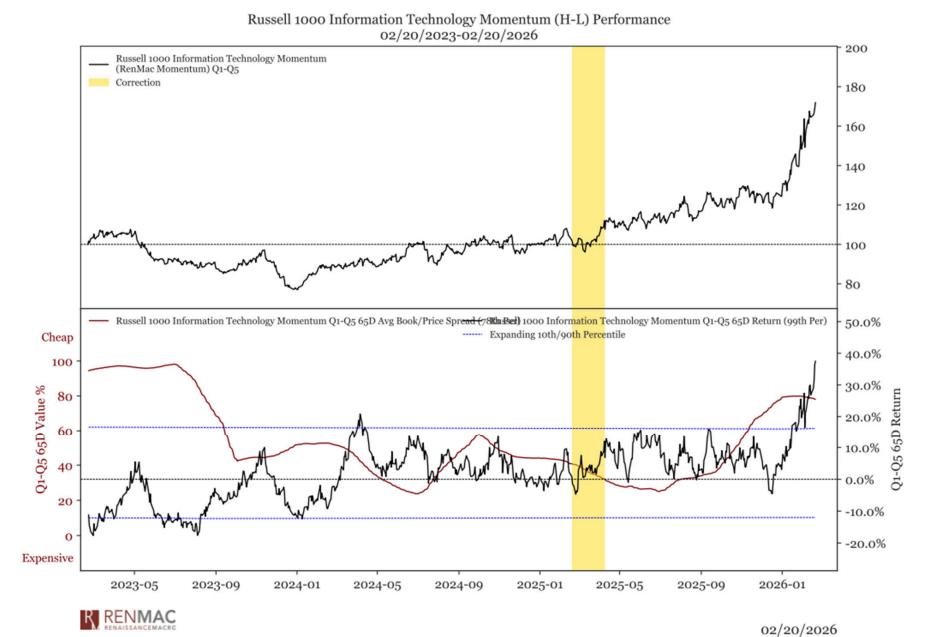
L/S Momentum Russell 1000 Technology
Source: Renaissance Macro Research

Year to date, the best performers in the Russell 1000 Technology Index (and presumably, the best charts) include Sandisk, Western Digital, Corning, Vertiv Holdings, Micron, and Applied Materials.

More Markets

See all Markets
markets

Better-than-expected jobs data has Federal Reserve’s standout doves shying away from rate cuts

Surprisingly strong labor market data has the Federal Reserve’s standout doves more willing to stand down from advocating for additional rate cuts.

Governor Christopher Waller said his decision on whether he would be in favor of a rate cut at the Fed’s upcoming meeting in March would be “a coin flip” depending on the jobs market data for February.

“If the labor market data for February are consistent with the stronger job creation and low unemployment rate initially reported in January, indicating that downside risks to the labor market have diminished, it may be appropriate to hold the FOMC's policy rate at current levels and watch for continued progress on inflation and strength in the labor market,” he said in a speech on Monday.

In January, nonfarm payrolls growth of 130,000 came in well above estimates, and the unemployment rate unexpectedly dipped to 4.3%. The unemployment rate had edged down to 4.4% in December.

Prediction markets indicate that the Federal Reserve is seen as a near lock to keep its policy rate unchanged at the March meeting. The prediction market-implied odds of a rate cut in June are a little over 60%.

(Event contracts are offered through Robinhood Derivatives, LLC — probabilities referenced or sourced from KalshiEx LLC or ForecastEx LLC.)

Loading...
 

Governor Stephen Miran also recently told The Peg that, in the absence of further data, he would probably move up his expectation for the appropriate level of the federal funds rate at year-end by 50 basis points (to 2.625%).

“The labor market came in a little bit better than I came to expect over the last few months,” he said. “There’s been some signs of even more firming in goods inflation.”

Both Waller and Miran dissented from the US central bank’s decision to keep rates unchanged in January, preferring an interest rate cut.

Loading...
 

Governor Stephen Miran also recently told The Peg that, in the absence of further data, he would probably move up his expectation for the appropriate level of the federal funds rate at year-end by 50 basis points (to 2.625%).

“The labor market came in a little bit better than I came to expect over the last few months,” he said. “There’s been some signs of even more firming in goods inflation.”

Both Waller and Miran dissented from the US central bank’s decision to keep rates unchanged in January, preferring an interest rate cut.

markets

OpenAI teams up with consulting giants to boost its enterprise business

OpenAI has a new sales force to market its enterprise AI tools to big corporations.

In a press release, the ChatGPT maker unveiled a number of “Frontier Alliances” with consulting companies Accenture, Boston Consulting Group, Capgemini, and McKinsey.

“Frontier” refers to OpenAI’s platform introduced earlier this month that “helps enterprises build, deploy, and manage AI agents that can do real work.”

These alliances come amid an industrywide love affair with Anthropic’s Claude Code, which has juiced the startup’s revenue projections.

Companies may want to introduce AI tools, but do not have a good strategy around how to get started. That’s where consulting companies come in.

For companies in that situation, going to one of these consulting firms for AI-related help might now be like going to a financial adviser who gets an extra commission from having you invest in a specific fund offered by the investment arm of their firm.

The consulting industry was a forerunner to software in terms of facing AI disruption and, in the case of Accenture, seeing its share price slump as the market rallied. Employment in the sector peaked right around the time that ChatGPT was launched.

For Accenture, this marks the latest in a series of AI collaborations and builds off its prior partnership with OpenAI. The positive spin on this strategy from Accenture's perspective is that management is accepting that the consulting business will be fundamentally transformed by AI, and wants to be among the first movers in adapting to survive that transition. Uncharitably, as we’ve said, this is “training your replacements.”

markets

Novo Nordisk sinks after its experimental obesity drug falls short of Eli Lilly’s in head-to-head trial

Novo Nordisk sank after the newest generation of its weight-loss shot, CagriSema, failed to show it was more effective than tirzepatide, the weight-loss and diabetes drug sold by Eli Lilly.

In a head-to-head trial, patients taking Novos drug lost 23% of their body weight after 84 weeks, compared to 25.5% with tirzepatide. Novo said it is exploring additional trials to test CagriSema, including higher-dose combinations.

The results are a hit to Novo, which was the first to bring GLP-1s to market but has now been outsold by Eli Lilly and faces increased competition from new competitors planning to bring weight-loss drugs to market. Earlier this month, Novo predicted that its sales would decline by between 5% and 13% in 2026 amid rising competition.

The company recently debuted its Wegovy pill, the first GLP-1 pill for weight loss to come to market. Early uptake has been strong, but Lillys pill, orforglipron, is also coming to market later this year.

Latest Stories

Sherwood Media, LLC produces fresh and unique perspectives on topical financial news and is a fully owned subsidiary of Robinhood Markets, Inc., and any views expressed here do not necessarily reflect the views of any other Robinhood affiliate, including Robinhood Markets, Inc., Robinhood Financial LLC, Robinhood Securities, LLC, Robinhood Crypto, LLC, or Robinhood Money, LLC.