
Markets
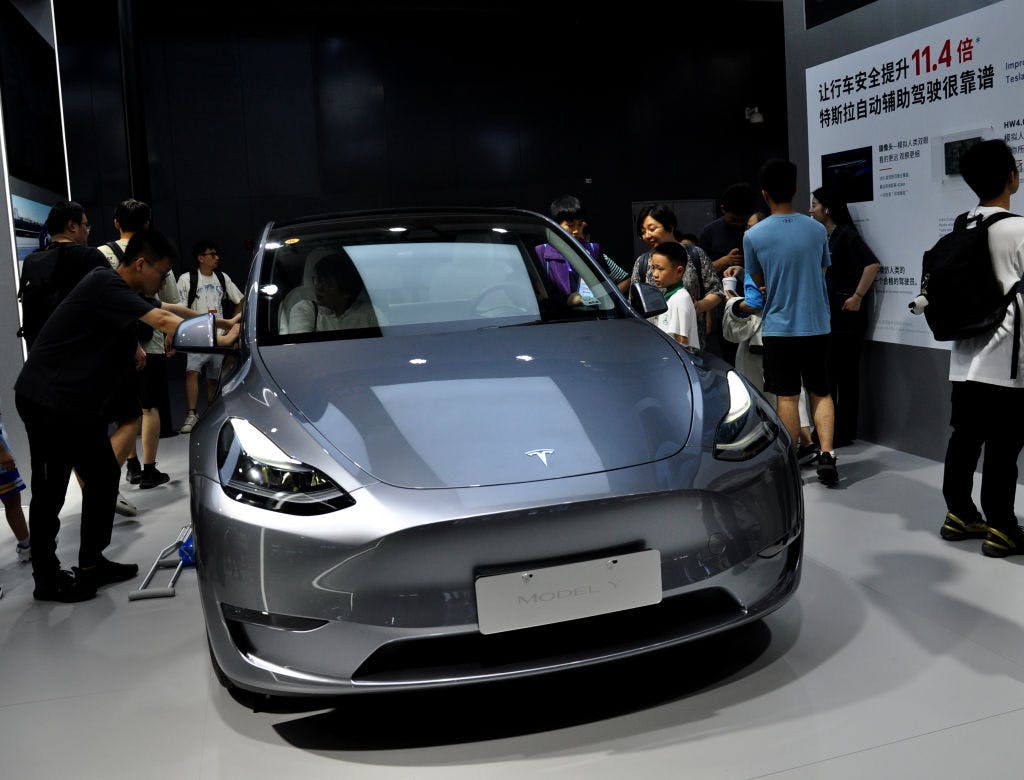
Tesla Model Y
Tesla Model Y (VCG / Getty Images)

Tesla’s market share is down, but its valuation is still sky-high

Tesla’s competitors are elbowing in, but it’s still easily worth more than Ford and GM combined

The New York Times reported yesterday that Tesla’s share of the US electric car market fell below 50%:

Tesla accounted for 49.7% of electric vehicles sales from April through June, down from 59.3% a year earlier as the company led by Elon Musk lost ground to General Motors, Ford Motor, Hyundai and Kia, the research firm, Cox Automotive said. It was the first time the company’s market share fell below 50% in a quarter, according to Cox.

I’d like to share a few stats on Tesla, Ford, and General Motors:

Tesla sells fewer cars than General Motors and Ford. Tesla is also worth ~$500 billion more than General Motors and Ford, combined. Why is that? The market has, for a while, valued Tesla as some combination of a technology company and a growth company due to its position as the market leader in electric vehicles and its high revenue growth.

In April, when the “growth” argument weakened after Tesla posted an 8.5% annual decline in deliveries, I pointed out that because Tesla’s margins were in line with those of traditional auto manufacturers, as opposed to tech companies, and Tesla’s deliveries were flatlining, shouldn’t Tesla’s valuation fall more in-line with auto manufacturers?

And now, Tesla has slipped below 50% market share in the US, its biggest market. I guess, if you wanted, you could have previously made the argument that EVs are inherently more valuable than regular cars because “EVs are the future” (even though their gross margins are similar), and give Tesla a premium valuation as it dominated the EV market. But Tesla now only represents half of the EV market. As EV adoption continues to grow, and competitors increase their EV sales, Tesla’s market share will likely continue to decline (even if its total deliveries increase). My question is this: at what point will the value of Tesla’s EVs converge with the value of other car companies’ EVs? Because right now, either 1) Tesla’s cars are overvalued or 2) competitors’ EVs are undervalued.

Of course, maybe I’m overthinking this, and Tesla will always be worth more than its competitors, combined, regardless of sales, because it’s Tesla, and Tesla has Elon Musk, and you can’t assign a dollar value to their CEO and his… engaged following.

More Markets

See all Markets
markets

UnitedHealth falls after Berkshire dumps its stake while picking up Macy's and Delta

UnitedHealth fell more than 5% in premarket trading Monday after Berkshire Hathaway disclosed Friday that it had fully exited its stake in the health insurer.

According to Berkshire’s latest 13F filing, which shows holdings as of March 31, the conglomerate sold its entire ~5 million-share stake in UnitedHealth — less than a year after first buying the stock in the second quarter of 2025 — as part of a broader portfolio overhaul under Greg Abel, who succeeded Warren Buffett as CEO on January 1.

UnitedHealth shares have been volatile over the past year amid concerns over rising medical costs and DOJ scrutiny of its billing practices — though its latest earnings report showed signs of stabilization, with the company beating Q1 earnings estimates and raising its full-year profit outlook.

Berkshire also fully exited positions in a number of other stocks in the first quarter, including Amazon, Domino’s, Pool Corp, Mastercard, and Visa, all of which were mildly in the red in early trading.

Meanwhile, Berkshire added Delta Air Lines and Macy’s to its equity portfolio, while boosting stakes in Alphabet and the New York Times.

markets

NextEra reportedly in talks to acquire Dominion, valuing the company at around $66 billion

Dominion Energy soared 12% in premarket trading on Monday on reports that NextEra Energy is in advanced talks to acquire the company in a deal that would create a more than $400 billion utility giant (including debt), as suppliers race to meet growing demand to power AI data centers.

The mostly-stock deal would value Dominion at about $76 per share, or around $66 billion, and see NextEra exchange about 0.8 per share for each outstanding share of Dominion, Bloomberg reported, citing people familiar with the matter. The arrangement, which requires federal and local approvals but could be announced as soon as today, would leave NextEra shareholders with about 75% of the combined company as well as a small additional cash component.

Including debt, the deal values Dominion at ~$116 billion and would land as the largest power tie-up on record — underscoring the scale and scope of today’s energy businesses in the age of AI.

NextEra Energy, America’s biggest utility company with an enterprise value of more than $300 billion, has seen its valuation lead over its rivals narrow in recent years. Buying Dominion, which is worth ~$111 billion including debt, would allow NextEra to reach deeper in PJM Interconnection. Importantly, PJM is the country’s largest electric grid and covers Virginia, which has America’s biggest concentration of data centers.

markets

SpaceX reportedly plans to IPO in mid-June, chooses to list on Nasdaq

Elon Musk’s aerospace and satellite manufacturer, SpaceX, could price its initial public offering as soon as June 11 and make its public market debut on June 12, Reuters reported Friday. SpaceX is preparing for a monster IPO, reportedly aiming to raise $75 billion at a record $1.75 trillion valuation.

Sources familiar with the matter told Reuters that Musk’s company had chosen to list on the Nasdaq.

SpaceX is moving through its IPO timeline and is said to be ready to hit the road to secure commitments from investors around June 4, according to Reuters.

SpaceX did not immediately respond to requests for comment.

Go Deeper: What happens to Tesla stock when SpaceX goes public?

markets

Figma spikes after raising full-year sales outlook as the software company leverages AI for growth

Figma jumped postmarket Thursday after posting impressive sales in Q1, surpassing Wall Street expectations and raising its full-year guidance. The key numbers:

  • Q1 revenue of $333.4 million (compared to analyst estimates of $316 million).

  • Q2 sales guidance of $348 million to $350 million (estimate: $329.7 million).

  • Full-year revenue between $1.422 billion and $1.428 billion (up from previous guidance of $1.37 billion).

The digital design software firm is the latest company to diminish investor fears about AI-induced disruption by making the technology work for them. Like Atlassian or Datadog, Figma said it was able to use AI to its advantage, bringing more customers on board and getting them to spend more.

In the press release, Praveer Melwani, Figma CFO, said:

As AI gets better, Figma is accelerating and customer usage and workflows on our platform are deepening. Our platform and AI products drove faster growth for both new customer acquisition and expansion within existing accounts.

Revenue grew 46% year over year in Q1 2026, an acceleration from growth of 40% in Q4 2025.

Latest Stories

Sherwood Media, LLC and Chartr Limited produce fresh and unique perspectives on topical financial news and are fully owned subsidiaries of Robinhood Markets, Inc., and any views expressed here do not necessarily reflect the views of any other Robinhood affiliate, including Robinhood Markets, Inc., Robinhood Financial LLC, Robinhood Securities, LLC, Robinhood Crypto, LLC, Robinhood Money, LLC, Robinhood U.K. Ltd, Robinhood Derivatives, LLC, Robinhood Gold, LLC, Robinhood Asset Management, LLC, Robinhood Credit, Inc., Robinhood Ventures DE, LLC and, where applicable, its managed investment vehicles.

