
Markets
Fort Worth Live Stock Exchange building
The Fort Worth Live Stock Exchange building (built 1902), located in the famous Stockyards, was a center for cattle traders. Today, the building houses professional services and the North Fort Worth Historical Society Museum (Getty Images)

Texas wants a piece of Wall Street

With its long-teased stock exchange, TXSE, winning SEC approval in September, the state is taking aim at a market long ruled by just two giants.

After more than a year of buzz, the Lone Star State’s own stock exchange is finally starting to look real.

Last Friday, the Texas Stock Exchange (TXSE) — a Dallas-based challenger pitching itself as a “pro-business” alternative to Wall Street — announced an investment from JPMorgan, bringing its total funding above $250 million ahead of its planned 2026 launch. More than 70 investors have joined so far, including BlackRock, Charles Schwab, and Citadel Securities.

TXSE’s debut marks the first SEC-approved exchange in decades that will eventually be able to both list as well as trade public companies’ shares — potentially challenging the long-standing duopoly of the New York Stock Exchange and Nasdaq.
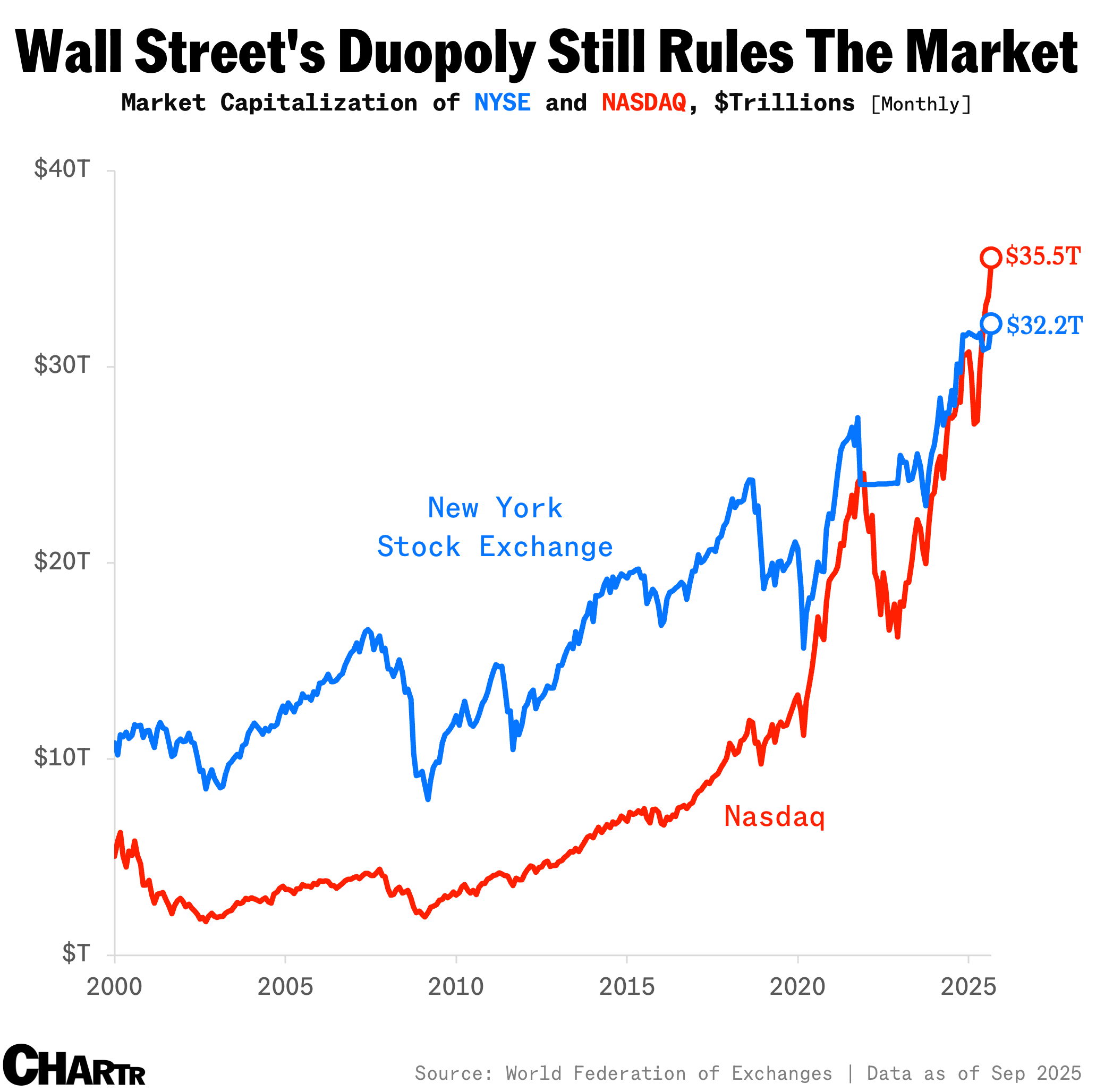
NYSE VS NASDAQ
Sherwood News

Since 2008, the two have been the only primary listing venues in the US, together accounting for virtually 100% of the country’s public equities — worth more than $67 trillion, per data from the World Federation of Exchanges. The tech-friendly Nasdaq, which controlled less than a third of that in 2000, now commands more than half (52%), powered by Big Tech’s relentless rally.

Texas’ plan is to spoil New York’s party, pledging to reduce “the burden of going and staying public,” likely meaning simpler, cheaper listing standards and fewer compliance hurdles than its rivals. The state has been doubling down on efforts to lure Corporate America, launching a new business court system last year to compete with the Chancery Court of Delaware, a state that houses most S&P 500 companies.

But TXSE won’t be ’lone in Texas: in February, the NYSE said it’s reincorporating its Chicago exchange into “NYSE Texas,” based in Dallas, while the Nasdaq announced plans to open a regional headquarters there in March.

More Markets

See all Markets
markets

Nike sinks to lowest level since 2014 after warning of “challenged” sales environment in Q4 report

Did Nike do it?

Investors had a mixed reaction after the global sports apparel company reported its fourth quarter earnings on Tuesday after the bell. Shares initially rose 5% as Nike beat out Wall Street expectations amid a hefty tariff refund bonus. However, the stock then sank to its lowest level since August 2014 in postmarket trading.

Here are the Q4 numbers:

  • Revenue of $11.0 billion (estimate: $10.8 billion).

  • Adjusted earnings per share of $0.20 (estimate: $0.12).

Ahead of this report, Nike warned that results would be flattered by a one-time tariff refund (now estimated at roughly $0.52 per share for the bottom line). That gave the company an extra cushion in snapping its streak of seven quarters of year-over-year profit declines.

Over the past year, the company had been punished by tariffs on imported goods, stagnant consumer spending, and increasing competition from other footwear brands like New Balance, Adidas, and Hoka.

Outgoing CFO Matthew Friend deemed it an “increasingly challenging operating environment, where sell-through remains challenged.”

markets

Rocket Lab deal lifts space stocks

Shares of Rocket Lab are surging after announcing an $8 billion acquisition of satellite communications operator Iridium Communications, helping lift a broader basket of space-related stocks as investors piled back into the sector.

Planet Labs, AST SpaceMobile and Redwire all traded higher alongside Rocket Lab, extending gains in an industry that has drawn enhanced investor attention in recent months in light of the strategic importance that governments place on space and satellite communications infrastructure.

In a presentation, Rocket Lab’s management called the purchase “a shortcut” for its satellite communications business.

Under the terms of the agreement, Iridium shareholders will receive $27 in cash and Rocket Lab stock, valuing Iridium at $54 per share. Backed by a $3.6 billion bridge loan committed by Deutsche Bank and Wells Fargo, Rocket Lab absorbs Iridium’s globally licensed spectrum and an active base of 2.5 million subscribers.

Rocket Lab has also remained one of the most active launch providers in the sector. The company completed its 12th launch of the year last week, maintaining one of the highest launch cadences among commercial space companies.

Today's rally helps offset a brutal stretch for the group. Rocket Lab shares had fallen over 35% over the prior month, while Planet Labs stock was down more than 40% and AST SpaceMobile stock was down around 30% over the same window.

markets
Jake Lahut

Comcast shares rise on news of NBCUniversal spinoff deal

Comcast rose on the news that the telecom behemoth is spinning off NBCUniversal and Sky from its cable portfolio. 

Comcast initially jumped up to 17% in early trading, with the deal leaving management to focus on its core verticals of cable, wireless, and business services. 

NBCUniversal and Sky will form a new publicly traded company, similar to Versant Media, the holding company of CNBC and MS NOW that Comcast officially spun off in January. Bravo, one of the most lucrative properties that remained at Comcast, will remain part of NBCUniversal in the deal. The Universal theme parks and studios will also come with the new spinoff entity, along with Telemundo and Peacock.

Mike Cavanagh, the co-CEO of Comcast, will become the CEO for NBCUniversal, according to CNBC. 

The spinoff will be completed in about a year, according to a Comcast company statement. Its shareholders will also own shares in NBCUniversal, according to the same statement.

Latest Stories

Sherwood Media, LLC and Chartr Limited produce fresh and unique perspectives on topical financial news and are fully owned subsidiaries of Robinhood Markets, Inc., and any views expressed here do not necessarily reflect the views of any other Robinhood affiliate, including Robinhood Markets, Inc., Robinhood Financial LLC, Robinhood Securities, LLC, Robinhood Crypto, LLC, Robinhood Money, LLC, Robinhood U.K. Ltd, Robinhood Derivatives, LLC, Robinhood Gold, LLC, Robinhood Asset Management, LLC, Robinhood Credit, Inc., Robinhood Ventures DE, LLC and, where applicable, its managed investment vehicles.

