

Markets
76th Annual Golden Globe Awards - Press Room
The Golden Globe gets a kiss. (Kevin Winter/Getty Images)

We’re living in the golden age of gold

Bullion has been beating US stocks by a big margin since the end of 1999.

With the S&P 500 on track to deliver back-to-back years of returns north of 25% for the first time since 1997-98, and the US making up a whopping 66% of the MSCI ACWI Index for global equities, recency bias might suggest suggest we’re living in a golden age for the US stock market.

A bit of historical perspective from Deutsche Bank, however, shows that’s anything but the case.

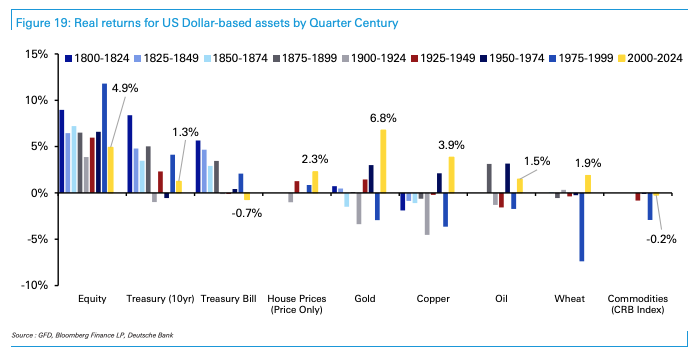
The asset of the new millennium has been gold, delivering a real return of 6.8% per year since the end of 1999 despite being a shiny rock that generates no earnings and pays no dividends. So far, the S&P 500 has averaged total returns of 4.9% over this stretch.

Remarkably, in a testament to how poorly-managed miners have been through boom-bust cycles, the companies that can sell gold to generate earnings and pay a dividend are actually far, far trailing the S&P 500 over this same period!

Why has the so-called barbarous relic done so well?

Well, for starters, consider that inflation-protected US Treasury yields were very low during this period. This reduces the opportunity cost of holding gold — it’s not like you were getting a substantial real return holding those instruments. We often see gold move inversely to real rates for extended periods of time.

The global financial crisis was also an event that severely undermined people’s faith in the stability of our fiat-backed system, leading to a bid for an asset that’s served as “hard money” in the past. That trend was supercharged by the broader commodity rally that followed the financial crisis thanks to Chinese stimulus that was very resource-intensive. More recently, the theme of central banks adding to their gold holdings in the wake of the sanctions that followed Russia’s invasion of Ukraine has helped buoy demand for the precious metal.

I’d add that “gold benefited from postpandemic inflation,” but that doesn’t seem to be borne out by the data. The inflation-adjusted return for gold was negative during the period in which inflation started to ramp in March 2021 through its peak in mid-2022. It was only after inflation decelerated that gold began to boom in earnest.
Deutsche Bank Quarter Centuries
Source: Deutsche Bank

“A surprising point from this chart is that US equities haven’t actually had a great quarter century in real terms. In fact, at just +4.9% per annum, it’s the second-lowest of the nine quarter centuries since 1800,” wrote Deutsche’s team of strategists led by Jim Reid, head of global economics and thematic research. “The only worse quarter century in real terms was 1900-1924, which saw bank collapses in the early part of the period, a world war later on, and a mini depression and pandemic towards the end of it.”

The question of why this period looks so lackluster for US stocks is easier to answer: there were two large stock-market meltdowns, and the postpandemic inflation caused stocks to decline in nominal terms and produce a far worse showing in real returns during 2022.

Of course, the starting point is critical: the S&P 500’s peak during the dot-com bubble comes a few short months into the beginning of this chunk of time. Perhaps that’s extra food for thought here considering we’ve been in the midst of another mega-cap tech boom for the past decade and change — albeit one with much, much more foundational support from earnings growth than what prevailed during the dot-com boom. But in the end, we (nearly) all agree to go by the Gregorian calendar, and round numbers have prominence for a reason.

Add this to make it a veritable buffet of thought, since US stocks are very richly valued, as judged by the forward price-to-earnings ratio: “The pattern of riskier assets outperforming does normally hold over the very long run, but it can take several years for that to become evident, especially if you start from an elevated valuation point relative to history as we did in 2000,” Deutsche’s team wrote.

More Markets

See all Markets
markets

Hardware stocks jump thanks to server demand and record Lenovo revenue

Server stocks are rallying as Dell, Super Micro Computer, and Hewlett Packard Enterprise ride the momentum of Hong Kong-based Lenovo. The PC makers stock rose 19% on Friday, hitting an all-time high, on record Q4 earnings.

Powering the positive earnings report was the companys AI-related revenue, which grew 84% in the fourth quarter and now makes up over a third of total revenue. Investors seem to think the increased demand for servers could have trickle-down effects for other companies.

The companys results and commentary reinforced the outlook for strong AI-infrastructure demand while indicating resilient broader traditional server and storage spending, wrote Woo Jin Ho, a senior technology analyst at Bloomberg Intelligence. Lenovos $21 billion AI-server pipeline and remarks that demand is outpacing supply support Dells AI-demand momentum and point to robust orders.

AIs insatiable computing demand is reshaping the hardware industry and driving up server demand.

Dell will report first-quarter earnings on Thursday, May 28.

Policeman with Piercing Eyes

Take-Two’s “GTA 6” forecast feels absurdly conservative

Take-Two issued a 2027 net bookings forecast about $1 billion below Wall Street’s estimates. The stock is falling on Friday.

The D-Wave 2X quantum system, is operated at the NASA Advanced Supercomputing facility's Quantum Artificial Intelligence Laboratory at NASA's Ames Research Center in Mountain View, Calif., as seen on Tuesday December 8, 2015.

Quantum computing CEOs hope “validating” government backing proves their technology is no longer speculative

The government funding is a push to boost the foundational elements of quantum computing to get the industry ready for prime time. The CEOs of Infleqtion and D-Wave give us their thoughts.

markets

Ross Stores surges as Q1 results beat expectations, full-year guidance raised

Ross shares are rising after the company delivered strong Q1 results, with sales topping Wall Street’s projections.

The stock soared 6.3% just after the open.

Key numbers:

  • Earnings per share of $2.02 vs. $1.47 year over year (estimate: $1.72).

  • Sales of $6.01 billion, up 21% year over year (estimate: $5.61 billion).

  • Comparable sales growth of 17% (estimate: 8.58%).

CEO Jim Conroy attributed the results to better traffic in stores. “Customer traffic was the primary driver of the strong sales trend as compelling merchandise assortments, higher customer acquisition and engagement from our ongoing marketing initiatives, and an improved in‑store experience are resonating with shoppers.”

The company also noted that transaction volume grew across all key demographics, including “income levels, ethnicities, and age groups, including younger customers.” Sales were also likely buoyed by standard seasonal tailwinds, including consumer spending from tax refunds.

Backed by the strong quarter, the company lifted its full-year targets. Ross now projects same-store sales growth of 6% to 7%, up from the prior forecast of 3% to 4%, topping Wall Street’s estimate of 4.64%. It boosted its annual EPS guidance to a range of $7.50 to $7.74, versus the prior outlook of $7.02 to $7.36.

Ross Stores has been one of the retail sector’s standout performers this year, rising around 20% year to date as of Thursday’s close.

Latest Stories

Sherwood Media, LLC and Chartr Limited produce fresh and unique perspectives on topical financial news and are fully owned subsidiaries of Robinhood Markets, Inc., and any views expressed here do not necessarily reflect the views of any other Robinhood affiliate, including Robinhood Markets, Inc., Robinhood Financial LLC, Robinhood Securities, LLC, Robinhood Crypto, LLC, Robinhood Money, LLC, Robinhood U.K. Ltd, Robinhood Derivatives, LLC, Robinhood Gold, LLC, Robinhood Asset Management, LLC, Robinhood Credit, Inc., Robinhood Ventures DE, LLC and, where applicable, its managed investment vehicles.

