
Markets
Leaping Lamb
Getty Images
SPY GAMES

The S&P 500 inclusion effect springboard is back in a big way

That temporary price bump had cooled throughout the 2010s — now it’s heating up again, per a new Goldman Sachs report.

Hyunsoo Rim

It’s not unusual to see shares pop when a company is set to join the S&P 500, an index now linked to a staggering $20 trillion in global assets. Just last Friday, Block soared 10% after its inclusion was announced, while Datadog spiked 15% on similar news earlier this month. 

Known as the “S&P 500 Index Effect,” this short-lived bump is fueled in part by fresh demand from $13 trillion worth of passive funds and ETFs tracking the benchmark, which are required to buy shares of newly added companies.

But over the past decade, this effect had been losing steam. According to a 2023 Harvard study, the average announcement day return for S&P 500 additions dropped from 9.4% in the 1990s to just 0.8% by the late 2010s — partially because markets got better at absorbing these shocks, and traders got better at predicting inclusions.

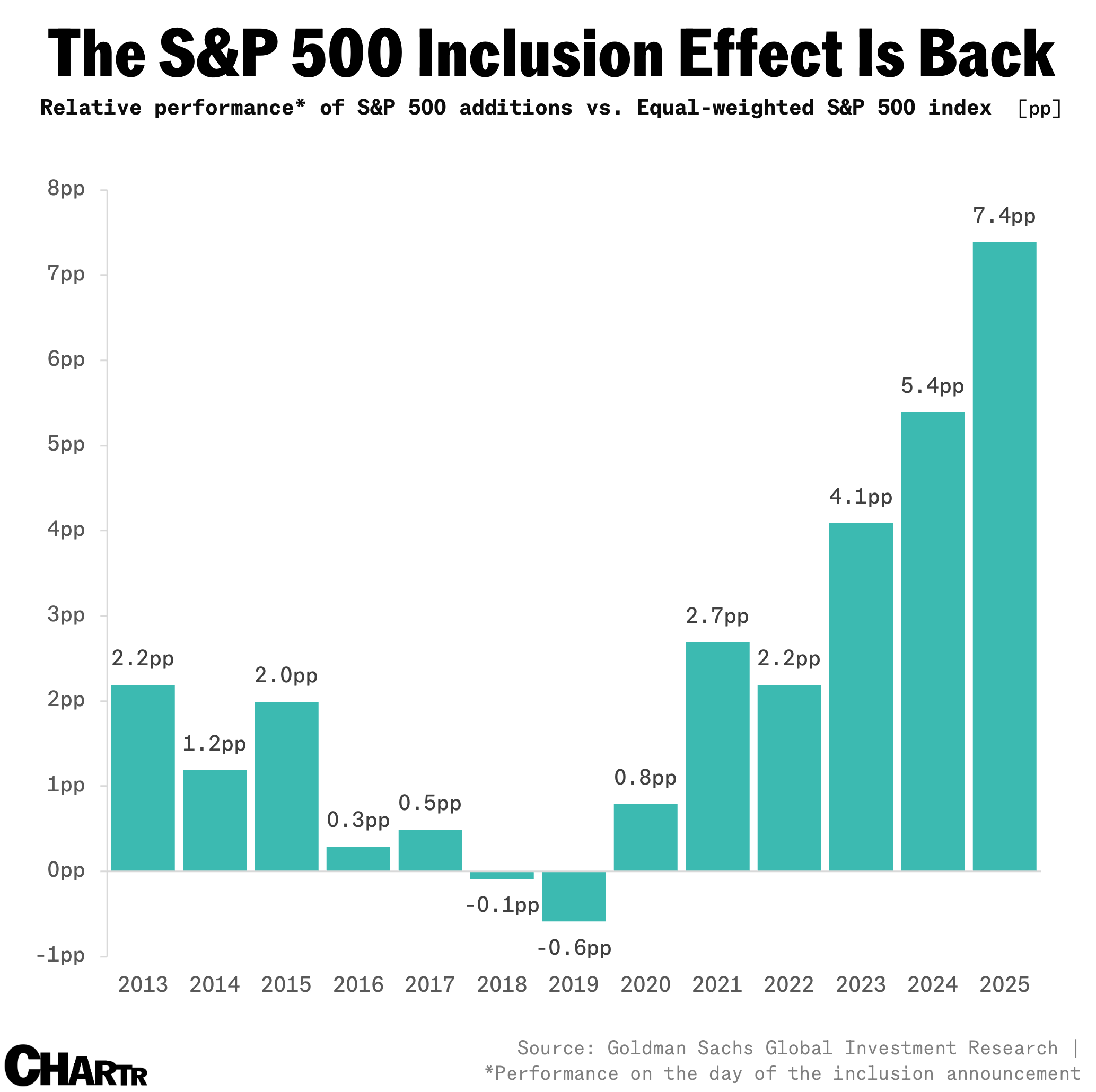
Now, though, a new Goldman Sachs analysis suggests the inclusion effect may be staging a comeback.
s&p500
Sherwood News

Since 2021, stocks newly added to the S&P 500 have outperformed the equal-weighted index by an average of 4 percentage points on the announcement day — with nearly three-quarters of those stocks beating the benchmark.

Source matters

One factor driving the revival is that fewer companies are migrating from the S&P MidCap 400 Index. Per Goldman’s estimate, stocks added from outside the S&P 400 have seen average relative gains of 5.3 pp since 2013, while those graduating from the midcap index actually dipped 0.4 pp.

Retail hype may also be adding fuel, with recent entrants like Coinbase, Super Micro Computer, Palantir, and Datadog already beloved by traders ahead of their debut — and tied to popular themes like AI or crypto

So, which big names could be next in line for America’s flagship index?

Go Deeper: Datadog is now in the S&P 500. These big stocks still aren’t.

More Markets

See all Markets

US airlines pop on report Spirit preparing to shut down as government rescue deal fails to gain support

US airlines are spiking on Friday following a Wall Street Journal report that low-budget carrier Spirit Airlines is preparing to shut down. According to CBS News, the airline could cease operations as early as Saturday, barring an intervention.

In late April, President Trump said he would “love somebody to buy Spirit.” The administration weighed a $500 million rescue package, though it received significant blowback from members of Congress and ultimately didn’t receive support from Spirit’s creditors.

On Friday, Trump told reporters that the administration has given Spirit a “final proposal.”

Shares of Spirit’s rivals surged on the report, with budget carriers like Frontier Airlines and JetBlue climbing by double digits. The big four — Delta Air Lines, United Airlines, American Airlines, and Southwest Airlines — rose by low single digits. Alaska Air and Allegiant also saw a bump.

markets

Estée Lauder gets a glow-up after earnings beat, guidance hike

Estée Lauder shares are soaring after the beauty giant released Q3 earnings results that topped expectations and raised its full-year outlook, while also expanding its restructuring plan.

The key numbers:

  • Revenue of $3.71 billion (compared to analysts’ estimate of $3.69 billion).

  • Adjusted earnings per share of $0.91 (estimate: $0.65).

Estée Lauder also lifted its full-year earnings outlook to a range of $2.35 to $2.45 per share, up from $2.05 to $2.25 previously.

The bottom line is getting flattered by job cuts, with management increasing that target to as many as 10,000 roles, up from a prior range of 5,800 to 7,000, as part of a broader effort to streamline operations and shift toward faster-growing sales channels.

The rally comes after a tough stretch for the stock, which is down more than 20% year to date, with the results inspiring hope that its turnaround efforts will bear fruit.

CEO Stéphane de La Faverie said fiscal 2026 is “promising to be the pivotal year we intended,” with the company expecting to restore organic sales growth and expand margins for the first time in four years.

Amid these positive signals, Estée Lauder flagged risks from tariffs, geopolitical tensions, and potential disruptions tied to the Middle East.

markets

Moderna beats Q1 estimates and reaffirms full-year guidance

Moderna rose in premarket trading after it reported earnings results that beat Wall Street expectations and reaffirmed its full-year guidance.

For the first three months of 2026, the company reported:

  • An adjusted loss per share of $3.40, less than the $4.45 loss per share analysts polled by FactSet had expected.

  • Revenue of $352 million, more than the $236 million the Street was anticipating. About 80% of that came from outside the US, the company said.

For the full year in 2026, the company still expects:

  • Revenue to grow 10%. Currently, analysts are penciling in $2 billion in 2026 sales, which is about a 5% increase.

Moderna was tapped by the US government to quickly develop a vaccine for COVID-19 in 2020, a product that has seen its sales plummet, but remains the company’s main source of revenue.

Now, the company sees growth on the horizon this year, after the European Commission approved its combination vaccine for the flu and COVID-19 for adults ‌50 years and older. Indeed, Moderna said a growing share of its revenue is coming from international markets.

The company has had a harder time getting approval from the US Food and Drug Administration, though the agency said in February that it would reconsider its stand-alone flu vaccine.

markets

Chevron posts mixed Q1 results, as sales miss offsets big earnings beat

Chevron is modestly lower after posting mixed Q1 results, as investors wonder whether elevated oil prices and crack spreads will continue to buoy earnings in the quarters to come.

The key numbers:

  • Q1 revenue of $48.6 billion (compared to analyst estimates of $50.6 billion).

  • Adjusted earnings per share of $1.41 (estimate: $0.90).

  • Production of 3.86 million barrels of oil equivalent per day (estimate: 3.8 million).

The upside surprise in Chevron’s upstream (production) business more than offset underwhelming results in its downstream (refined) division.

Friday’s dip comes with Chevron outperforming most of the Energy Select Sector SPDR Fund as of 10:36 a.m. ET, with tumbling West Texas Intermediate futures weighing on energy stocks.

Chevron said earnings would have been better if not for “unfavorable timing effects” totaling about $2.9 billion, which included mark-to-market losses on derivatives and inventory accounting impacts, weighing on reported earnings.

“Despite heightened geopolitical volatility and related supply disruptions, Chevron delivered solid first-quarter performance,” CEO Mike Wirth said, citing strong US operations and production growth following the integration of Hess.

Ahead of these results, Chevron had also cautioned that supply may take time to respond to higher prices. Wirth also said in a CBS interview that restoring production is “not like turning on a faucet,” noting it can take “weeks and months, in some cases years” to bring disrupted fields and infrastructure back online.

The results also come as Wirth met with President Trump and other energy executives this Tuesday to discuss potential steps to stabilize oil markets in the event that shipments through the Strait of Hormuz remain limited.

Latest Stories

Sherwood Media, LLC produces fresh and unique perspectives on topical financial news and is a fully owned subsidiary of Robinhood Markets, Inc., and any views expressed here do not necessarily reflect the views of any other Robinhood affiliate, including Robinhood Markets, Inc., Robinhood Financial LLC, Robinhood Securities, LLC, Robinhood Crypto, LLC, Robinhood Derivatives, LLC, or Robinhood Money, LLC. Futures and event contracts are offered through Robinhood Derivatives, LLC.

