
Markets
TOPSHOT-US-POLITICS-TRUMP-BIDEN
President Joe Biden shakes hands with President-elect Donald Trump during a meeting in the Oval Office (Saul Loeb/Getty Images)
second time’s the charm?

Fund managers with $500 billion are piling into the same “Trump trades” that mostly fizzled out last time

I guess there’s a reason that they call them “Trump trades,” not “Trump investments.”

Luke Kawa

The knee-jerk market reaction to Donald Trump’s victory in the presidential election — US equities and the dollar outperforming their peers — has been a case of déjà vu all over again.

And fund managers with $565 billion in assets are diving into so-called “Trump trades” in earnest: the same things that everyone bought the last time.

Bank of America’s closely watched global fund-manager survey had an interesting wrinkle this month: with responses received between November 1 and 7, they were able to isolate how much investors’ views changed immediately following the US vote.

The common theme from these respondents, who collectively manage $565 billion, was as pro-US as a bald eagle eating apple pie.

Those surveyed before the election thought US and global stocks would be about neck-and-neck in 2025; now, American equities are decisively the preferred option.
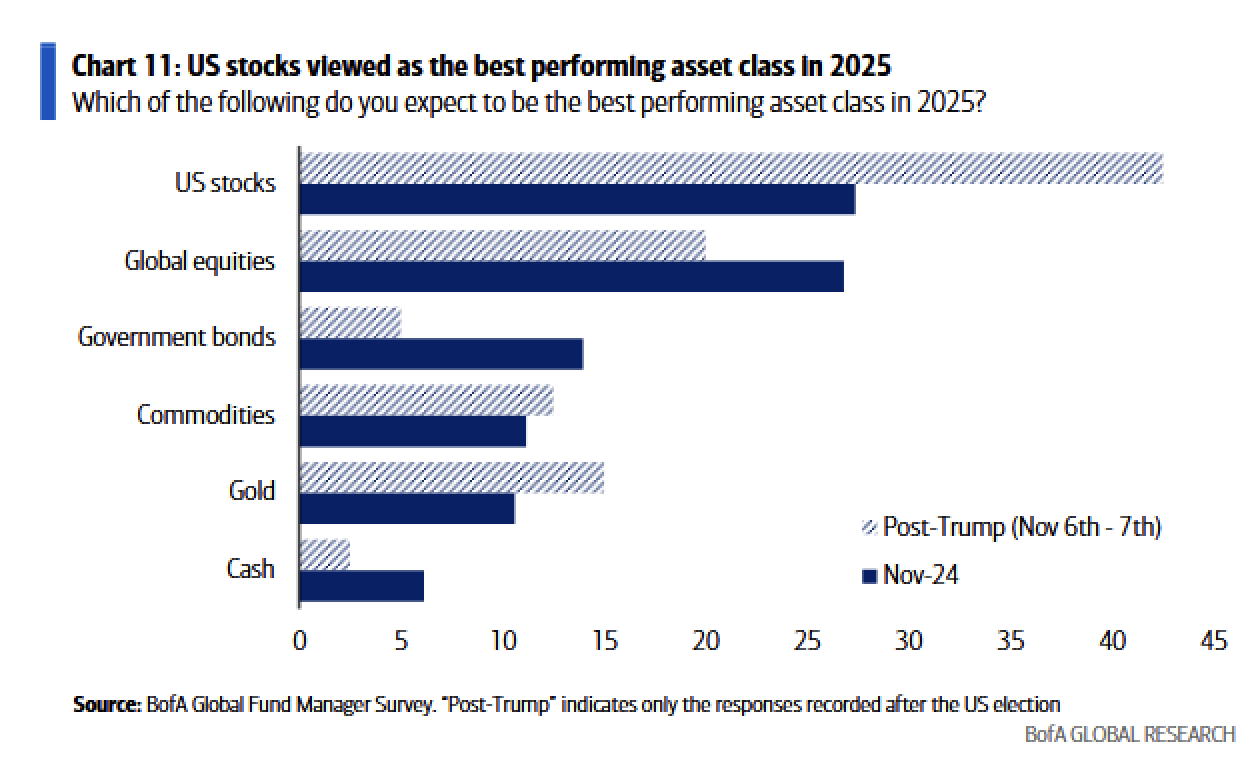
US stocks Nov 24 FMS
Source: BofA

The US dollar? The top pick to outperform in the world of foreign exchange.
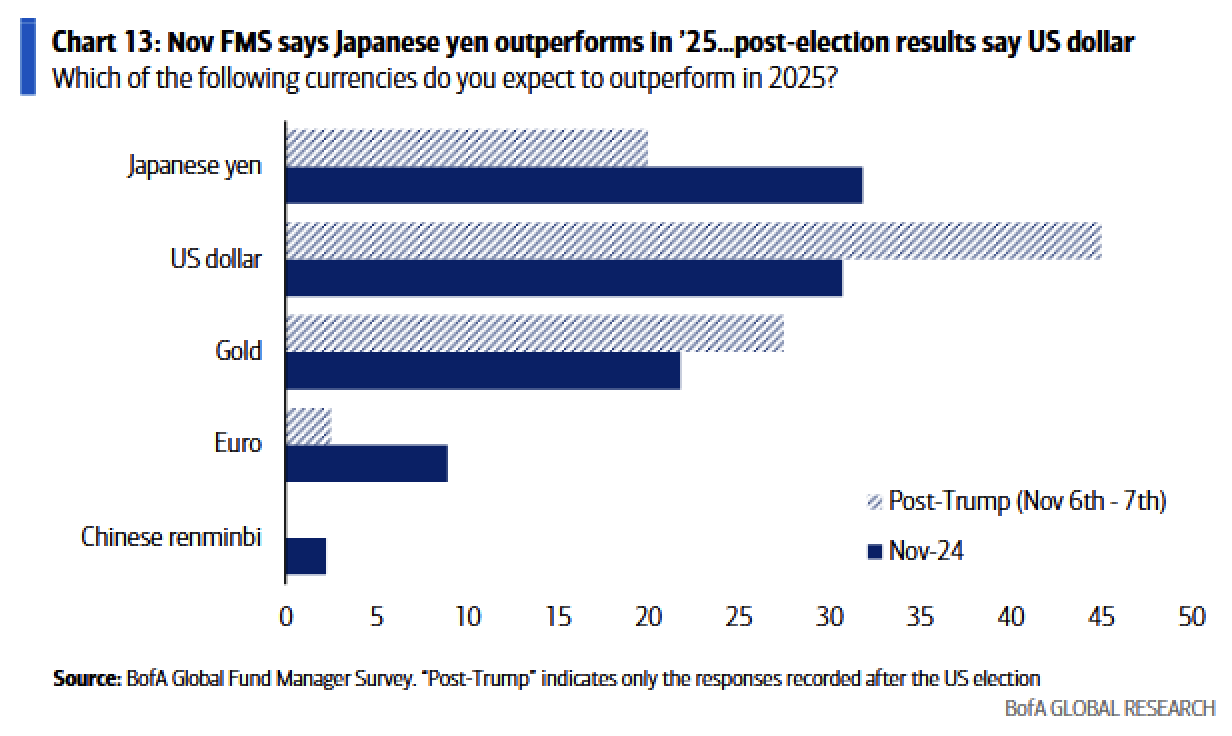
Foreign exchange FMS Nov 2024
Source: BofA

And it’s now conventional wisdom within this group that small caps, which are more sensitive to domestic growth and tax changes, will outperform the S&P 500.
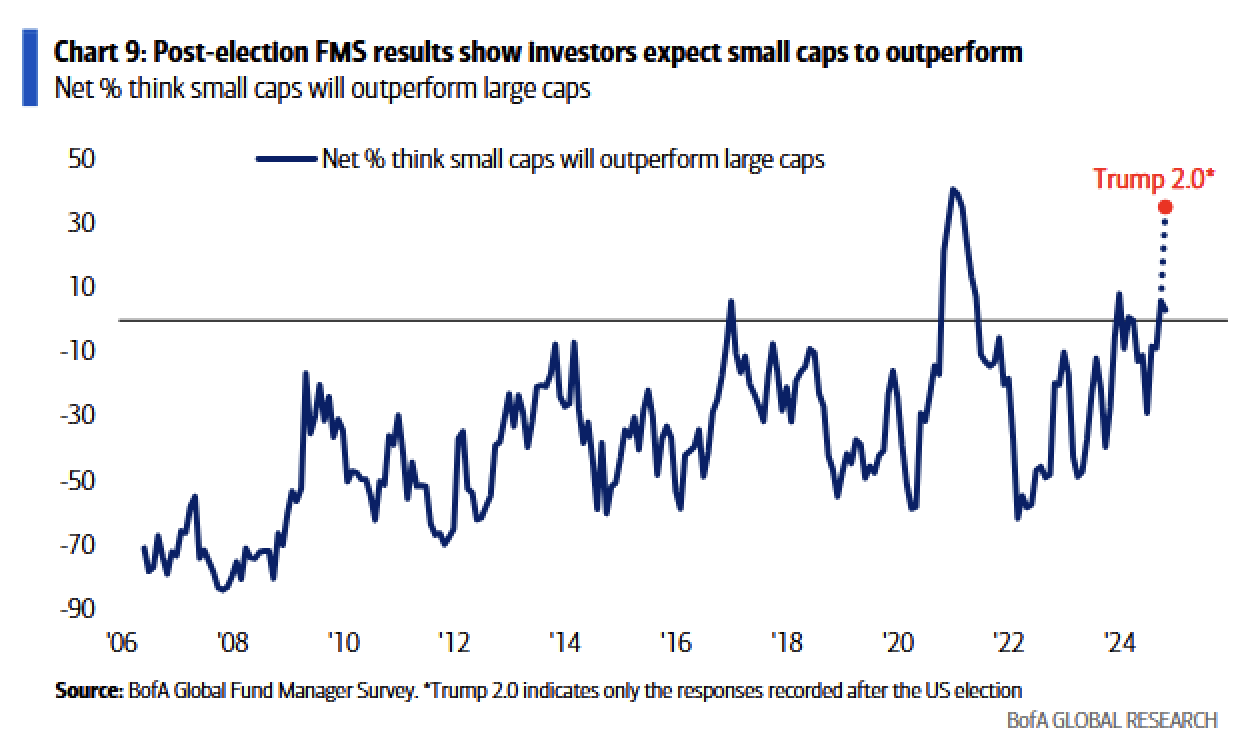
Small vs large BofA FMS Nov 24
Source: BofA

Let’s evaluate how all of these trades fared through Trump 1.0.

Small caps proceeded to underperform large caps by more than 20% from Election Day 2016 through Election Day 2020, even after getting off to a 10% lead within a month of Trump’s surprising 2016 victory. Heck, US small caps barely outperformed developed-market small caps as a whole over this period despite superior US economic growth and the Tax Cuts and Jobs Act, a specific catalyst that benefited this cohort relative to their international peers!

The Dollar Spot Index, which tracks the value of the greenback versus other major developed market currencies? Down between the 2016 and 2020 presidential elections. Oh, what about the Bloomberg Dollar Spot Index, which also includes emerging-market currencies like the Mexican peso and Chinese offshore yuan, which got smacked on the 2016 results? Also down from November 8, 2016, through November 3, 2020.

Then there are US stocks. Yes, these outperformed the MSCI World between Trump’s election win and Biden’s, as they did between Trump’s win and Biden’s after that, and during both of Obama’s terms. You have to go back to George Bush’s win over John Kerry to find a time when US stocks underperformed their global counterparts from one presidential race through the next.

US stocks over their global peers isn’t a really Trump trade; it’s a tech trade.

The S&P 500 has outperformed for a long time primarily due to the outsize earnings power of established and emergent tech giants.

While that profitability was boosted by tax cuts, Big Tech was not one of the key beneficiaries of the TCJA. The yawning gap between the growth in forward-earnings estimates for Nasdaq 100 (which is even more tech-heavy than the S&P 500) compared to the MSCI ACWI between the 2016 and 2020 elections is a story of operational excellence and global footprints.

Fiscal policy, trade policy, regulatory policy, all of that certainly matters for markets. But sometimes (dare I say, oftentimes), there are bigger forces at play, or markets are simply unable to trade the same thematic catalyst for years on end — unless it’s a major factor underpinning incremental increases in profitability.

So-called “Trump trades” are much more a “reaction-to-Trump-winning trades” than they have been durable, investable themes. I guess there’s a reason why they call them “Trump trades” and not “Trump investments.”

More Markets

See all Markets
markets

SpaceX reportedly plans to IPO in mid-June, chooses to list on Nasdaq

Elon Musk’s aerospace and satellite manufacturer, SpaceX, could price its initial public offering as soon as June 11 and make its public market debut on June 12, Reuters reported Friday. SpaceX is preparing for a monster IPO, reportedly aiming to raise $75 billion at a record $1.75 trillion valuation.

Sources familiar with the matter told Reuters that Musk’s company had chosen to list on the Nasdaq.

SpaceX is moving through its IPO timeline and is said to be ready to hit the road to secure commitments from investors around June 4, according to Reuters.

SpaceX did not immediately respond to requests for comment.

Go Deeper: What happens to Tesla stock when SpaceX goes public?

markets

Figma spikes after raising full-year sales outlook as the software company leverages AI for growth

Figma jumped postmarket Thursday after posting impressive sales in Q1, surpassing Wall Street expectations and raising its full-year guidance. The key numbers:

  • Q1 revenue of $333.4 million (compared to analyst estimates of $316 million).

  • Q2 sales guidance of $348 million to $350 million (estimate: $329.7 million).

  • Full-year revenue between $1.422 billion and $1.428 billion (up from previous guidance of $1.37 billion).

The digital design software firm is the latest company to diminish investor fears about AI-induced disruption by making the technology work for them. Like Atlassian or Datadog, Figma said it was able to use AI to its advantage, bringing more customers on board and getting them to spend more.

In the press release, Praveer Melwani, Figma CFO, said:

As AI gets better, Figma is accelerating and customer usage and workflows on our platform are deepening. Our platform and AI products drove faster growth for both new customer acquisition and expansion within existing accounts.

Revenue grew 46% year over year in Q1 2026, an acceleration from growth of 40% in Q4 2025.

markets
Luke Kawa

Infleqtion reports Q1 adjusted loss, offers modest boost to full-year sales guidance

Infleqtion is falling in postmarket trading after reporting a Q1 adjusted loss from operations of $13.2 million and sales of $9.5 million.

Management modestly upgraded its sales guidance to “at least” $40 million for 2026, adding that language to enhance the target provided in early April. Revenues of $40 million would mark an increase of roughly 23% compared to the $32.5 million generated in 2025, and an acceleration from growth of 12% last year.

The company utilizes neutral-atom technology to make quantum sensors used in clocks and antennas in addition to computers.

“Q1 reinforced our confidence that quantum is gaining momentum as the market shifts toward deployable systems, real applications, and measurable customer value,” said CEO Matt Kinsella. “Across computing, sensing, and software, we are seeing expanding customer activity especially in national security, space, and hybrid quantum-AI applications.”

Shares are roughly flat since February 13, which is just before the company went public via a SPAC, after being down 35% near the end of March, and then up nearly 30% in mid-April.

The quantum computing space benefited from the return of speculative appetite in April after the US and Iran agreed to a ceasefire. The cohort was later bolstered after Nvidia unveiled a suite of open models designed to leverage AI to improve calibration and error correction for quantum computers.

markets
Luke Kawa

Applied Materials rallies after better-than-expected Q2 results, strong sales guidance

Shares of Applied Materials are gaining in postmarket trading after the company reported robust Q2 results and a sales outlook that indicate building momentum.

  • Net sales: $7.9 billion (compared to analyst estimates of $7.7 billion and guidance for $7.65 billion, plus or minus $500 million).

  • Adjusted earnings per share: $2.86 (estimate: $2.68, guidance: $2.68, plus or minus $0.20).

For Q3, the company anticipates net sales of $8.95 billion (plus or minus $500 million; estimate: $8.15 billion) with adjusted EPS of $3.36 (plus or minus $0.20; estimate: $2.88).

“The growth in AI that Applied has been investing for is now in full force,” CFO Brice Hill said in the press release.

Management has consistently indicated that it expects demand to pick up in the second half of this year, but its first-half results have already blown away expectations by a wide margin. All this appetite for semiconductors to support AI compute is fantastic news for companies like Applied Materials that make the equipment to produce these specialized chips.

Shares of Applied Materials closed near a record high ahead of this report, up more than 70% year to date.

Latest Stories

Sherwood Media, LLC and Chartr Limited produce fresh and unique perspectives on topical financial news and are fully owned subsidiaries of Robinhood Markets, Inc., and any views expressed here do not necessarily reflect the views of any other Robinhood affiliate, including Robinhood Markets, Inc., Robinhood Financial LLC, Robinhood Securities, LLC, Robinhood Crypto, LLC, Robinhood Money, LLC, Robinhood U.K. Ltd, Robinhood Derivatives, LLC, Robinhood Gold, LLC, Robinhood Asset Management, LLC, Robinhood Credit, Inc., Robinhood Ventures DE, LLC and, where applicable, its managed investment vehicles.

