

Markets
markets

Trump’s tariffs brought billions of dollars in customs revenue, but now the US may have to give it back

The US has collected ~$40 billion worth of customs duties since April, but with the US Court of International Trade blocking the majority of President Trumps tariffs, the government may end up returning the money.

After raking in a record $15.6 billion in customs revenue in April, the Treasury hit a new all-time high again this month, likely from Trumps 10% baseline tariffs on nearly all imports, with some $22 billion accumulated so far in May. Thats a massive jump from $9 billion back in January, and is likely lower than reality, as the customs-only figure excludes excise taxes on specific imported goods like fuel, alcohol, and tobacco.
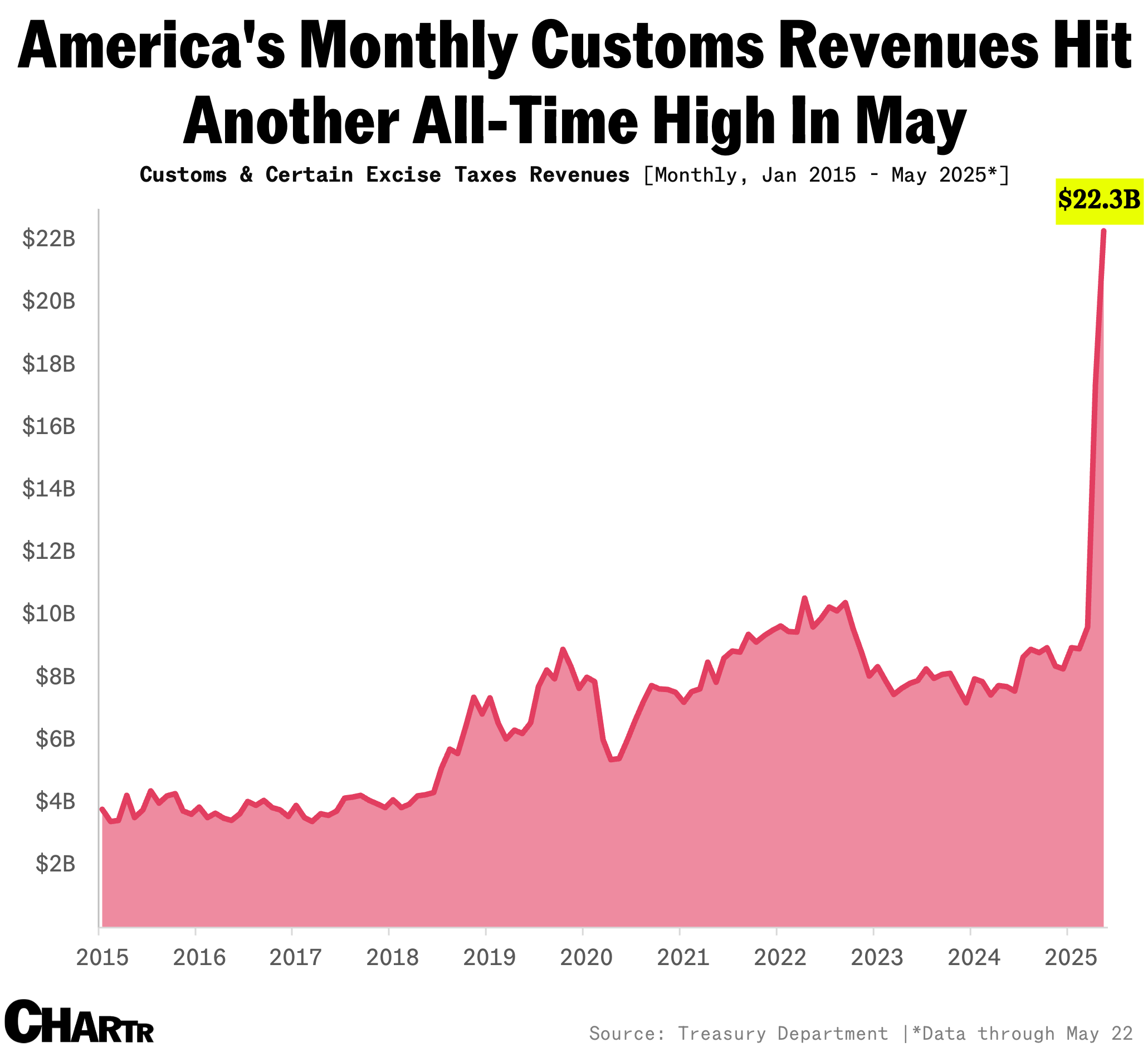
America's customs revenue is growing
Sherwood News

But the new ruling invalidates all orders rooted in the International Emergency Economic Powers Act, including last months Liberation Day tariffs on almost all US trading partners and levies against China, Mexico, and Canada enacted before then. Trump now has up to 10 days to sort out the necessary administrative actions, unless the administrations notice of appeal filed against the decision goes through.

The revenue was a boon but still small compared to the fiscal pressure America is under. Mounting federal debt is raising concerns in bond markets, and Trumps big, beautiful bill,” which includes tax cuts, might cost an additional $3.8 trillion over the next decade.

Of course, theres also a catch: even if the ruling holds, the White House could deploy other trade laws and continue imposing sector-specific tariffs, which might not change the final outcome for most major U.S. trading partners, per Goldman Sachs analyst Alec Phillips.

But the new ruling invalidates all orders rooted in the International Emergency Economic Powers Act, including last months Liberation Day tariffs on almost all US trading partners and levies against China, Mexico, and Canada enacted before then. Trump now has up to 10 days to sort out the necessary administrative actions, unless the administrations notice of appeal filed against the decision goes through.

The revenue was a boon but still small compared to the fiscal pressure America is under. Mounting federal debt is raising concerns in bond markets, and Trumps big, beautiful bill,” which includes tax cuts, might cost an additional $3.8 trillion over the next decade.

Of course, theres also a catch: even if the ruling holds, the White House could deploy other trade laws and continue imposing sector-specific tariffs, which might not change the final outcome for most major U.S. trading partners, per Goldman Sachs analyst Alec Phillips.

More Markets

See all Markets
markets

Data center trade deep in the red

The data center trade is seeing its steepest sell-off since the market rout that was ignited by President Donald Trump’s Rose Garden tariff announcement back in April.

Goldman Sachs’ themed basket of AI data center shares was down more than 6% at around 12 p.m. ET, putting it on track for its worst day since the tariff announcement.

Losses hammered seemingly every form of input needed for the sprawling concrete server warehouses at the heart of the investment boom.

Hardware makers including data storage companies like Sandisk, Western Digital, and Seagate Technology Holdings, as well as DRAM maker Micron — some of the best-performing stocks in the S&P 500 this year — were taking a licking, as were networking stocks Cisco and Arista Networks and data center builders such as Vertiv Holdings and electrical and mechanical contractor Emcor.

Optimism for all things AI has seemed to evaporate throughout the week, as the stock market greeted lackluster quarterly numbers from Oracle and Broadcom with jittery sell-offs and concern about growing debts that could crater cash flows.

Those worries seem to be spreading to ancillary beneficiaries of the AI boom on Friday, gouging a chunk out of charts that retail dip buyers have not — at least so far — stepped in to buy as we head into the weekend.

markets

Oracle denies Bloomberg report that it’s delaying some data centers for OpenAI to 2028 from 2027

Getting a multi-hundred-billion-dollar backlog for cloud computing revenues from data center projects is easy. Building them is hard.

Oracle extended declines to as much as -6.5% on the day on the heels of a Bloomberg report that the cloud giant has pushed back the completion dates for some of the data centers it’s building for OpenAI to 2028 from 2027, citing people familiar with the work. Oracle denied this report, telling Reuters that there have been no delays to any sites required to meet its contractual commitments and that all milestones remain on track.

Shares had fully pared their report-induced drop ahead of Oracle’s reply, but remain in the red for the day.

Bloomberg said the reported postponement was attributed to labor and material shortages.

Oracle has been spending more on capex than Wall Street had anticipated, leading to higher-than-expected cash burn. Management boosted its full-year capital spending plans by $15 billion after reporting Q2 results earlier this week.

Oracle’s cloud infrastructure sales came in short of estimates in its fiscal 2026 Q2, a signal that markets already had reason to doubt its ability to quickly turn its humungous RPO (that is, remaining purchase obligations) into revenues.

Traders also seem to be of the mind that potential delays to data center completions are going to limit sales for what goes into them.

Some of the bigger losers since the Bloomberg headline hit the wires include:

markets

Broadcom’s post-earnings tumble is weighing on Google’s entire AI ecosystem

Broadcom’s post-earnings plunge is prompting a sharp pullback in Google-linked AI stocks, which had been on fire thanks to the warm reception to Gemini 3.

The stocks getting hit hard:

A basket of these Google-linked AI stocks compiled by Morgan Stanley is suffering one of its worst losses of the year. This brisk retreat also follows the release of GPT-5.2 by OpenAI.

markets

Citi initiates coverage of Planet Labs with “buy” rating

Planet Labs was up after aerospace and defense analysts at Citi initiated coverage with a “buy/high risk” rating and $19 price target.

The stock is up more than 40% this week, after a strong earnings result that spotlighted the company’s growing opportunity in linking its core business of capturing daily images of the planet with AI technologies.

Citi analysts noted the potential for a positive flywheel effect for Planet Labs as it deepens its focus on integrating AI into its offerings:

“AI is accelerating the conversion of pixels to decisions, where Planet’s daily scan and deep archive offer a uniquely large training corpus and broad-area foundation for automation. AI-enabled solutions (MDA/GMS/AMS) are gaining traction with customers such as NATO and the U.S. DoW, validating the approach of integrating AI into broad-area monitoring products... These AI moves create a compounding advantage: more coverage generates more training data, which improves models, which in turn increases product utility and addressable demand.”

The stock has also caught the attention of some of the retail trading crowd, with call options activity spiking on Thursday as traders rode the market reaction to the results.

Latest Stories

Sherwood Media, LLC produces fresh and unique perspectives on topical financial news and is a fully owned subsidiary of Robinhood Markets, Inc., and any views expressed here do not necessarily reflect the views of any other Robinhood affiliate, including Robinhood Markets, Inc., Robinhood Financial LLC, Robinhood Securities, LLC, Robinhood Crypto, LLC, or Robinhood Money, LLC.