
Markets
US-AI-TECH-COMPUTERS-TELECOM
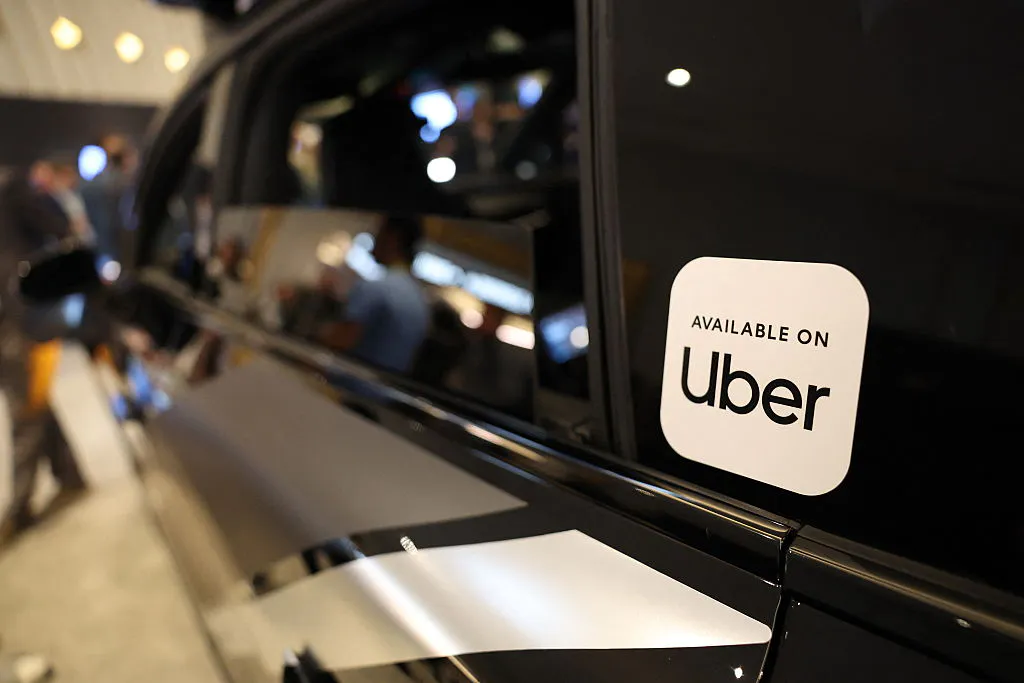
Lucid, Nuro, and Uber unveil a robotaxi during Nvidia Live at CES 2026 (Patrick T. Fallon/Getty Images)

Uber Q1 earnings, Q2 guidance come in above Wall Street estimates

Uber reported earnings before the bell Wednesday.

Uber rose over 10% at one point in premarket trading Wednesday after earnings per share in the company’s first quarter beat analyst expectations, helping to offset a very slight revenue miss. For Q1, the company reported:

  • Adjusted EPS of $0.72, versus the FactSet analyst consensus of $0.69.

  • Revenue of $13.2 billion, compared with Wall Street’s $13.3 billion.

  • Bookings of $53.7 billion, versus the $52.8 billion analysts had forecast.

For the next quarter, Uber is forecasting adjusted EPS of $0.78 to $0.82, with the midpoint above the $0.78 that analysts had expected.

Uber has long been an asset-light entity, where contract drivers brought their own vehicles to Uber’s ride-hailing platform. That’s changed as the company, now at the center of the robotaxi era, has committed more than $10 billion to buying up robotaxi fleets and investing in the companies that make them. For context, Uber spent a total of $336 million in 2025 on capital expenditure.

On the earnings call, investors will be interested to hear how that spending affects Uber’s profits going forward.

More Markets

See all Markets
Mickey Goofy Donald baseball

Disney rises after quarterly revenue beat, boosted by streaming and theme park growth

Disney reported its second-quarter results before markets opened on Wednesday.

markets

Oscar Health beats Q1 estimates on lower medical costs, reaffirms full-year guidance

Oscar Health is soaring in premarket trading after it reported earnings results that beat Wall Street expectations and reaffirmed its full-year guidance.

For the first three months of 2026, the company reported:

  • Earnings per share of $2.07, compared to the $1.11 analysts polled by FactSet were expecting.

  • Revenue of $4.65 billion, higher than the $4.5 billion that was penciled in.

  • A medical cost ratio of 70.5%, lower than the 73.8% the Street was expecting. The company said this was because of a “disciplined pricing strategy, claims and risk adjustment seasonality from metal and new member mix, and favorable prior period reserve development.”

For the full year, Oscar reaffirmed the guidance it gave in February:

  • Revenues between $18.7 billion and $19 billion, in line with the $18.8 billion analysts are expecting.

  • Its medical cost ratio to sit between 82.4% and 83.4%, also in line with the 83.3% the Street is penciling in.

The company, like most health insurers, struggled last year amid rising medical costs. Oscar’s higher-than-expected profit was driven by a sharp drop in medical costs and increased premiums alongside higher enrollment.

markets

Stocks rally, oil falls as US and Iran reportedly close in on deal to end war

Stocks rallied and oil prices fell after Axios reported that the White House is closing in on an agreement to end the war with Iran, which would lift restrictions around transit through the Strait of Hormuz.

The one-page, 14-point memorandum of understanding to end the war also reportedly includes Iran committing to a moratorium on nuclear enrichment and the US agreeing to lift its sanctions, among other things.

Many of the terms would hinge on a final agreement being reached, potentially leaving the chance for “an extended limbo in which the hot war has stopped but nothing is truly resolved,” per Axios.

S&P 500 futures, which were already in the green in the early hours of Wednesday, got a jolt on the news and are currently up 0.7% as of 6 a.m. ET.

Brent crude futures fell 6.90% to $102.29 per barrel. Oil and gas producers like Occidental Petroleum, Coterra Energy, APA Corporation, and ConocoPhillips fell in premarket trading along with oil giants Exxon and Chevron.

Meanwhile, airlines and cruise lines — several of which just told investors high fuel prices would weigh on their profits — rose in early trading. Delta Air Lines, United Airlines, JetBlue, American Airlines, Royal Caribbean, Carnival, and Norwegian all rose.

Many of the terms would hinge on a final agreement being reached, potentially leaving the chance for “an extended limbo in which the hot war has stopped but nothing is truly resolved,” per Axios.

S&P 500 futures, which were already in the green in the early hours of Wednesday, got a jolt on the news and are currently up 0.7% as of 6 a.m. ET.

Brent crude futures fell 6.90% to $102.29 per barrel. Oil and gas producers like Occidental Petroleum, Coterra Energy, APA Corporation, and ConocoPhillips fell in premarket trading along with oil giants Exxon and Chevron.

Meanwhile, airlines and cruise lines — several of which just told investors high fuel prices would weigh on their profits — rose in early trading. Delta Air Lines, United Airlines, JetBlue, American Airlines, Royal Caribbean, Carnival, and Norwegian all rose.

markets

Alphabet gains on report that Anthropic’s committed to spending $200 billion on cloud services over the next 5 years

Shares of Google are catching a bid in postmarket trading after The Information reported that Anthropic plans to spend $200 billion on Google Cloud over the next five years, citing a person with knowledge of the situation.

That would amount to more than 40% of its $462 billion backlog as of the end of Q1, which nearly doubled from $240 billion in Q4.

The relationship between the two companies has been deepening in recent weeks, with Google reportedly planning to invest up to $40 billion in Anthropic, but this reports puts a firm price tag on how much the AI chatbot developer will be paying out to the hyperscaler.

Last year, when it was revealed that Oracle’s remaining performance obligations were dominated by OpenAI, the stock gave back some of its massive advance. Counterparty and concentration risk has been an overhang on the cloud giant ever since.

That’s a stark contrast to how traders are behaving today. It’s a sign of how Alphabet is seemingly on much more secure financial footing than Oracle (even after today’s debt offerings!), and also, probably, implies that Anthropic is a more reliable customer than OpenAI. In addition, as The Information noted, Google has more ways to make money off its relationship with Anthropic than Oracle does with OpenAI.

Anthropic has been a victim of its own success: the popularity of Claude Code and Cowork have revealed compute constraints and left users frustrated by caps. In response, the Claude developer has embarked upon a mad scramble for compute, striking or expanding deals with CoreWeave, Amazon, Google, and Broadcom.

OpenAI, on the other hand, is now billing the billions it’s burned on securing compute as a competitive advantage.

Latest Stories

Sherwood Media, LLC produces fresh and unique perspectives on topical financial news and is a fully owned subsidiary of Robinhood Markets, Inc., and any views expressed here do not necessarily reflect the views of any other Robinhood affiliate, including Robinhood Markets, Inc., Robinhood Financial LLC, Robinhood Securities, LLC, Robinhood Crypto, LLC, Robinhood Derivatives, LLC, or Robinhood Money, LLC. Futures and event contracts are offered through Robinhood Derivatives, LLC.

