
Markets
Aerial image of a forked road within a forest of horse chestnut trees - concept for "taking a decision" / choice / options. 3d render
Which way, globally important economy? (Getty Images)
Mind the gap

The US still has an inflation problem — so does China, it’s just the exact opposite one

Since the pandemic, the world’s biggest economies have been wrestling with two very different problems.

Claire Yubin Oh

Prices go up too fast? Boo. Prices go down? Also boo.

That’s the short version of the dueling narratives in the two most important economies on the planet, after the latest set of Chinese and the US inflation prints, out last week, revealed that the gaping inflation hole between the world’s two biggest economies is now at its widest since the end of March 2024.

Though the US breathed a sigh of relief as its inflation rate eased to a lower-than-expected 2.8% in February, consumer expectations for how much prices will rise in the coming 12 months have nearly doubled since November, as the American middle class expects to continue having to contest with price rises. In China, however, the opposite is true — the latest consumer inflation figures dropped far more than expected to -0.7%, leaving Chinese CPI below zero for the first time in 13 months.
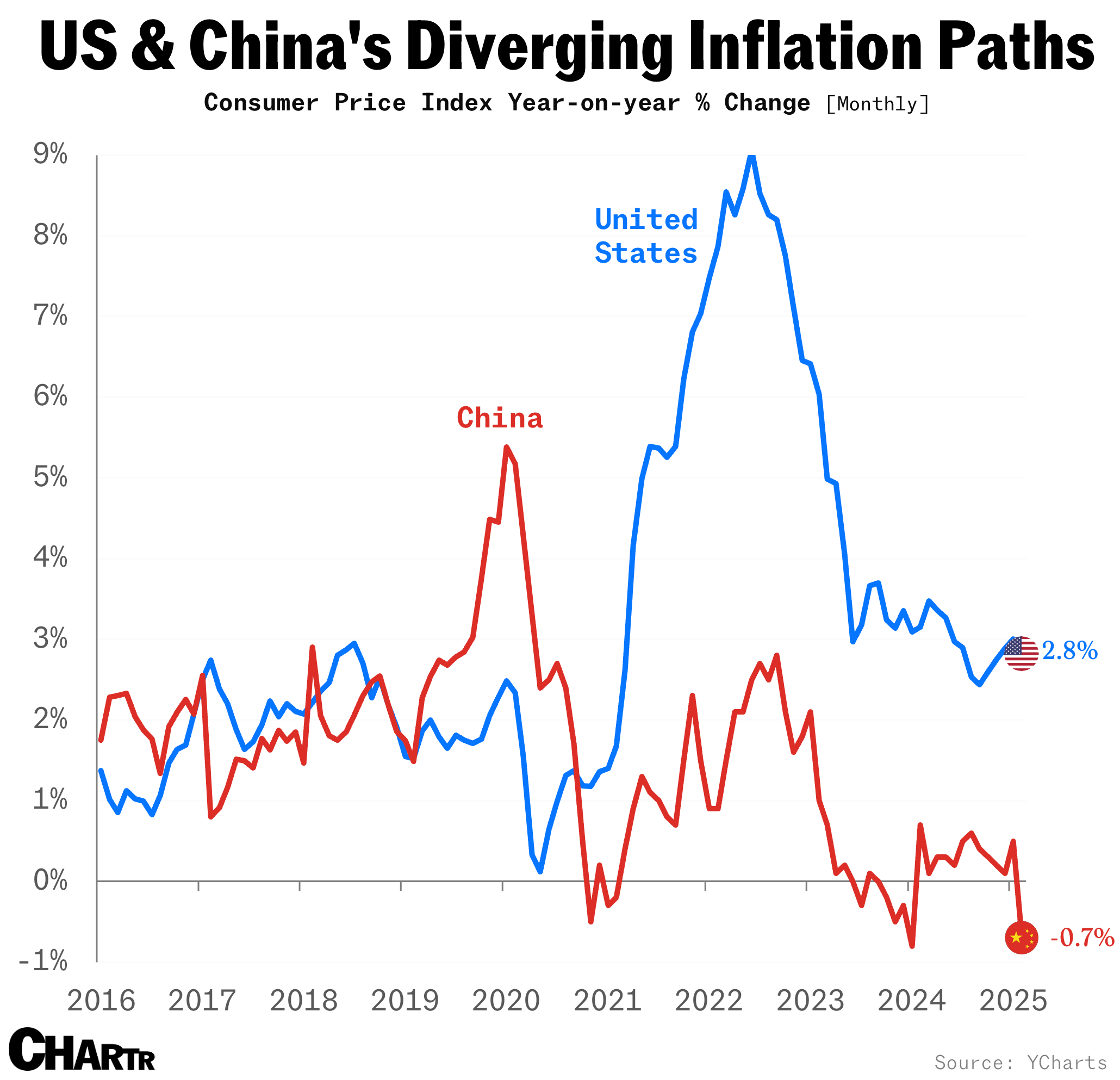
China Vs. US inflation
Sherwood News

Despite ongoing efforts on both ends of the inflation spectrum, the fire and ice situation between the two countries is expected to continue, particularly amid an escalating trade dispute whose impacts are yet to be fully reflected in the respective CPI data.

During the pandemic, Beijing had eyes on the supply side, encouraging production at the price of offering consumers appropriate stimuli, while the US mobilized major monetary easing to keep things moving. To oversimplify, since then, Chinese economists have been losing sleep over ways to open people’s wallets, while the worry in Washington has been about keeping a lid on demand.

The lesser of two evils

While prices falling sounds like a nice reprieve — particularly if you’re a US consumer who’s faced over three years of inflation — that’s arguably the worse of the two problems to be facing, at least if you’re an economist. Deflation incentivizes saving, as consumers and businesses withhold spending as they wait for prices to drop... which tends to lead to more price drops, more saving, and a vicious cycle of delayed consumption or investment.

Investors will be closely watching today’s Federal Reserve meeting for any hints of how the US will tackle still stubborn inflation. In China, it’s Hail Mary time, with the government revealing a 30-point stimulus plan on Sunday in a bid to keep the economy out of a prolonged deflationary spiral.

More Markets

See all Markets
markets

Micron jumps amid report of memory chip price hikes

Shares of Micron are catching a bid on Wednesday after South Korean media reported that its biggest competitors are raising selling prices for a line of high-bandwidth memory chips even though these will soon no longer be the most cutting-edge offerings available.

“According to industry sources on the 24th, memory semiconductor companies such as Samsung Electronics and SK Hynix have reportedly raised HBM3E supply prices by nearly 20%,” per the report from Chosun Biz. “This is unusual, considering that prices typically drop ahead of next-generation HBM launches. The prevailing view is that this is due to upward adjustments in HBM3E orders for next year from companies like Google and Amazon, which design their own AI accelerators, as well as NVIDIA, the largest HBM3E customer.”

Micron, along with those two companies, make up the triumvirate of high-bandwidth memory chip suppliers. These companies are all moving towards ramping their next-gen HBM4 production next year.

Meanwhile, appetite for HBM3E is being reinforced in part by President Trump’s move to allow Nvidia to sell its H200 chips to China.

markets

Opendoor acquires HomeBuyer.com in bid to boost home flipping and mortgage opportunities

Opendoor Technologies has acquired mortgage services platform HomeBuyer.com, according to a post on X from Chief Growth Officer Morgan Brown. Brown did not disclose financial terms of the deal in the post.

There’s an element of an acqui-hire here too, as HomeBuyer.com founder Dan Green will serve as Director of Mortgage Growth for Opendoor.

HomeBuyer.com offers tools for potential home buyers to assess their financing options, and mortgages are a logical avenue for Opendoor to pursue as the online real estate company looks transform the home buying and selling process in the US. At the very least, streamlining the financing process for potential buyers under its own roof should help Opendoor’s quest to pursue higher volumes of homes flipping.

Shares of Opendoor are little changed in premarket trading.

Many Opendoor bulls, including EMJ Capital’s Eric Jackson, have pointed to Opendoor’s potential to bolster its presence in mortgage, title, and other housing services as part of their optimistic view on the stock. In November along with the release of Q3 earnings, CEO Kaz Nejatian announced a new partnership with Roam pertaining to assumable mortgages.

Opendoor certainly hasn’t been idle during the holiday season. Earlier this week, the CEO touted an explosion in the company’s home-buying footprint to include all of the lower 48 US states, and management also announced that Coinbase Canada CEO Lucas Matheson was coming in to serve as its president.

markets

Intel drops on report that Nvidia stopped testing the 18A chip production process used by the chip manufacturer

Early on Christmas Eve, shares of Intel are tumbling like Santa off a rooftop after one too many spiked egg nogs.

Reuters reports that Nvidia “recently tested out whether it would manufacture its chips using Intel’s production process known as 18A but stopped moving forward, two people familiar with the matter said.”

Intel, for its part, told Reuters that its 18A processes are “progressing well” while it “continues to see strong interest” for its more advanced 14A production process. Previous reporting from the outlet indicated that in CEO Lip-Bu Tan’s early days leading Intel, he considered shelving the 18A manufacturing process entirely in favor of 14A in a bid to be more competitive with the likes of TSMC.

The $4 trillion chip designer announced a $5 billion investment in the chipmaker back in September as part of a collaboration that would see the two parties co-develop data center and PC products. That news sent shares of Intel up 23% in a single session, their biggest one-day gain since 1987.

Latest Stories

Sherwood Media, LLC produces fresh and unique perspectives on topical financial news and is a fully owned subsidiary of Robinhood Markets, Inc., and any views expressed here do not necessarily reflect the views of any other Robinhood affiliate, including Robinhood Markets, Inc., Robinhood Financial LLC, Robinhood Securities, LLC, Robinhood Crypto, LLC, or Robinhood Money, LLC.