

Markets
Extreme Closeup of a Needle In A Haystack
Getty Images
JUST BUY THE HAYSTACK

VOO has dethroned SPY as the world’s largest ETF

SPY got a 17-year head start, but Vanguard’s low-cost S&P 500 tracker now tops the ETF charts, thanks to a legion of loyal Bogle-heads... and their $632 billion.

John Bogle, legendary American investor and entrepreneur, famed for popularizing the bedrock of modern-day equity investing — index funds — once said: “Don’t look for the needle in the haystack. Just buy the haystack!”

As millions of people took his advice, eschewing their egos and the idea of trying to pick individual winners in the stock market, trillions of dollars have flowed into low-cost index funds and ETFs. And as of this week, the biggest of those is now VOO, the S&P 500 ETF provided by Vanguard — the firm founded by Bogle himself in 1975. VOO now counts some $632 billion in total assets, per data from Bloomberg, finally overtaking its longtime rival, SPDR S&P 500 Trust, the S&P 500 tracker run by State Street.
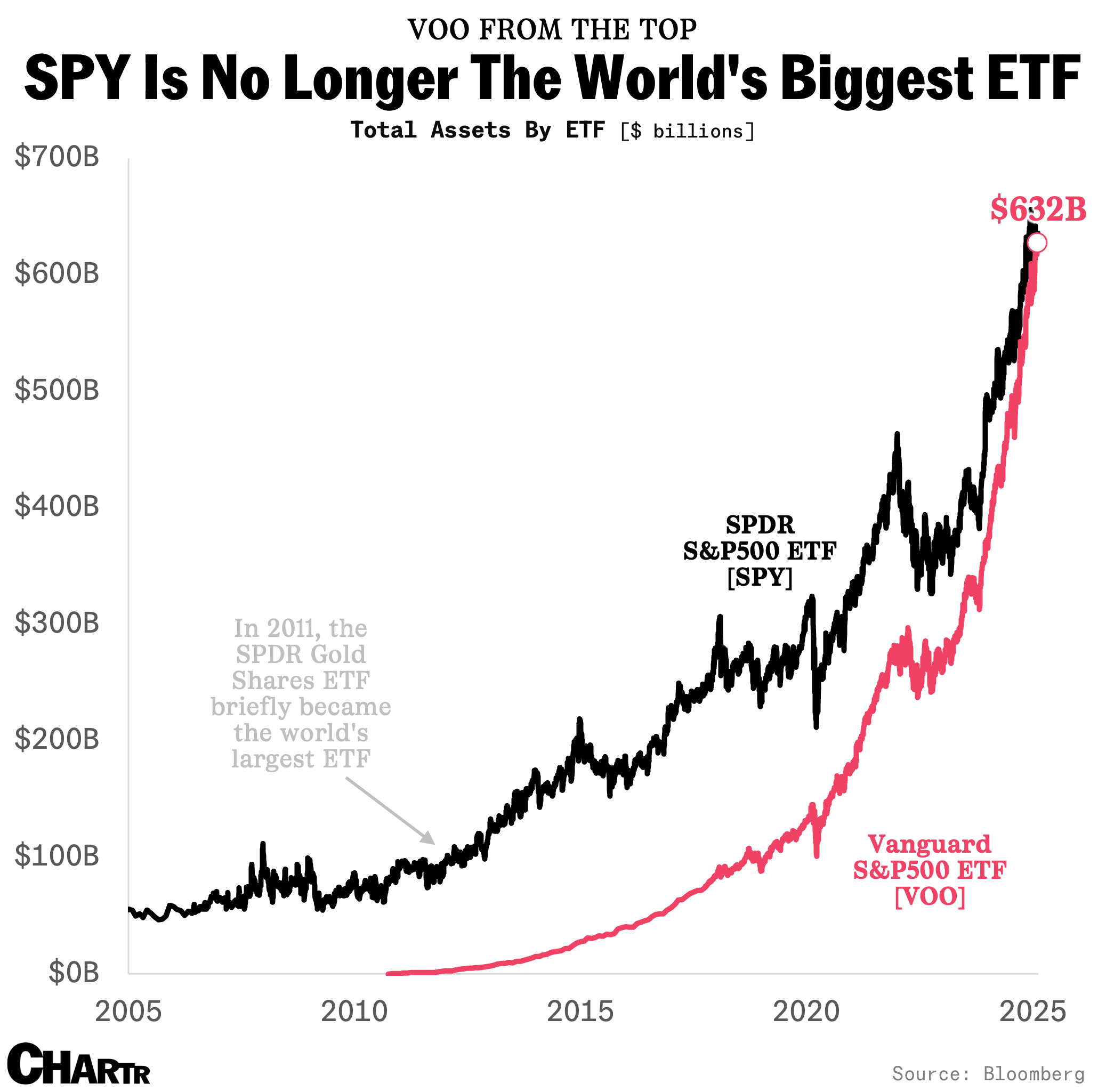
VOO vs. SPY
Sherwood News

VOO-doo economics

ETFs have become wildly popular, offering retail and institutional investors the ability to invest in hundreds of America’s largest and most innovative companies through one clean, tradeable security. But VOO was hardly first to the scene, starting only in 2010 — so how did it soar to the top of the rankings? After all, both SPY and VOO aim to do the same thing: track the performance of the S&P 500 Index.

Various arguments could be made, but there’s really only one reason: VOO is cheaper, charging a miniscule 0.03% per year for the privilege of investing in it, considerably less than the 0.09% expense ratio of SPY. No one loves a bargain more than returns-obsessed investors.

More Markets

See all Markets
markets

Whirlpool tumbles on Q1 earnings, says war is causing “recession-level” decline in US appliance demand

Shares of home-appliance giant Whirlpool Corp. are tumbling on Thursday following its Q1 earnings and stark warning about consumer confidence.

According to Whirlpool, the war with Iran “resulted in recession-level industry decline in the US as consumer confidence collapsed in late February and March.”

The company’s Q1 sales were down about 10% year over year. In April, Whirlpool issued its “largest price increase in more than a decade,” with costs for consumers rising 10%. US appliance demand dropped 7.4% in Q1, Whirlpool said, including a 10% drop in March.

“This level of industry decline is similar to what we have observed during the global financial crisis and even higher than during other recessionary periods,” CEO Marc Bitzer said on the company’s earnings call.

Whirlpool shares were down more than 20% in premarket trading, but pared some of those losses in early trading. It remains on pace for one of its worst trading days in company history.

markets

Krispy Kreme jumps on narrower Q1 loss and “significant progress on turnaround”

Krispy Kreme’s shares are climbing this morning, with the stock ticking up around 5% as the market opened after the company reported narrowing losses and highlighted the success of its turnaround efforts before the bell.

For the quarter ended March 29, 2026, Krispy Kreme trimmed its net loss to $22.8 million, down from $33.3 million a year earlier, though still wider than the $10.8 million loss analysts had penciled in (compiled by Bloomberg). Adjusted EBITDA for Q1 came in at $33.1 million, a little more than the $30.6 million that analysts had been expecting.

CEO Josh Charlesworth struck an optimistic note around the earnings, commenting that Q1 “highlighted significant progress across every pillar of our turnaround plan” and that management expects “this momentum to continue through 2026, driven by profitable growth in the U.S. with key strategic partners, higher digital sales, and international expansion.”

The donut chain is tightening its belt quicker than previously anticipated and expects a net leverage ratio of less than 5.5x in 2026, where they’d expected the level to remain at or below 5.5x last quarter. DNUT also expects more than $15 million in cash flow by the end of the fiscal year as it tightens its debt reduction target.

The company’s newly introduced FY2026 net revenue outlook, forecast to be between $1.25 billion and $1.35 billion, fell below Wall Street’s $1.46 billion estimates — a discrepancy that Krispy Kreme addressed by saying that analyst expectations don’t yet reflect recent asset sales.

markets

Datadog surges after boosting 2026 sales forecast, pulling software stocks higher

Shares of Datadog are surging after the cloud-monitoring platform announced Q1 results that beat Wall Street forecasts on the top and bottom lines while hiking its full year sales guidance.

Key numbers:

  • Revenue of $1.01 billion (up 32% year over year and above analyst estimates of $957.8 million).

  • Adjusted EPS of $0.60 (estimate: $0.52).

Full-year revenue guidance was lifted to $4.3 billion to $4.34 billion from the earlier range of $4.06 billion to $4.1 billion. Management also raised the company’s full-year guidance, now giving an adjusted EPS outlook of $2.36 to $2.44.

The boost to the sales outlook isn’t just helping Datadog, but also the beaten-down semiconductor industry at large. The iShares Expanded Tech Software ETF is up about 4% as of 10:46 a.m. ET, with the likes of Palo Alto Networks, GitLab, Palantir, Atlassian, and CrowdStrike outperforming.

“Overall, we view this as a transformational print/guide for DDOG as the company continues to demonstrate that AI is a powerful demand catalyst rather than a disruptive threat with mission-critical positioning across cloud migration, digital transformation, and now AI training/inference workloads creating a multi-year runway for accelerating growth and continued share gains,” wrote Wedbush analyst Dan Ives in the wake of this report, boosting his price target to $220 from $190.

The rally comes as Datadog announced that it has received FedRAMP High certification, meeting federal government cloud security and compliance standards for handling sensitive unclassified information. The certification is designed to protect controlled unclassified information in cloud environments through strict security controls.

“This milestone reinforces Datadog’s leadership in cloud security and compliance, and sets a new standard for observability platforms in regulated sectors,” said Emilio Escobar, CISO at Datadog.

Going into the report, Datadog had gained over 47% year to date.

markets

Vistra rises after reporting better-than-expected Q1 numbers

Power provider Vistra, a key AI energy trade, reported better-than-expected results early Thursday, sending shares up in premarket trading.

The Texas-based company, which supplies nuclear energy, natural gas, and coal-fueled power to wholesale and retail markets, reported:

  • Net income of $1.029 billion (including a massive $723 million unrealized gain from hedges expected to settle in future years) vs. Wall Street expectations for $434.2 million.

  • Adjusted EBITDA of $1.49 billion vs. expectations for $1.44 billion, per FactSet.

  • Revenue of $5.6 billion vs. an estimated $5.1 billion, per Bloomberg.

Vistra reaffirmed its 2026 Ongoing Operations Adjusted EBITDA guidance range of $6.8 billion to $7.6 billion and Ongoing Operations Adjusted Free Cash Flow before Growth range of $3.925 billion to $4.725 billion.

The companys shares soared 258% in 2024 amid a flurry of excitement over the AI energy boom. Last year was more muted, with the stock rising 17%. So far in 2026, shares were down roughly 4% through yesterday’s close.

markets

Peloton jumps on surprisingly strong Q3 cash flow generation, boost to outlook

Peloton shares are jumping in premarket trading after the company reported a modest Q3 sales beat while generating surprisingly strong cash flows.

The key numbers:

  • Revenue of $630.9 million (compared to analyst estimates of $617.6 million).

  • Adjusted EBITDA of $126.2 million (estimate: $128.7 million).

  • Free cash flow of $150.5 million (estimate: $54.2 million).

For full-year 2026, Peloton nudged up its revenue guidance to a range of $2.42 billion to $2.44 billion, and also boosted its adjusted EBITDA and free cash flow outlooks.

Peloton has spent the last few years working through the aftermath of its pandemic-era hardware boom. The company announced a series of product updates last year in October featuring updated cross-training bikes and treadmills that include AI-powered form tracking and stronger processors.

Under CEO Peter Stern, the company is pivoting toward new growth levers by renewing efforts to expand content distribution and reach commercial markets. This includes the launch of the Peloton Commercial Series for high-use environments, which helped drive a 14% year-over-year increase in commercial business revenue.

A pillar of this strategy is its global partnership with Spotify. By integrating over 1,400 on-demand Peloton fitness classes into a new Fitness hub for Spotify Premium members, the company aims to reach new audiences outside its own hardware ecosystem.

Latest Stories

Sherwood Media, LLC produces fresh and unique perspectives on topical financial news and is a fully owned subsidiary of Robinhood Markets, Inc., and any views expressed here do not necessarily reflect the views of any other Robinhood affiliate, including Robinhood Markets, Inc., Robinhood Financial LLC, Robinhood Securities, LLC, Robinhood Crypto, LLC, Robinhood Derivatives, LLC, or Robinhood Money, LLC. Futures and event contracts are offered through Robinhood Derivatives, LLC.

