
Markets
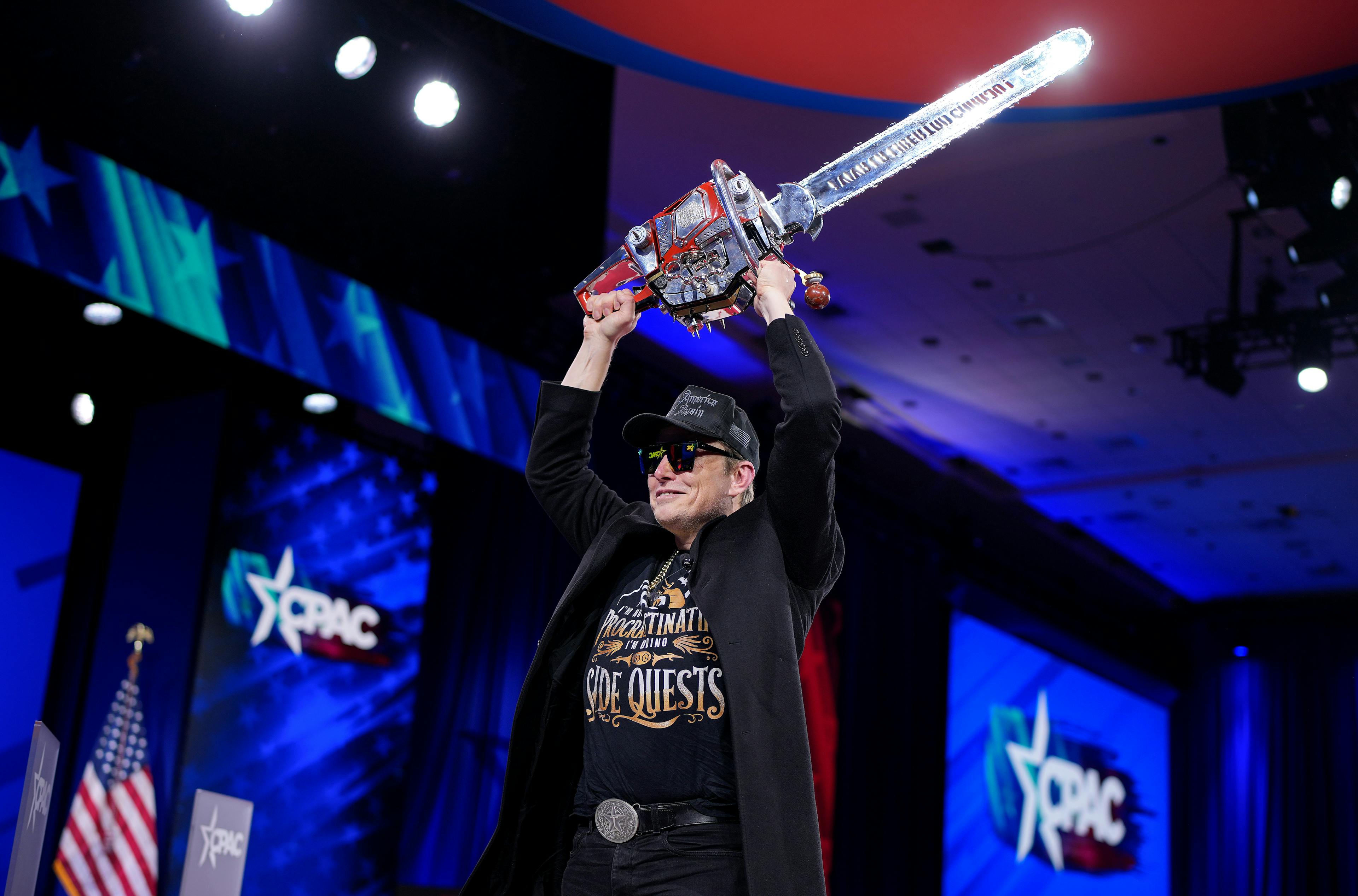
Elon Musk wields a chainsaw
That chainsaw ain’t cutting the US budget deficit (Andrew Harnik/Getty Images)
Tears for Shears

What Elon Musk and the teary UK Treasury chief have in common

The recent travails of these two very distinct characters prove one clear point: there’s no real appetite to curb government spending.

Luke Kawa

Jon Turek, head of global macro research firm JST Advisors, penned an absolute banger this week, drawing a parallel between how two recent well-publicized and market-moving events on either side of the Atlantic give us sharp insight into a critical dynamic for the global economic and financial market outlook.

Rachel Reeves became the UK Chancellor of the Exchequer (roughly the Treasury secretary, in US parlance) with a pledge to balance the British government’s books (a very big challenge — good luck with that!). Her job security was very publicly not backed by Prime Minister Keir Starmer during a session of Parliament, which fostered a spike in longer-term British bond yields.

Elon Musk became head of a new agency designed to cut government spending (DOGE) in the Trump administration, and enthusiasm over how his role could benefit his company Tesla caused the stock to more than double from shortly before the November 2024 US election through mid-December. He now finds himself in very public political and personal spats with the president, during which time Tesla’s share price has fallen about 14%.

Turek’s conclusion: “The ‘fiscal cutters’ have almost literally been run out of town.”

More, from Turek:

There was something last week, that while at the surface had absolutely nothing to do with each other, it felt like it had everything to do with each other.

Last week we saw President Trump talk about the possibility of deporting Elon Musk, who has now begun his own political party. While across the pond, during a session of parliament, Rachel Reeves was seemingly hung out to dry by her Prime Minister in a way that led to an emotional reaction.

Now, I get these two things seem completely independent, but the underlying motif is quite clear. Both of these characters were brought into the arguably two worst fiscal situations in G10 to bring tough budget cuts and begin the process of returning fiscal discipline. Rachel Reeves was tasked with effectively being the opposite of the Conservative debacle culminating in the Liz Truss moment, and Elon Musk with DOGE was meant to usher in a new level of discipline to the federal government with aggressive spending cuts...

When you zoom out, it is hard to find a G10 market that is doing less fiscal than they did last year, and that is after five years of material budget deficits across the developed world.

Turning this back to markets, he thinks the natural path forward is for global yield curves — that is, the difference between shorter- and longer-term borrowing costs — to continue to steepen.

“I think central banks will cut rates, but those rate cuts will both feel like ‘a lot’ and also insignificant,” he wrote. “They will feel like a lot relative to the inflation backdrop, but it is hard to see what they do to the economy in a world where the level of back end real yields is so driven by the current fiscal paradigm. That is a very constructive world for steepeners.”

More Markets

See all Markets
markets

Nebius rises after AI hedge fund Situational Awareness discloses 5.6% stake

Nebius jumped 12% in premarket trading Thursday after Situational Awareness, the hedge fund run by former OpenAI researcher Leopold Aschenbrenner, disclosed a major stake in the AI cloud company.

According to its 13G filed Wednesday, the fund reported owning 12.4 million Class A shares of Nebius, representing a 5.6% stake worth ~$2.6 billion as of Wednesday’s closing price. The position didn’t appear in the fund’s most recent 13F filing — which covered holdings as of March 31 and included other neocloud companies such as CoreWeave and IREN — suggesting the Nebius stake was added sometime after the first quarter.

The disclosure puts Situational Awareness among Nebius’s largest disclosed institutional shareholders, at least based on the latest available ownership filings, which show Blackrock as the largest institutional holder as of March 31, with 4.5% of shares outstanding.

One of the "neocloud" stocks, Nebius has gained traction recently after securing large cloud contracts with Microsoft and Meta, as well as an equity investment from Nvidia and an energy partnership with Bloom. Shares are up 165% this year and a whopping 475% over the past 12 months.

Founded in 2024 by Aschenbrenner — and named after his widely-read essay on artificial superintelligence — Situational Awareness has built its portfolio around the physical infrastructure AI runs on, from chips and data centers to power and compute. Per its 13F filings, the fund’s reported portfolio value climbed to $13.7 billion as of the first quarter, up nearly 2.5x from $5.5 billion at the end of 2025.

markets

Snowflake climbs after Q1 results top expectations, guidance gets a boost

Shares of Snowflake are surging after the company beat Wall Street’s projections in its latest earnings report, delivering on its AI thesis, with Q1 revenue up 33%.

It also announced an acquisition of an AI agent platform.

Snowflake stock soared 30% in after-hours trading. If that move were to hold on Thursday, it would more than erase Snowflake’s nearly 20% decline so far this year.

Here are the numbers:

  • Revenue of $1.39 billion in the first quarter (compared to analyst estimates of $1.32 billion).

  • Adjusted earnings per share of $0.39 (estimate: $0.32).

  • Full-year product revenue guidance for 2027 of $5.84 billion, up from previous guidance of $5.66 billion (estimate: $5.67 billion).

Snowflake is a cloud-based database company — essentially allowing businesses to mine their data for insights, charging for compute and storage along the way.

The company’s stock has fallen this year as the company manages competition from hyperscalers like Amazon Web Services as well as the high cost of AI-related build-outs as they double down on AI tools.

On Wednesday, Snowflake announced an eye-popping $6 billion multi-year deal with AWS to "to accelerate enterprise agentic AI adoption."

Last year, Snowflake — which now calls itself “the AI Data Cloud company” — announced a $200 million deal to power its agentic AI with Anthropic’s Claude.

Alongside its Q1 earnings, Snowflake also announced it has signed an agreement to purchase Natoma, a platform for securely integrating AI agents with data, like Snowflake’s. Terms of the deal weren’t disclosed.

“AI agents will only become enterprise-ready if organizations can govern how they operate across systems, applications and tools,” said Pratyus Patnaik, cofounder and CEO of Natoma. “Together with Snowflake, we’re building the governance and connectivity layer that enables enterprises to securely operationalize AI at scale.”

markets

Synopsys drops despite better-than-expected Q2 results, big boost to full-year guidance

Synopsys is falling in postmarket trading despite delivering better-than-expected quarterly results and boosting full-year guidance by more than analysts had anticipated.

For its fiscal Q2, the electronic design automation firm (which helps chipmakers make chips) reported:

  • Revenue of $2.28 billion (compared to analyst estimates of $2.25 billion and guidance for $2.25 billion, plus or minus $25 million).

  • Adjusted earnings per share of $3.35 (estimate: $3.14, guidance for $3.14 plus or minus $0.03).

Management boosted its full-year sales outlook to a range of $9.63 billion to $9.71 billion; the consensus estimate matches the low end of that range. On the bottom line, Synopsys now expects adjusted earnings per share between $14.72 and $14.80, which is well about the consensus call for $14.45.

The company has received two high-profile backers since December: Nvidia unveiled a stake in the company that month as part of a partnership to “design, simulate and verify intelligent products.” More recently, Elliott Investment Management took an activist position in the company, reportedly pushing for higher sales and margins closer to its peer Cadence Design Systems.

Along with these results, management announced that the company entered into a cooperation pact with Elliott, and is adding Elliot Managing Partner Jesse Cohn to the board.

markets

Marvell Technology boosts sales guidance for this year and the next (again)

Marvell Technology gave back most of its big knee-jerk gains after the custom chip and networking company released results in line with estimates while continuing to offer an increasingly optimistic view on future sales.

Shares peaked during the conference call as management formalized Marvell’s sales outlook.

The company lifted its revenue guidance for this fiscal year to $11.5 billion, up $500 million from the outlook delivered last quarter. The following year, Marvell anticipates sales of $16.5 billion, a $1.5 billion boost in the view versus three months ago. That fiscal 2028 guidance is well ahead of Wall Street’s call for $15.3 billion.

“We are seeing exceptional AI-related bookings, and as a result, we are significantly raising Marvell’s revenue outlook for both fiscal 2027 and fiscal 2028 compared with the guidance we provided last quarter,” said Chairman and CEO Matt Murphy in the press release, attributing this to “strong demand across a broad set of Marvell solutions.”

Taking a step back, here were the key numbers for Marvell’s opening quarter in fiscal 2027:

  • Net revenue: $2.42 billion (estimate: $2.41 billion, guidance for $2.4 billion plus or minus 5%).

  • Adjusted net income per share: $0.80 (estimate: $0.80, guidance for $0.79 plus or minus $0.05).

For the current quarter, management expects sales between $2.57 billion and $2.84 billion, the midpoint of which is higher than the $2.61 billion consensus estimate. The outlook for adjusted net income per share is $0.93, plus or minus $0.05, which is above the $0.90 call from the Street.

It’s déjà vu all over again. Marvell had set a high bar for itself coming into this report. The stock surged even after its Q4 results came in broadly in line with estimates in early March, as management issued rosy Q1 guidance and an upgrade to their sales forecast through 2027 (its fiscal 2028).

That bar is just getting even higher. To borrow a line from Creative Strategies CEO and Principal Analyst Ben Bajarin, “All viable compute will be used.”

That sentiment is the loose reason why the stock has more than doubled year to date heading into this release, riding the wave of heavy demand for both compute and connectivity solutions.

Marvell already counts Microsoft and Amazon as major customers (and is reportedly in talks with Google about custom chips). At the end of March, the company got the Jensen Huang seal of approval, receiving a $2 billion investment from Nvidia as part of a partnership to ensure custom chips work seamlessly within Nvidia’s data center architecture.

Latest Stories

Sherwood Media, LLC and Chartr Limited produce fresh and unique perspectives on topical financial news and are fully owned subsidiaries of Robinhood Markets, Inc., and any views expressed here do not necessarily reflect the views of any other Robinhood affiliate, including Robinhood Markets, Inc., Robinhood Financial LLC, Robinhood Securities, LLC, Robinhood Crypto, LLC, Robinhood Money, LLC, Robinhood U.K. Ltd, Robinhood Derivatives, LLC, Robinhood Gold, LLC, Robinhood Asset Management, LLC, Robinhood Credit, Inc., Robinhood Ventures DE, LLC and, where applicable, its managed investment vehicles.

