
Markets
Dow Jones Industrials Average Closes Day 477 Points Up
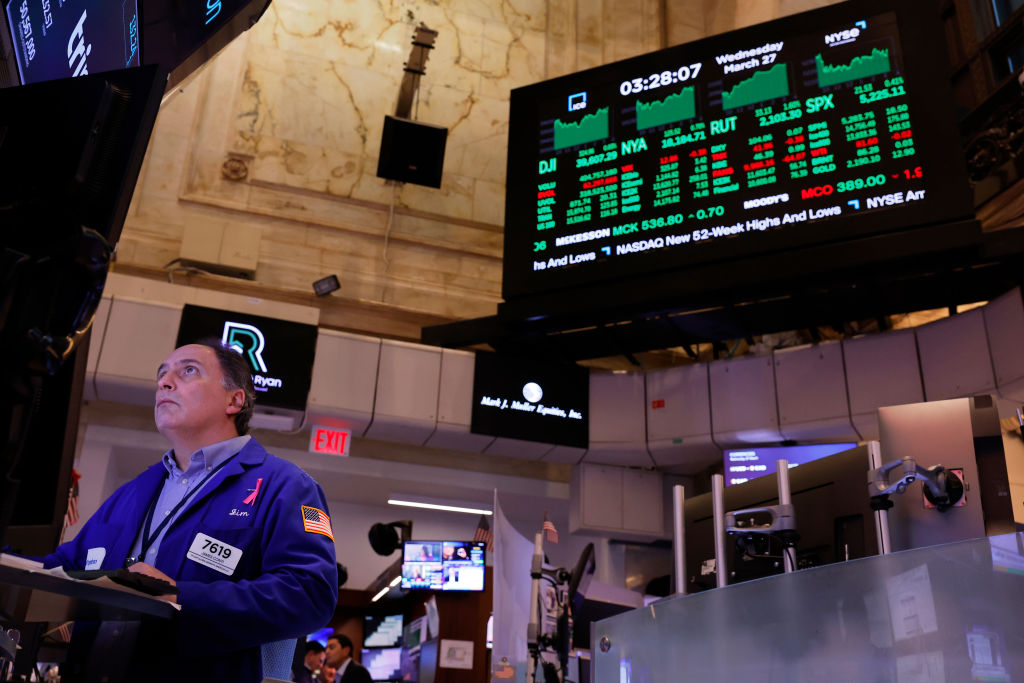
New York Stock Exchange (Photo by Michael M. Santiago/Getty Images)
Adios, ERP

By one measure, stocks haven't looked this bad in decades

Earnings are important, but they aren't everything in the stock market.

Jack Raines

Are stocks too expensive? The answer is... it depends.

In finance, we use the term "equity risk premium" (ERP) to measure the difference between expected returns from stocks, which are risky assets, and Treasury securities, which are risk-free, to see how much investors are being compensated for taking on additional risk. Typically, the equity side of this equation is the earnings yield, or expected earnings divided by price, of the S&P 500.

Currently, the S&P's expected 2024 earnings yield is 4.2%, while its expected 2025 yield is 4.8%, per Y Charts. Meanwhile, 10-year Treasuries are paying approximately 4.6%.

Yesterday, the Wall Street Journal reported that, as higher interest rates have pushed Treasury yields up, the S&P 500's equity risk premium (using forward earnings estimates) touched its lowest level in 20 years.
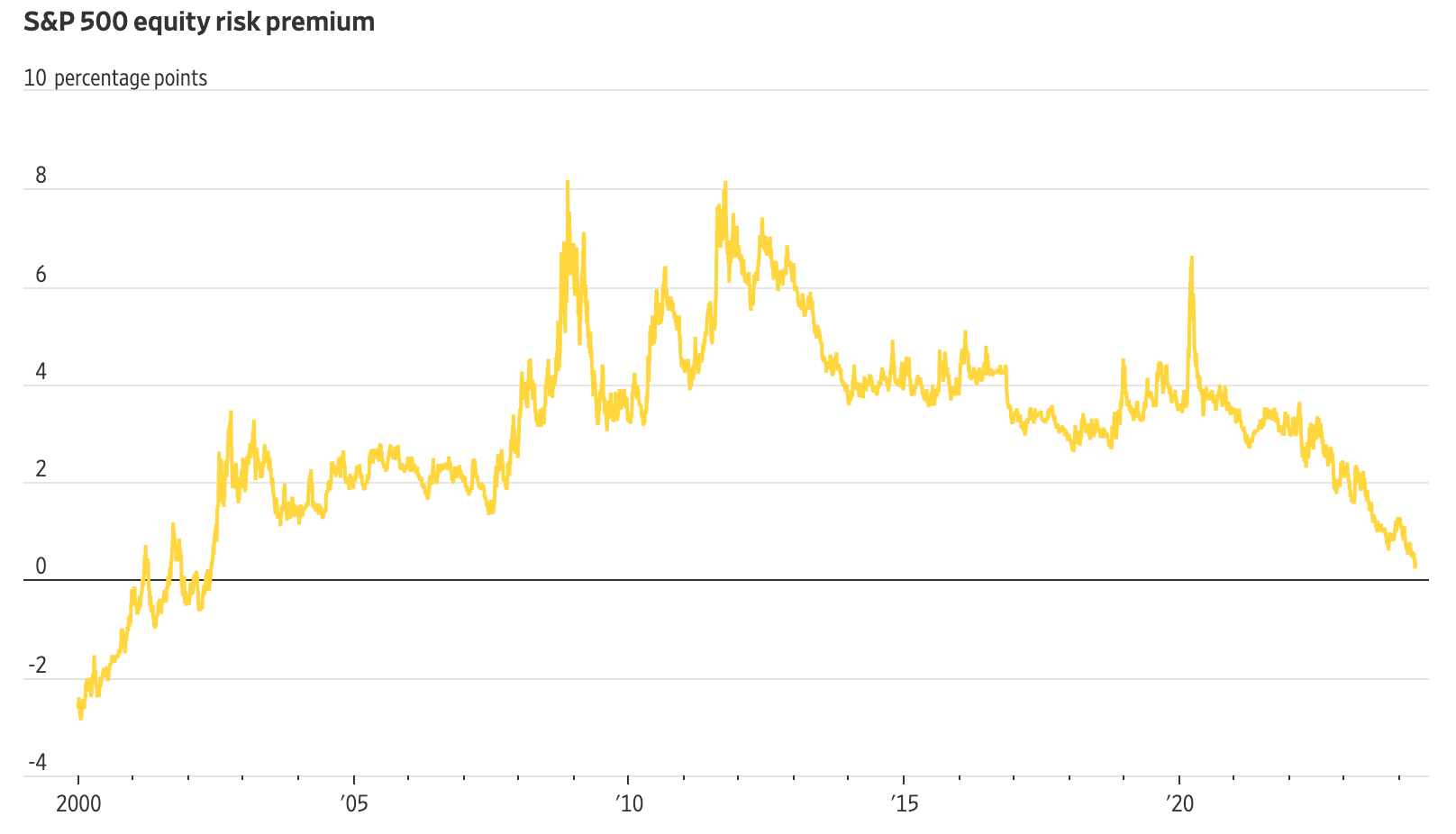
S&P ERP
Source: Wall Street Journal

This doesn't seem great for stocks! Why invest in equities when you can earn almost the same amount of yield as you would by investing in risk-free Treasuries?

Well, one reason is that the S&P 500's earnings don't necessarily dictate its returns.

Going back to 1960, the average current earnings yield was 6.5%, while the average forward earnings yield was 7.0%. Over that same period, the S&P 500 still averaged 8.6% annual returns.

In layman's terms, the S&P 500 tends to outperform its earnings yield from year to year.

Yes, as interest rates stay higher, Treasuries become more attractive investments. That being said, stocks aren't necessarily doomed just because the ERP has narrowed.

More Markets

See all Markets
markets

SpaceX gets a wave of bullish ratings from Wall Street analysts

SpaceX received more than a dozen positive analyst calls on Tuesday — including from major Wall Street banks — as they initiate coverage on Elon Musk’s space and AI company.

SpaceX went public on June 12 at a $2.2 trillion valuation, the largest debut in history. While the company hasn’t yet posted a profit, it seems to have convinced Wall Street that it will get there and grow its valuation on the way.

Of the at least 17 analysts that gave a rating on Tuesday, all but one gave it a “buy” or “outperform” rating. MoffettNathanson was "neutral."

The ratings come as SpaceX joined the Nasdaq 100 index, a benchmark tech-heavy basket of companies that underpins millions of portfolios. The inclusion adds built-in demand for the stock from index funds and ETFs.

Still, SpaceX fell more than 5% on Tuesday amid a broader sell-off, and is currently effectively flat from its opening price of $150 a share.

Latest Stories

Sherwood Media, LLC and Chartr Limited produce fresh and unique perspectives on topical financial news and are fully owned subsidiaries of Robinhood Markets, Inc., and any views expressed here do not necessarily reflect the views of any other Robinhood affiliate, including Robinhood Markets, Inc., Robinhood Financial LLC, Robinhood Securities, LLC, Robinhood Crypto, LLC, Robinhood Money, LLC, Robinhood U.K. Ltd, Robinhood Derivatives, LLC, Robinhood Gold, LLC, Robinhood Asset Management, LLC, Robinhood Credit, Inc., Robinhood Ventures DE, LLC and, where applicable, its managed investment vehicles.

