
Markets
Businessman Wondering How Low It Can Go
Getty Images
Weird Money

We're in a godawful vintage for venture funds

Data from Carta shows that venture funds launched in 2021 and 2022 are struggling.

Jack Raines

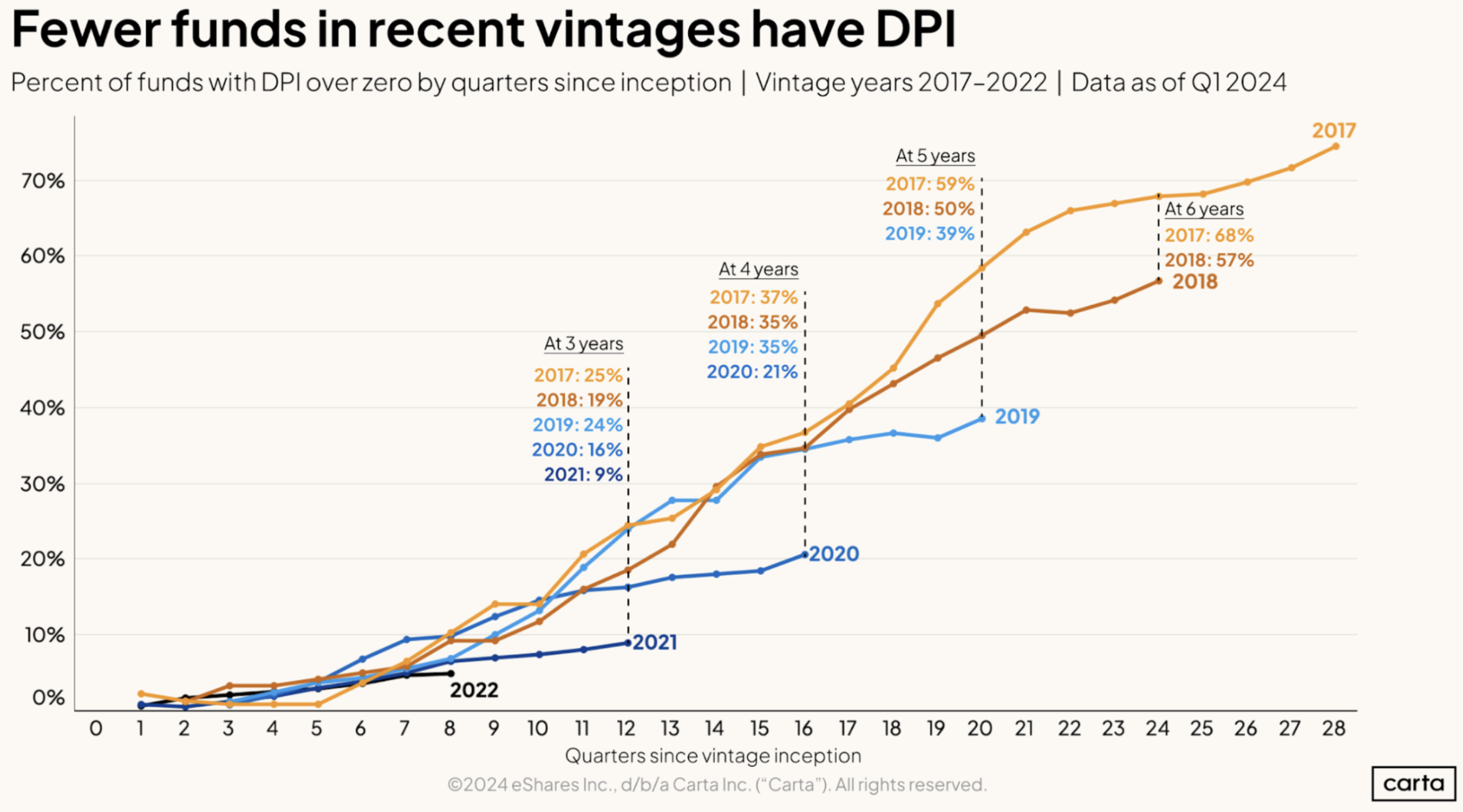
Equity management platform Carta published a detailed report on the state of venture capital through Q1 2024, and the results show that funds launched in 2021 and 2022 are not having a great time. Check these two slides from their report showing median internal rate of return (IRR) and distribution to paid-in capital (DPI) for different vintages over time:
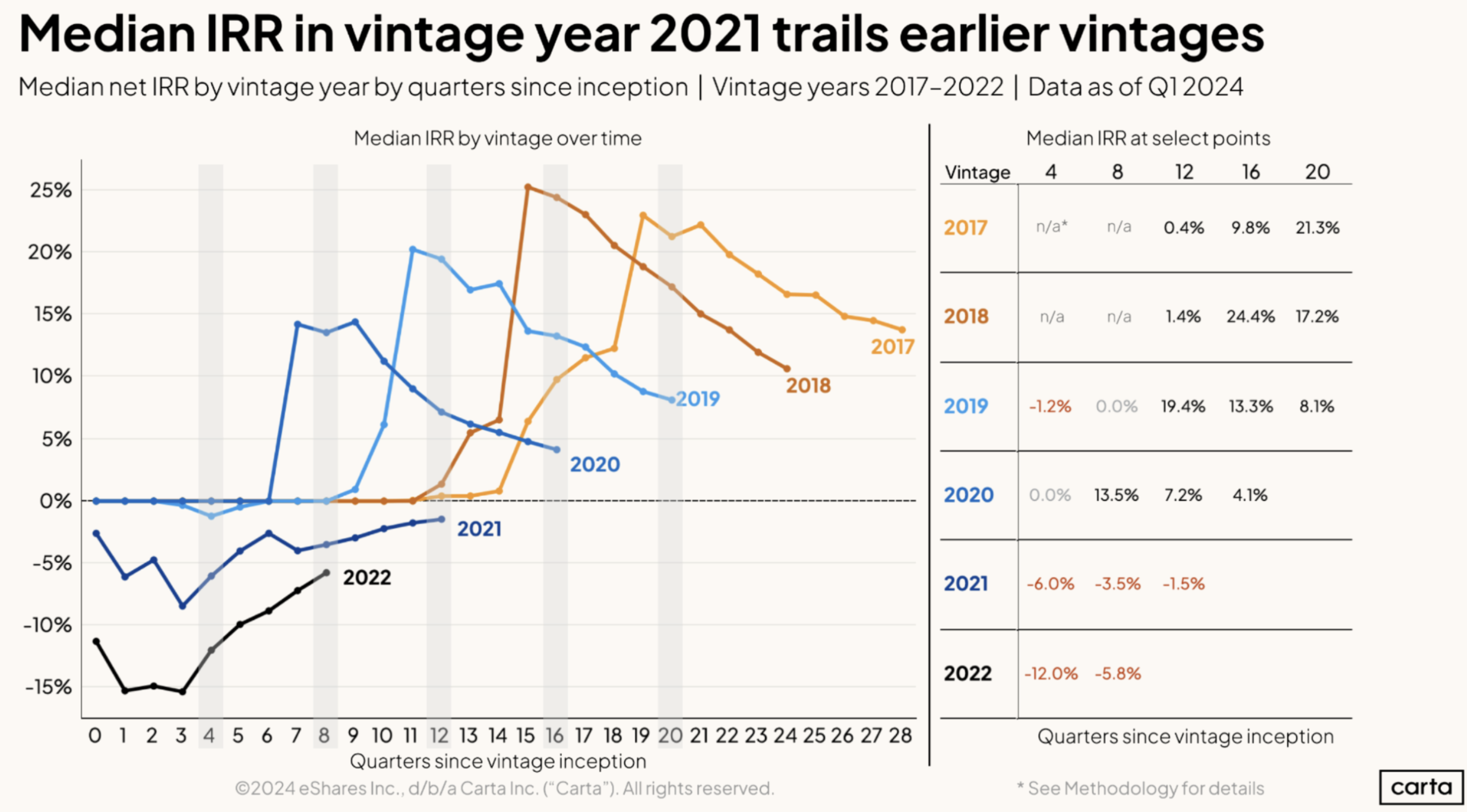
Median IRR Carta
Median DPI Carta

IRR, which is one of the most commonly used performance metrics in venture, measures the returns of a fund while accounting for the time value of cash flows. Through 12 quarters, the median IRR of 2021 funds is negative, while the median IRR for the previous four vintages over the same time period was positive.

The median DPI for 2021 funds is even worse. DPI is the ratio of capital paid out to investors vs. what they invested, and through three years, 2021’s median DPI of 9% is less than half of the median DPI for 2017-2019 funds, and seven percentage points off from 2020.

The TL;DR is that younger funds are underperforming their predecessors by a wide margin.

Why the underperformance, and what does it all mean?

First, the 2021 market was hot, with the exit value in the US VC market hitting a record $797 billion. Thanks to a hot market, it was easier than ever to raise new VC funding, a record $128.3 billion in new venture funding was raised in the US, and 270 first-time funds were launched, the highest number in the last decade.

However, valuations and deal volume collapsed beginning in 2022 as the fed began raising interest rates, with exit value in the US venture market falling from its $797 billion peak in 2021 to just $61.5 billion in 2023. As valuations collapsed, many startups needing new funding were forced to raise down rounds, or funding rounds at lower valuations, and Carta noted that in Q1 2023, almost 20% of all venture investments were down rounds, vs. 5% of deals in 2022.

While funds raised prior to 2021 benefited from high-priced exits in a hot market, funds that launched in 2021 and 2022 have seen their returns struggle as they began deploying capital at market peaks. The biggest losers of this trend are the first-time funds who raised in 2021. While mature firms, who likely exited positions at the market high of 2021, can point to their multi-year track records when raising new funds, first-time venture funds are being judged on their current funds’ performances. Limited partners who invest in first-time venture funds want to see returns before committing to a new fund, and, unless returns improve for 2021 and 2022 funds, many of these first-time funds will struggle to raise new funding in the future.

More Markets

See all Markets
markets

Wendy’s spikes on heightened attention from Reddit’s retail traders

From flipping burgers to being flipped by retail traders:

It seems Wendy’s may now be a meme stock?

Shares are up over 30% in early trading, with the ticker being the most mentioned on the WallStreetBets subreddit over the past 12 hours, per SwaggyStocks.

As of 9:03 a.m. ET, more money had changed hands trading Wendy’s stock in the premarket than Microsoft, Palantir, Apple, Amazon, or Meta.

(I’m no doctor, but I think pairing this with a short-lived meme stock of 2025, Krispy Kreme, could result in negative health outcomes.)

User u/ElegantCombination43 recently tried to stir up support by posting in r/wallstreetbets that redditors “need to save Wendy’s before it’s too late,” adding that “we’ll all be out of a job” if it goes bankrupt.

On Tuesday morning, the fast food chain announced a C-Suite shuffle, hiring Steve Cirulis from Potbelly to serve as chief financial officer and chief strategy officer.

Wendy’s could certainly use a shot in the arm to bolster its operations: trailing 12-month sales and adjusted earnings per share for Wendy’s are flat and lower, respectively, since the end of 2023.

Anyhow, Wendy’s fries are superb and second to none. Don’t @ me.

markets

Google invests $75 million in film studio A24, forms AI partnership

Google is investing roughly $75 million in independent film studio A24 as part of an AI partnership, according the Wall Street Journal. The investment marks Google’s first direct stake in a film studio.

Under the agreement, A24 will work with Google DeepMind to develop and test AI tools for filmmaking and production workflows, the Journal reports.

The deal comes as A24 continues to expand its business beyond indie films into television, music, and live events. Since its 2013 launch, the studio has produced Oscar-winning films such as Everything Everywhere All at Once. Its revenue has more than doubled over the past two years, according to the Journal, and the company was last valued at $3.5 billion in a Thrive Capital-led funding round in 2024.

Google’s investment comes as major technology companies increasingly deepen ties with media companies as generative AI tools become more integrated into creative industries. For Google, the partnership also expands DeepMind’s reach into entertainment and film production.

The firm and TV industry is pushing to develop AI tools that can be integrated into the time-consuming and expensive production process. In a sign of the potential value of such tools, in March, Netflix announced it would acquire Ben Affleck's startup InterPositive, which is building AI film-making tools, for $600 million.

markets

Getty Images surges following OpenAI partnership

Getty Images is surging in early trading after the company announced a multi-year licensing and product partnership with OpenAI.

Under the agreement, OpenAI will license Getty’s library of images, videos, and metadata for use in training and improving its AI models, while Getty will integrate OpenAI’s generative AI tools into its own products and services.

The deal comes as Getty faces growing pressure from generative AI tools that can create stock image-like images in seconds, threatening parts of its traditional licensing business. Getty posted revenue of $226.6 million in Q1, down 2.5% year over year on a currency-neutral basis.

Getty was one of the earliest major content companies to challenge AI firms in court, suing Stability AI in 2023 for allegedly scraping millions of copyrighted images without permission to train image-generation models.

The OpenAI deal follows Getty’s 2025 licensing agreement with Perplexity, which gave the AI search company access to Getty’s library and required image credits with links to original sources.

Before the announcement, Getty shares had been trading below $1 for months. The stock surged by 124% in early trading, erasing its year-to-date losses as investors are waiting to see if Getty can turn its licensed content library into a more valuable AI asset.

Latest Stories

Sherwood Media, LLC and Chartr Limited produce fresh and unique perspectives on topical financial news and are fully owned subsidiaries of Robinhood Markets, Inc., and any views expressed here do not necessarily reflect the views of any other Robinhood affiliate, including Robinhood Markets, Inc., Robinhood Financial LLC, Robinhood Securities, LLC, Robinhood Crypto, LLC, Robinhood Money, LLC, Robinhood U.K. Ltd, Robinhood Derivatives, LLC, Robinhood Gold, LLC, Robinhood Asset Management, LLC, Robinhood Credit, Inc., Robinhood Ventures DE, LLC and, where applicable, its managed investment vehicles.

