
Personal Finance
America food expenditure

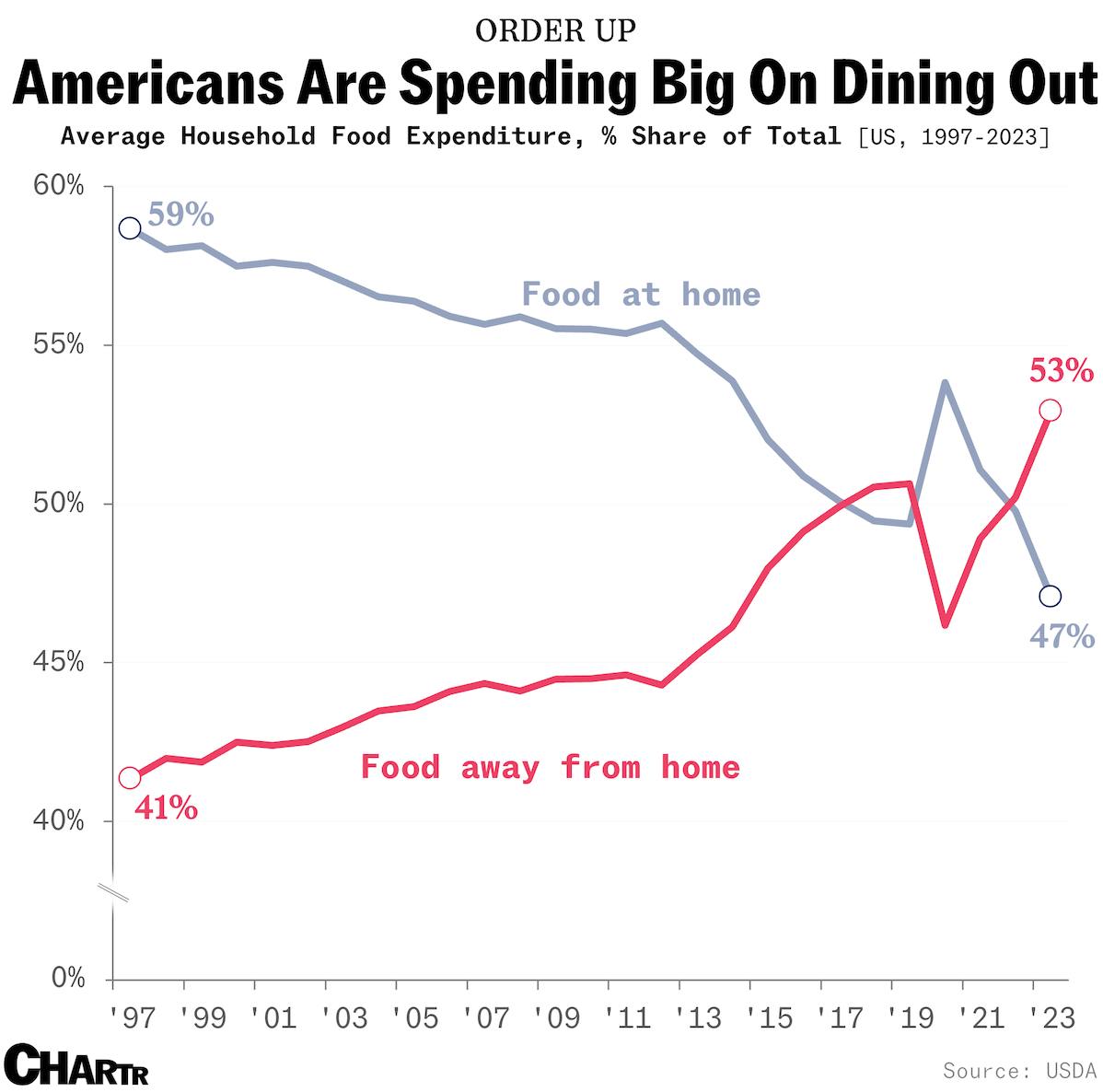
America now spends the majority of its food budget on food away from home

Turning tables

Despite some evidence that the backbone of the American economy, the mighty consumer, could be starting to crack under the weight of inflation, the nation’s restaurant industry remains on track for a record year.

Data out last week from the National Restaurant Association revealed that America’s restaurants — from fine dining to fast food — are set to haul in a total of $1.1 trillion this year, the highest figure on record, a few days later the WSJ reported that the hottest corner of the retail real estate market is the restaurant business.

Those reports underscore one simple fact: America has been dining out more and more, and it's showing no intention of stopping. Indeed, data from the USDA reveals that 53% of household food expenditure is now spent on food away from home, up from 41% in 1997.

That steady shift of about ~12% is associated with so many facets of modern life. The rise of convenience consumption, two-earner households, “foodie” culture, higher incomes, and cheaper and more available fast food have all played their part in America becoming a country that cooks less and eats out more.

On a longer time horizon, another trend is fascinating — America has been spending less of its income on food throughout the 20th century (chart here). But, in the last few years, that has started to tick back up, coinciding with the rise of spending on food away from home. Our takeaway? Food is increasingly an experience that America is willing to splurge on... even when inflation is hurting.

More Personal Finance

See all Personal Finance
personal-finance

Ahead of Mother’s Day, Google searches for “same day flower delivery” have ticked up a little earlier this year

If you’ve already made plans for a Mother’s Day gift in advance of this Sunday, congratulations. But if alarm bells are suddenly ringing, consider this a gentle reminder that, like a sizable share of the US population this time of year often does, you can still scrape together some last-minute flowers for the woman who carried you for nine months.

Data from Google Trends reveals that searches for “same day flower delivery” spike in the US in May every year, when Mother’s Day takes place. As we noted last February, the same query also gains traction around Valentine’s Day.

Flower
Sherwood News

This year, however, it appears that searches for last-minute flowers have remained elevated in the last two months after the usual peak in February — with the search interest this April actually exceeding that seen around Cupid’s Day.

Honestly, we’re not sure why searches are spiking a little early. One explanation might be that Passover and Easter have overlapped at the start of April, and Americans wanted to celebrate with some flowers. Maybe it’s a host of Claude bots that are now running errands for AI-obsessed execs — or perhaps Americans are just impulse-buying some seasonal spring blooms after an unusually warm March, without a particular occasion.

Graduate holding scroll and wearing robe, standing with parents

Which US cities give new grads the best shot in 2026?

The ideal place to start a career might be less about prestige and more about where the paycheck stretches furthest.

Latest Stories

Sherwood Media, LLC and Chartr Limited produce fresh and unique perspectives on topical financial news and are fully owned subsidiaries of Robinhood Markets, Inc., and any views expressed here do not necessarily reflect the views of any other Robinhood affiliate, including Robinhood Markets, Inc., Robinhood Financial LLC, Robinhood Securities, LLC, Robinhood Crypto, LLC, Robinhood Money, LLC, Robinhood U.K. Ltd, Robinhood Derivatives, LLC, Robinhood Gold, LLC, Robinhood Asset Management, LLC, Robinhood Credit, Inc., Robinhood Ventures DE, LLC and, where applicable, its managed investment vehicles.