
Personal Finance
10+ year tenure
Sherwood News

Been at your job for 10+ years? That’s increasingly unusual

Decade-long employment tenures are dying out, as workers move on more quickly.

Despite fears of a slowdown, the US labor market keeps showing signs of resilience, with 254,000 jobs added in September, per the Bureau of Labor Statistics. The odds that any of those new employees will still be at the same employer in a decade, however, are pretty low.

How to lose a job in 10 years

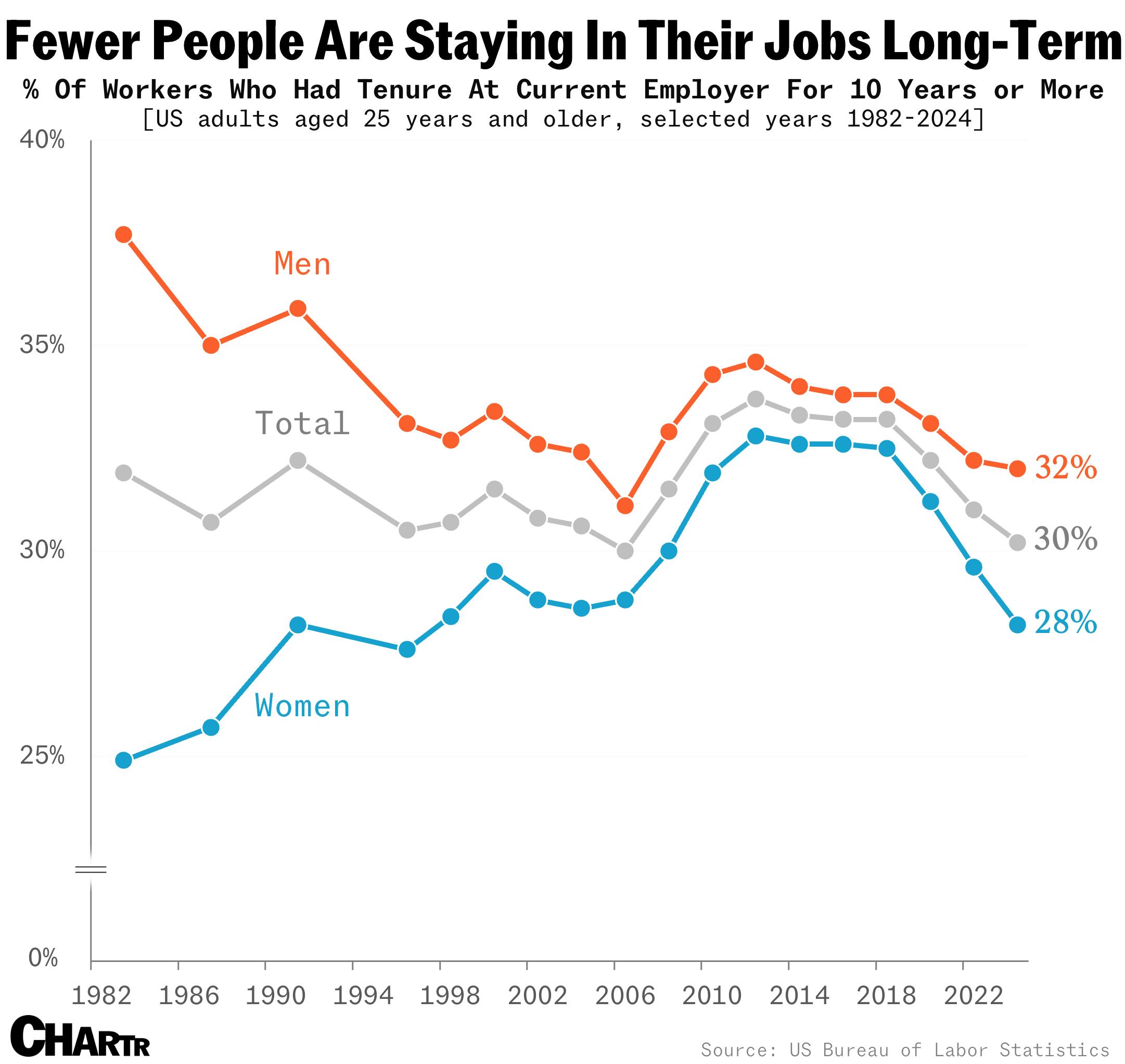
The latest BLS data on employee tenure shows that the number of American adults stepping down from long-term careers is stepping up. In 2024, the total percentage of employees aged 25 years or over who had been with their current employer for 10 years or more fell to just 30.2% — down 3% from only a decade prior.

So, how long should you stick around at a job? There’s no right answer, of course — though Fed data does show that job-movers tend to see better wage gains than job-stayers — but the average is around four years. Indeed, the same report found that the median years of tenure at a current employer was 3.9 years as of January, the lowest figure on record in 22 years.

Indeed, the concept of “a job for life” seems to be increasingly daunting for a generation of employees that like to keep their options open.

Interestingly, while women have historically trailed men in hitting the 10-year work milestone, the downward trend observed in recent years has been steeper for women, having decreased by 4.3% since 2018, compared with just 1.8% for men.

This disparity may have accelerated following the pandemic, when the “Great Resignation” saw a record ~47 million American workers quit their jobs in 2021 alone. Though evidence suggests this unprecedented exodus was years in the making, the immediate social upheaval of COVID-19 led to wide-reaching shifts in both perspective and lifestyle, which saw women, who typically hold more care obligations, quit their jobs at higher rates.

More Personal Finance

See all Personal Finance
personal-finance

Ahead of Mother’s Day, Google searches for “same day flower delivery” have ticked up a little earlier this year

If you’ve already made plans for a Mother’s Day gift in advance of this Sunday, congratulations. But if alarm bells are suddenly ringing, consider this a gentle reminder that, like a sizable share of the US population this time of year often does, you can still scrape together some last-minute flowers for the woman who carried you for nine months.

Data from Google Trends reveals that searches for “same day flower delivery” spike in the US in May every year, when Mother’s Day takes place. As we noted last February, the same query also gains traction around Valentine’s Day.

Flower
Sherwood News

This year, however, it appears that searches for last-minute flowers have remained elevated in the last two months after the usual peak in February — with the search interest this April actually exceeding that seen around Cupid’s Day.

Honestly, we’re not sure why searches are spiking a little early. One explanation might be that Passover and Easter have overlapped at the start of April, and Americans wanted to celebrate with some flowers. Maybe it’s a host of Claude bots that are now running errands for AI-obsessed execs — or perhaps Americans are just impulse-buying some seasonal spring blooms after an unusually warm March, without a particular occasion.

Graduate holding scroll and wearing robe, standing with parents

Which US cities give new grads the best shot in 2026?

The ideal place to start a career might be less about prestige and more about where the paycheck stretches furthest.

Latest Stories

Sherwood Media, LLC and Chartr Limited produce fresh and unique perspectives on topical financial news and are fully owned subsidiaries of Robinhood Markets, Inc., and any views expressed here do not necessarily reflect the views of any other Robinhood affiliate, including Robinhood Markets, Inc., Robinhood Financial LLC, Robinhood Securities, LLC, Robinhood Crypto, LLC, Robinhood Money, LLC, Robinhood U.K. Ltd, Robinhood Derivatives, LLC, Robinhood Gold, LLC, Robinhood Asset Management, LLC, Robinhood Credit, Inc., Robinhood Ventures DE, LLC and, where applicable, its managed investment vehicles.