

Personal Finance
Porcelain Piggy Bank and 2026 Text Sitting on Coin Stack, Over Defocused Wood Background
Getty Images
The K-SHAPED ECONOMY

More Americans are trying “No Spend January” as savings rate hits three-year low

Google searches for the spending freeze hit a new high, as nearly half of Americans say life feels “really expensive.”

Hyunsoo Rim

January can be a hard enough month as it is. For many Americans, a new calendar brings with it freezing weather — like the snowstorms that hit the East Coast over the weekend — a return to work from the festive season, and a mental reset. And some people make it even harder by piling on an extra challenge for the month, swearing off things like alcohol, sugar, or meat. This year, that list has a prominent addition: shopping.

According to a new survey by NerdWallet, more than a quarter of Americans have tried “No Spend January” at least once, pausing all discretionary spending and limiting purchases to essentials like bills and groceries for 31 days. 12% said they started one in 2026, with 44% of respondents saying that “life feels really expensive” right now. 
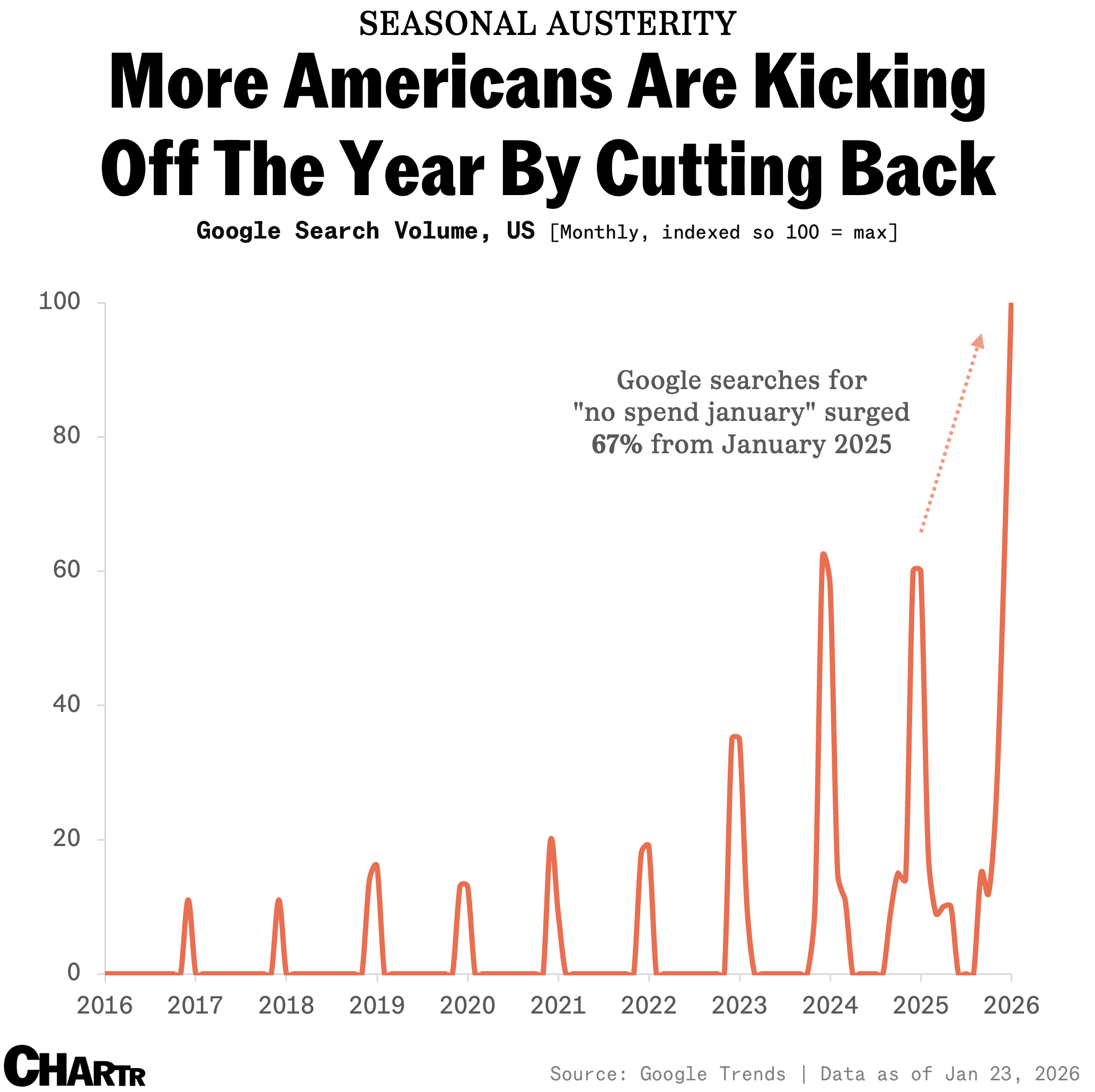
nospendjanuary
Sherwood News

The trend, different from other January resets centered on drinking and dietary changes, has recently gained traction on social media, as Gen Z and millennials increasingly take part in the thrifty challenge. Though not as well known as its alcohol- and meat-free peers, Google search interest for “no spend january” in the US just hit an all-time high, up 67% year on year — growing faster than the 47% increase for “dry january” and the declining search volume for “veganuary.” 

And this might be more than just a performative frugality. Inflation remains elevated, especially for everyday essentials, while hiring has slowed, leaving more consumers financially squeezed. The personal saving rate fell sharply to a three-year low in November, per last week’s data from the Bureau of Economic Analysis — hovering near 2008 levels, aside from the pandemic period.

Spending has held up in aggregate, but largely due to wealthier households, while lower- and middle-income consumers are increasingly drawing down savings or leaning more on debt as income growth slows — the so-called K-shaped economy.

More Personal Finance

See all Personal Finance
personal-finance

Ahead of Mother’s Day, Google searches for “same day flower delivery” have ticked up a little earlier this year

If you’ve already made plans for a Mother’s Day gift in advance of this Sunday, congratulations. But if alarm bells are suddenly ringing, consider this a gentle reminder that, like a sizable share of the US population this time of year often does, you can still scrape together some last-minute flowers for the woman who carried you for nine months.

Data from Google Trends reveals that searches for “same day flower delivery” spike in the US in May every year, when Mother’s Day takes place. As we noted last February, the same query also gains traction around Valentine’s Day.

Flower
Sherwood News

This year, however, it appears that searches for last-minute flowers have remained elevated in the last two months after the usual peak in February — with the search interest this April actually exceeding that seen around Cupid’s Day.

Honestly, we’re not sure why searches are spiking a little early. One explanation might be that Passover and Easter have overlapped at the start of April, and Americans wanted to celebrate with some flowers. Maybe it’s a host of Claude bots that are now running errands for AI-obsessed execs — or perhaps Americans are just impulse-buying some seasonal spring blooms after an unusually warm March, without a particular occasion.

Graduate holding scroll and wearing robe, standing with parents

Which US cities give new grads the best shot in 2026?

The ideal place to start a career might be less about prestige and more about where the paycheck stretches furthest.

Latest Stories

Sherwood Media, LLC and Chartr Limited produce fresh and unique perspectives on topical financial news and are fully owned subsidiaries of Robinhood Markets, Inc., and any views expressed here do not necessarily reflect the views of any other Robinhood affiliate, including Robinhood Markets, Inc., Robinhood Financial LLC, Robinhood Securities, LLC, Robinhood Crypto, LLC, Robinhood Money, LLC, Robinhood U.K. Ltd, Robinhood Derivatives, LLC, Robinhood Gold, LLC, Robinhood Asset Management, LLC, Robinhood Credit, Inc., Robinhood Ventures DE, LLC and, where applicable, its managed investment vehicles.