
Power
Traffic jam in Times Square in New York
(Alexander Spatari/Getty Images)

New York City named America’s worst city for traffic, one day after a congestion charge rolls out to fix that

NYC topped the rankings for gridlock in the US and was 2nd globally, a new report says.

At exactly one second after midnight on Sunday, a long-awaited legend at last cast its spell over New York City. Yes, first proposed back in 2007, congestion pricing has now finally hit Gotham, making it the first city in America to enforce the traffic-disincentivizing fee.

According to NYC’s Metropolitan Transportation Authority, the Congestion Relief Zone will cover “local streets and avenues at or below 60 Street” in Manhattan and charge drivers up to $9 a day to enter the area during peak times.

Despite drawing criticism from several government figures, the MTA estimates that the toll will result in “at least 80,000 fewer vehicles” entering the area every day, though that’s only about 11% of the total traffic that enters central Manhattan on any given weekday. Still, the new legislation should help reduce traffic jams, increase public-transport use, and improve air quality in what is America’s most congested district — and the second-most-congested city globally.
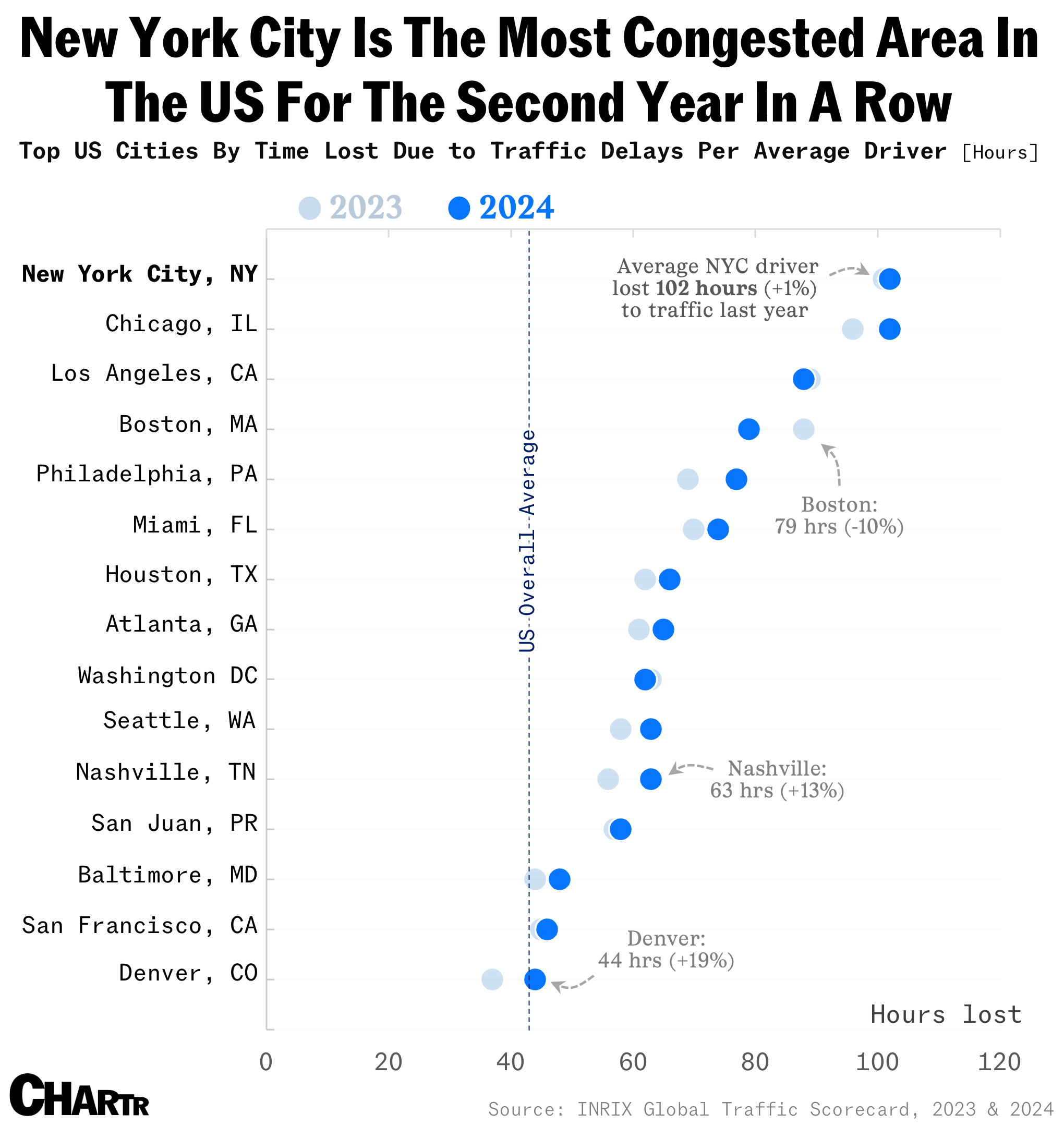
Congested cities
Sherwood News

Indeed, the INRIX Global Traffic Scorecard, conveniently released today, said that the average driver in NYC lost 102 hours to traffic last year — that’s more than four whole days spent sitting in gridlock — equal to Chicago’s traffic-delay times and just shy of the 105 hours recorded for Istanbul.

More Power

See all Power
power
Rani Molla

Pension leaders overseeing more than $1 trillion in assets call SpaceX’s corporate structure “extreme”

SpaceX is gearing up for what is expected to be the biggest IPO in history — a $75 billion raise at a record $1.75 trillion valuation. But some of Wall Street’s biggest whales aren’t happy with the plan.

Leaders from three of the largest US public pension systems — New York State, New York City, and California — sent a letter to CEO Elon Musk on Wednesday, calling out the company’s planned corporate structure as extreme and the “most management-favorable governance structure ever brought to the US public markets at ⁠this scale.”

Among their concerns: Musk’s inviolability since only he can remove himself as CEO, the elimination of class-action lawsuits, and a Texas shield that could require a staggering 3% of outstanding stock just to file a derivative suit.

While the group has requested a meeting with Musk, it’s not clear if the $1 trillion they oversee is enough to force Musk to entertain their demands. These funds may be caught in an index trap.” As passive benchmark trackers, they’ll be forced to buy the stock once it lists, stripping them of any boycott leverage. And with a tiny ~5% float and the expected massive demand from retail and other investors, Musk may be able to ignore a few whales.

power
Rani Molla

Nvidia, Tesla, Apple, Micron CEOs head to China with Trump

Executives from some of America’s biggest companies, including Apple, Tesla, and Boeing, are joining President Trump on his trip to China this week to help facilitate trade and investment between the countries. After a last-minute invite, Nvidia CEO Jensen Huang, who was initially snubbed, is also part of a trip aimed, in part, at resolving a prolonged import-export standoff between China and the US regarding AI and semiconductor technology.

Meta President and Vice Chairman Dina Powell McCormick is also going. Recently China blew up one of Meta’s major AI bets by unwinding the company’s acquisition of AI agent startup Manus.

In a post on Truth Social, Trump said the group was journeying to China to ask President Xi to “‘open up’ China so that these brilliant people can work their magic, and help bring the People’s Republic to an even higher level!”

He added, “I have never seen or heard of any idea that would be more beneficial to our incredible Countries!”

Here’s the full list of company executives, per Reuters:

power
Jake Lahut

Iran discussing US proposal to reopen Strait of Hormuz, cease hostilities for 30 days: NYT

Iranian officials told The New York Times Thursday that they are discussing a one-page proposal with the United States to temporarily reopen the Strait of Hormuz for 30 days and cease hostilities for the same period of time.

The reopening would come in exchange for the US lifting its naval blockade and halting all hostilities for that period, per the Times. The strait would be open to commercial traffic if both sides agree to the deal, according to three Iranian officials who spoke with the NYT.

The US has not yet commented on this specific proposal.

Shortly after news broke of Iranian consideration of the proposal, the US struck oil ports on the island of Qeshm and the coastal city of Bandar Abbas, a US military official told Jennifer Griffin of Fox News. The strikes do not constitute a restarting of the war, the official said.

The reopening would come in exchange for the US lifting its naval blockade and halting all hostilities for that period, per the Times. The strait would be open to commercial traffic if both sides agree to the deal, according to three Iranian officials who spoke with the NYT.

The US has not yet commented on this specific proposal.

Shortly after news broke of Iranian consideration of the proposal, the US struck oil ports on the island of Qeshm and the coastal city of Bandar Abbas, a US military official told Jennifer Griffin of Fox News. The strikes do not constitute a restarting of the war, the official said.

power
Jake Lahut

Ceasefire holds on Tuesday morning following an “exchange of fire” and shipping clashes

The nearly one-month ceasefire in the Middle East was under threat of being shattered, The New York Times reports, after a series of strikes between the US and Iran escalated on Monday. That fragile ceasefire seems to be holding, however, early on Tuesday.

US warships intercepted Iranian cruise missiles aimed at Navy vessels, according to Admiral Brad Cooper, the leader of US Central Command. The US attacked Iranian speedboats in response, per the NYT, and sank six of them, Cooper reported.

On top of the UAE facing a barrage of Iranian missiles and drones the same day, hostilities appeared to be opening up on multiple fronts in the region. Al Jazeera reported one of the strikes hit a key oil facility in the emirate of Fujairah, setting it ablaze.

The BBC reported early Tuesday that Mohammad Ghalibaf, the speaker of Iran’s parliament and a top negotiator in last month’s talks, had written on X: “We know well that the continuation of the status quo is intolerable for America, while we are just getting started.”

Oil prices, by far the strongest and most immediate signal of investor sentiment about the prospect of future clashes, ticked lower on Tuesday morning as reports of attacks diminished and shipping giant Maersk said that one of its ships passed through the Strait of Hormuz under US protection.

US warships intercepted Iranian cruise missiles aimed at Navy vessels, according to Admiral Brad Cooper, the leader of US Central Command. The US attacked Iranian speedboats in response, per the NYT, and sank six of them, Cooper reported.

On top of the UAE facing a barrage of Iranian missiles and drones the same day, hostilities appeared to be opening up on multiple fronts in the region. Al Jazeera reported one of the strikes hit a key oil facility in the emirate of Fujairah, setting it ablaze.

The BBC reported early Tuesday that Mohammad Ghalibaf, the speaker of Iran’s parliament and a top negotiator in last month’s talks, had written on X: “We know well that the continuation of the status quo is intolerable for America, while we are just getting started.”

Oil prices, by far the strongest and most immediate signal of investor sentiment about the prospect of future clashes, ticked lower on Tuesday morning as reports of attacks diminished and shipping giant Maersk said that one of its ships passed through the Strait of Hormuz under US protection.

power
Jake Lahut

US on par for $4.50 per gallon in the next week or 2: GasBuddy

Gas prices shooting up across several Midwestern states is putting the national average on track to hit $4.50 per gallon within the next two weeks, according to GasBuddy’s Patrick De Haan.

In Michigan, the price went from $3.78 a week ago and $4.18 Tuesday to over $4.25 on Wednesday.

Loading...
 

(Event contracts are offered through Robinhood Derivatives, LLC — probabilities referenced or sourced from KalshiEx LLC or ForecastEx LLC.)

Wisconsin, where gas remained below the national average of $4.22 as of Wednesday afternoon, saw a more modest but similar jump up to $3.96 per gallon, according to the American Automobile Association.

De Haan also mentioned Ohio, Indiana, and Illinois in his post on BlueSky as contributing to the surge. Of those states, gas is most expensive in the Land of Lincoln, at $4.52 per gallon.

Loading...
 

(Event contracts are offered through Robinhood Derivatives, LLC — probabilities referenced or sourced from KalshiEx LLC or ForecastEx LLC.)

Wisconsin, where gas remained below the national average of $4.22 as of Wednesday afternoon, saw a more modest but similar jump up to $3.96 per gallon, according to the American Automobile Association.

De Haan also mentioned Ohio, Indiana, and Illinois in his post on BlueSky as contributing to the surge. Of those states, gas is most expensive in the Land of Lincoln, at $4.52 per gallon.

Latest Stories

Sherwood Media, LLC and Chartr Limited produce fresh and unique perspectives on topical financial news and are fully owned subsidiaries of Robinhood Markets, Inc., and any views expressed here do not necessarily reflect the views of any other Robinhood affiliate, including Robinhood Markets, Inc., Robinhood Financial LLC, Robinhood Securities, LLC, Robinhood Crypto, LLC, Robinhood Money, LLC, Robinhood U.K. Ltd, Robinhood Derivatives, LLC, Robinhood Gold, LLC, Robinhood Asset Management, LLC, Robinhood Credit, Inc., Robinhood Ventures DE, LLC and, where applicable, its managed investment vehicles.