
Power
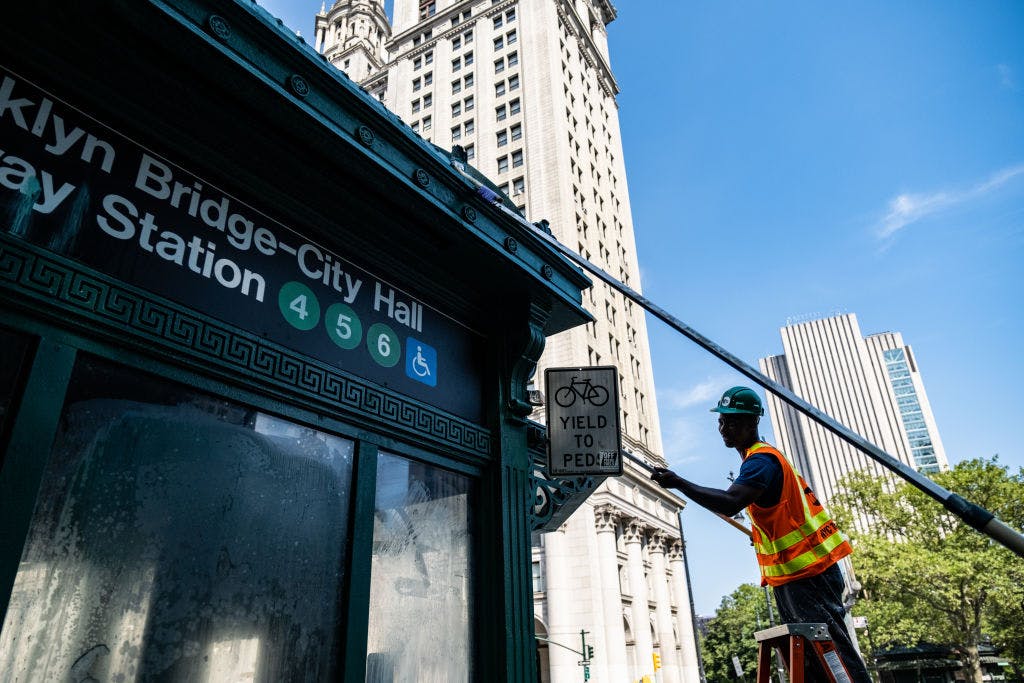
Worker painting subway entrance
(Photo by Jeenah Moon/Getty Images)

The MTA is under pressure to spend big on New York’s infrastructure

A report suggests the bill could be around $115 billion

The Metropolitan Transportation Authority (MTA) is under a lot of pressure at the moment, and not just from disgruntled New Yorkers who’ve suffered another hellish commute. The authority will declare its capital budget for the 2025-2029 period by October 1, and two separate reports have called on the agency to cough up as much as $115 billion over 5 years to get NY’s public transport back on track.

The $115 billion estimate comes from the Citizens Budget Commission (CBC), an independent fiscal watchdog. Meanwhile, a report from the state comptroller Thomas DiNapoli last week suggested that the MTA needs anywhere between $57.8 billion and $92.2 billion to cover the costs of replacing old units, expanding the network, and improving accessibility — or (as the president of the CBC put it) “the basics”. Both analyses suggested that the MTA could struggle to meet those financial thresholds, even with potential revenue from New York’s paused congestion pricing plan taken into account.

Travel money

For the 2020-2024 Capital Program, which was approved shortly before Covid struck the US in earnest, the MTA pledged to invest nearly $55 billion into the region’s subways, buses, railroads, and bridges/tunnels.
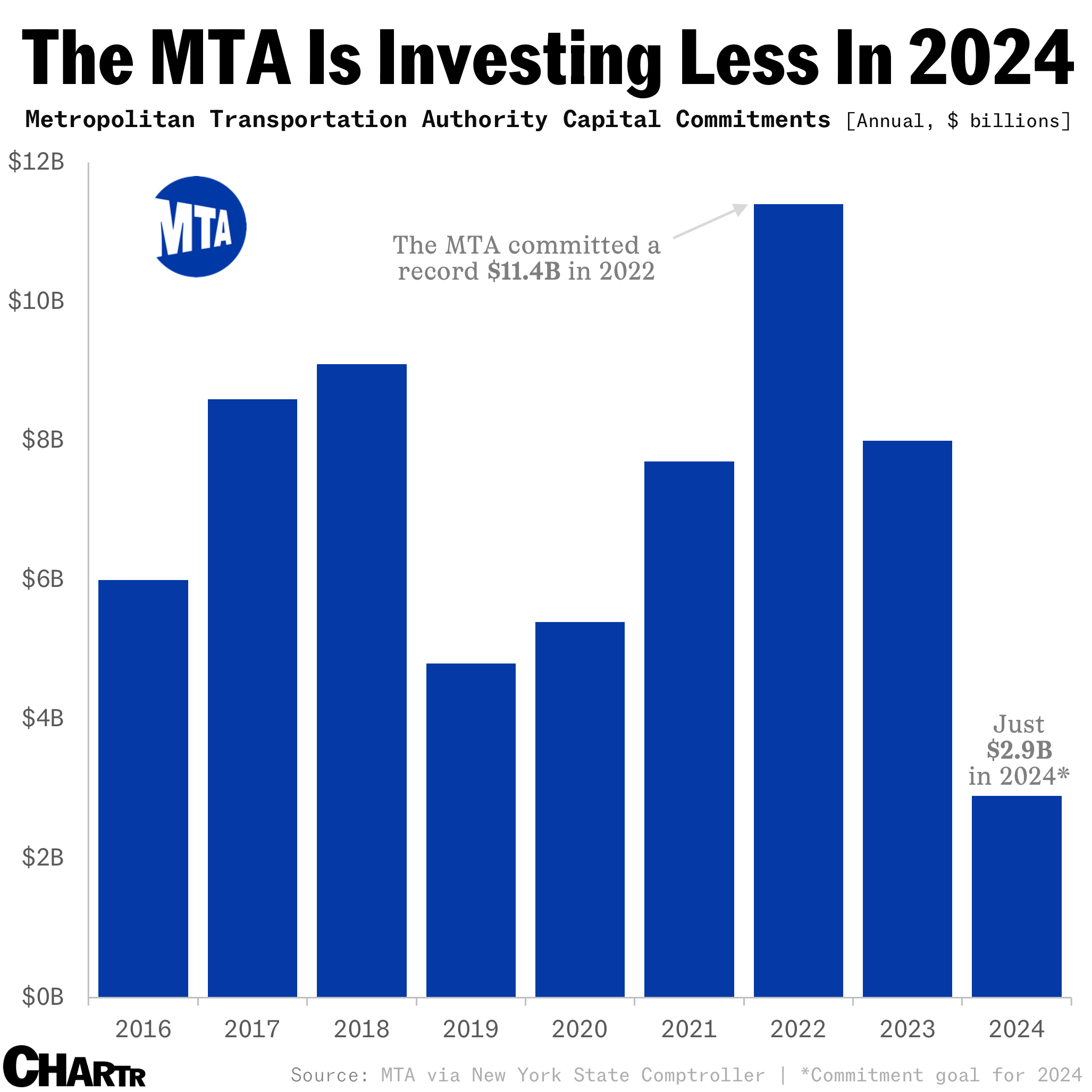
MTA capital commitments
Sherwood News

According to the authority’s capital commitment figures in the years since, however, it will have fallen short of that target by the time it publishes plans for the coming period next month.

Despite committing a record $11.4 billion in 2022 to revamp some of the busiest transit systems in the Western world, the MTA’s spending has slumped in the years since, dropping to $8 billion in 2023, and just $2.9 billion planned for this year. Interestingly, the agency reportedly claimed that the 2024 goal would have been $12 billion, were it not for pending litigation around the now-halted congestion pricing.

Meeting budget might be even harder in the post-pandemic world too. Indeed, passenger usage of New York City’s public transport remains subdued relative to pre-2020: subway daily ridership was just over the 3 million mark last week, nowhere near the 5+ million in 2019.
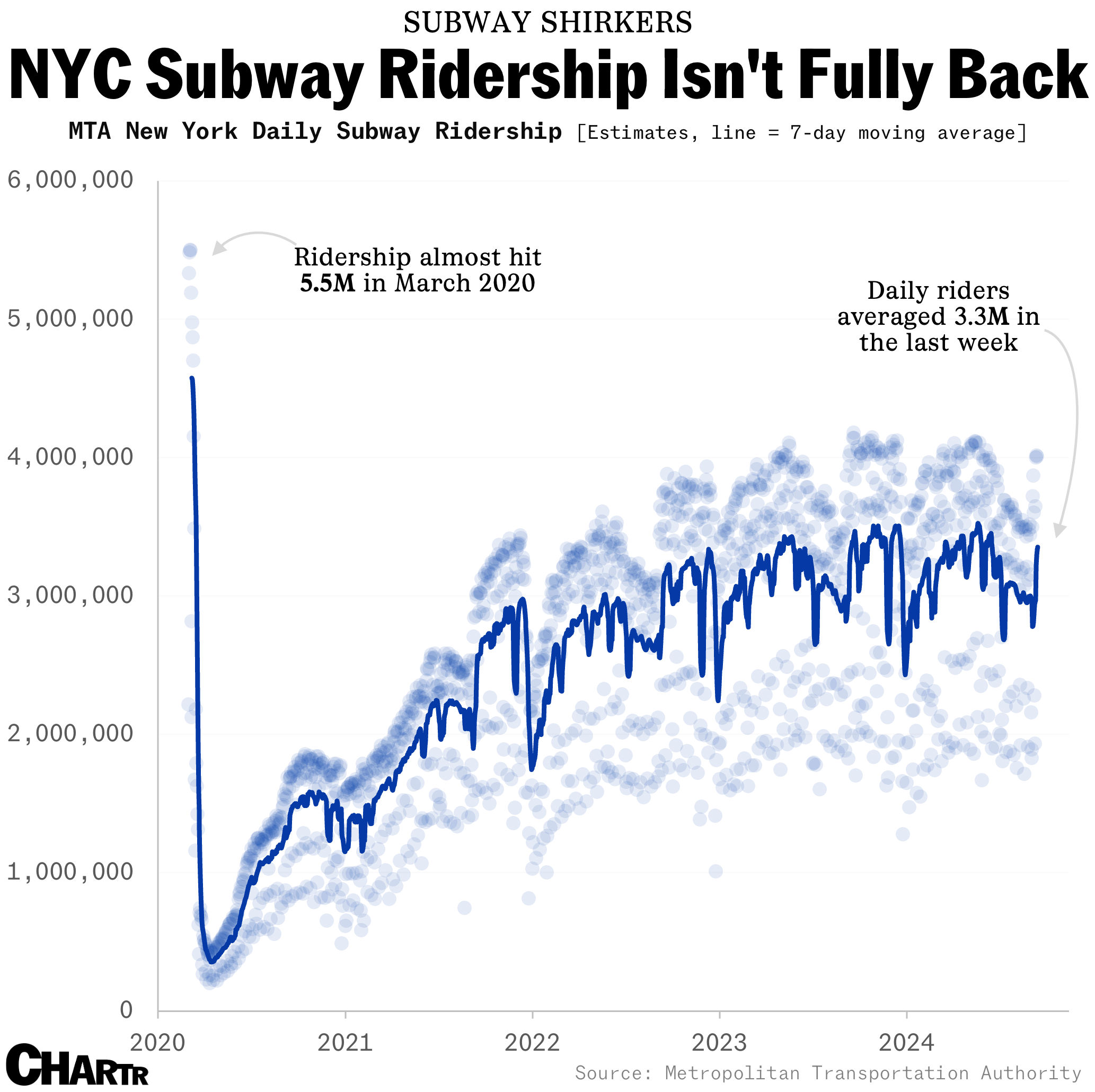

Subway ridership data
Sherwood News

More Power

See all Power
power
Jake Lahut

US launches another round of strikes on Iran, the second in 24 hours

In a familiar pattern, the US has begun launching new strikes on Iran Wednesday, on top of retaliatory strikes from Tuesday after Iran struck three ships crossing through the Strait of Hormuz using missiles and drones.

“The United States is holding Iran accountable for recent unjustified aggression against commercial shipping and civilian crews freely navigating a vital international waterway," US Central Command wrote in a statement, according to the Wall Street Journal.

Explosions were heard in Bandar Abbas and Sirik, which the US targeted in the earlier strikes, according to WSJ.

This marks the second round of strikes in the last 24 hours, putting the eight-week ceasefire on life support after President Donald Trump said he sees the preliminary deal as "over."

Sen. Jeanne Shaheen (D-NH), the top Democrat on the Senate Foreign Relations Committee, said in a statement that the latest round of strikes mark a "dangerous escalation," and that "our country is stuck in limbo with the very real possibility of further conflict and the prospect of even higher energy prices and increased inflation."

In a post on Truth Social, President Trump said the strikes were "in retribution for yesterday’s bombing of ships by Iran. If it happens again, it will get much worse!"

Explosions were heard in Bandar Abbas and Sirik, which the US targeted in the earlier strikes, according to WSJ.

This marks the second round of strikes in the last 24 hours, putting the eight-week ceasefire on life support after President Donald Trump said he sees the preliminary deal as "over."

Sen. Jeanne Shaheen (D-NH), the top Democrat on the Senate Foreign Relations Committee, said in a statement that the latest round of strikes mark a "dangerous escalation," and that "our country is stuck in limbo with the very real possibility of further conflict and the prospect of even higher energy prices and increased inflation."

In a post on Truth Social, President Trump said the strikes were "in retribution for yesterday’s bombing of ships by Iran. If it happens again, it will get much worse!"

power

WSJ: DOJ approved the Paramount-Warner Bros. deal even as investigators were leaning toward suing to stop it

The Justice Department’s approval of Paramount’s $111 billion acquisition of rival Warner Bros. Discovery Friday came as a surprise to the agency’s antitrust investigators, according to Wall Street Journal reporting.

Per the WSJ, a team of lawyers who’d scrutinized the merger were leaning toward recommending a lawsuit to block the deal, but hadn’t gotten to make their final recommendation, before they were told that it had been approved on Friday.

Antitrust investigators typically make a final recommendation to the agency in the review process — and that recommendation is often followed by the agency — but that step was reportedly skipped in this instance. Last month, Semafor reported that senior DOJ antitrust officials appeared likely to approve the Paramount-WBD combo.

The deal could still face antitrust challenges from a collection of states led by California, and EU regulators.

Per the WSJ, a team of lawyers who’d scrutinized the merger were leaning toward recommending a lawsuit to block the deal, but hadn’t gotten to make their final recommendation, before they were told that it had been approved on Friday.

Antitrust investigators typically make a final recommendation to the agency in the review process — and that recommendation is often followed by the agency — but that step was reportedly skipped in this instance. Last month, Semafor reported that senior DOJ antitrust officials appeared likely to approve the Paramount-WBD combo.

The deal could still face antitrust challenges from a collection of states led by California, and EU regulators.

power
Jake Lahut

Strait of Hormuz is closed to all oil tankers and commercial ships, Iran military says

In retaliation to US strikes, the Islamic Republic of Iran announced that the Strait of Hormuz is fully closed as of early Thursday morning in Tehran. The attacks from the US were separate from a series of retaliatory drone and missile launches overnight Tuesday into Wednesday.

President Donald Trump told Fox News in a phone interview on Wednesday night that “the bombing will stop soon,” but if Iran doesn’t sign the agreement put forward by special envoys Steve Witkoff and Jared Kushner, “we’ll bomb the shit out of them tomorrow night.”

When asked whether the ceasefire still stands, Trump described it as “the most violated ceasefire in the history of the world,” per Fox News.

According to Al Jazeerah, Iran’s Mehr news agency reported that Iran’s joint military command specified that any oil tankers or other commercial vessels will be attacked if they attempt to cross the strait.

This is the second day in a row hostilities have resumed to a level not seen since the early April ceasefire was announced.

US CENTCOM announced the series of strikes beginning at 5:15 p.m. ET on Wednesday, which Secretary of Defense Pete Hegseth previewed in on-camera remarks, promising to “strike ’em hard tonight” before later saying he would not broadcast whether the military would take any action.

Shortly after the announcement on the closure of the Strait of Hormuz to all commercial vessel traffic, Iranian state media reported that two ships attempting to cross were attacked.

This story is developing.

President Donald Trump told Fox News in a phone interview on Wednesday night that “the bombing will stop soon,” but if Iran doesn’t sign the agreement put forward by special envoys Steve Witkoff and Jared Kushner, “we’ll bomb the shit out of them tomorrow night.”

When asked whether the ceasefire still stands, Trump described it as “the most violated ceasefire in the history of the world,” per Fox News.

According to Al Jazeerah, Iran’s Mehr news agency reported that Iran’s joint military command specified that any oil tankers or other commercial vessels will be attacked if they attempt to cross the strait.

This is the second day in a row hostilities have resumed to a level not seen since the early April ceasefire was announced.

US CENTCOM announced the series of strikes beginning at 5:15 p.m. ET on Wednesday, which Secretary of Defense Pete Hegseth previewed in on-camera remarks, promising to “strike ’em hard tonight” before later saying he would not broadcast whether the military would take any action.

Shortly after the announcement on the closure of the Strait of Hormuz to all commercial vessel traffic, Iranian state media reported that two ships attempting to cross were attacked.

This story is developing.

power
Jake Lahut

United States and Iran trade retaliatory strikes, escalating war and rattling ceasefire

The war in Iran is heating back up. Overnight, both sides have been trading hostilities in a series of retaliations to other retaliations.

It marks the most robust escalation in combat since the April 8 ceasefire announcement.

Oil prices were little changed, with Brent crude futures down 0.48% as of 5:30 a.m. ET. At the same time, S&P 500 futures were down nearly 0.7% and the tech-heavy Nasdaq Composite had slipped 1.18%, as the escalations compounded a broader AI sell-off.

Travel stocks, like United Airlines and Royal Caribbean, which got a boost on Tuesday as oil prices fell, lost some of those gains in premarket trading. Meanwhile, oil giants such as Chevron and Exxon ticked higher and chipmakers such as Arm Holdings and Micron continued to slip.

The escalation ladder began ratcheting back up when Iran shot down an American helicopter with a drone while it was patrolling the Strait of Hormuz, a US official told NBC News. US forces then conducted strikes in Iran’s Qeshm Island, Sirik, Jask, and Bandar Abbas, according to Al Jazeera. In response, Iran attacked a US fleet in Bahrain, Al Jazeera also reported.

“The Iranians are trying to make clear that any attack on them would be responded to, regardless of the size and the scope,” Trita Parsi of the Quincy Institute for Responsible Statecraft in the US told Al Jazeera. “Now, of course, whether they are seeking to escalate the situation or de-escalate remains to be seen, and it will be very much measured by how they calibrated their response by attacking these US bases.”

The scope of the strikes and counterstrikes broadened out as of early Wednesday morning in Iran. Kuwait activated its air defense systems to intercept strikes, its army announced.

Mohamed Vall, a reporter for Al Jazeera reporting from inside Iran, described “a lot of activity in terms of air defence by the Iranians, and they talked about the downing of a helicopter, an American MQ-9 [drone] over Bushehr. So that gives you an idea about the scope of these attacks and counterattacks, or these retaliations across the Strait of Hormuz and the Gulf region tonight.”

Iran’s IRGC also reported targeting a hangar for American F-35 jets in Jordan, Al Jazeera reported.

Oil prices were little changed, with Brent crude futures down 0.48% as of 5:30 a.m. ET. At the same time, S&P 500 futures were down nearly 0.7% and the tech-heavy Nasdaq Composite had slipped 1.18%, as the escalations compounded a broader AI sell-off.

Travel stocks, like United Airlines and Royal Caribbean, which got a boost on Tuesday as oil prices fell, lost some of those gains in premarket trading. Meanwhile, oil giants such as Chevron and Exxon ticked higher and chipmakers such as Arm Holdings and Micron continued to slip.

The escalation ladder began ratcheting back up when Iran shot down an American helicopter with a drone while it was patrolling the Strait of Hormuz, a US official told NBC News. US forces then conducted strikes in Iran’s Qeshm Island, Sirik, Jask, and Bandar Abbas, according to Al Jazeera. In response, Iran attacked a US fleet in Bahrain, Al Jazeera also reported.

“The Iranians are trying to make clear that any attack on them would be responded to, regardless of the size and the scope,” Trita Parsi of the Quincy Institute for Responsible Statecraft in the US told Al Jazeera. “Now, of course, whether they are seeking to escalate the situation or de-escalate remains to be seen, and it will be very much measured by how they calibrated their response by attacking these US bases.”

The scope of the strikes and counterstrikes broadened out as of early Wednesday morning in Iran. Kuwait activated its air defense systems to intercept strikes, its army announced.

Mohamed Vall, a reporter for Al Jazeera reporting from inside Iran, described “a lot of activity in terms of air defence by the Iranians, and they talked about the downing of a helicopter, an American MQ-9 [drone] over Bushehr. So that gives you an idea about the scope of these attacks and counterattacks, or these retaliations across the Strait of Hormuz and the Gulf region tonight.”

Iran’s IRGC also reported targeting a hangar for American F-35 jets in Jordan, Al Jazeera reported.

power

New York legislature passes 1-year data center moratorium

The New York state legislature has passed a one-year ban on large data centers in the state.

The bill now heads to Gov. Kathy Hochul’s desk, where it faces an uncertain fate. If Hochul signs the bill, it would become the first such statewide ban to succeed in becoming law.

That’s far from certain, as Hochul has opposed state-level legislation over data centers. In May, Hochul said, “This is a local decision for municipalities, its land use, which is the purview of local governments. It’s not a statewide approach necessarily, but its something Im looking at intensely.”

In April, Maine Gov. Janet Mills vetoed a similar statewide moratorium on data centers.

Opposition to data centers is growing rapidly across the US. A federal data center moratorium bill was introduced in March, and at least 14 states have proposed pauses on data center construction, according to the National Conference of State Legislatures.

That’s far from certain, as Hochul has opposed state-level legislation over data centers. In May, Hochul said, “This is a local decision for municipalities, its land use, which is the purview of local governments. It’s not a statewide approach necessarily, but its something Im looking at intensely.”

In April, Maine Gov. Janet Mills vetoed a similar statewide moratorium on data centers.

Opposition to data centers is growing rapidly across the US. A federal data center moratorium bill was introduced in March, and at least 14 states have proposed pauses on data center construction, according to the National Conference of State Legislatures.

Latest Stories

Sherwood Media, LLC and Chartr Limited produce fresh and unique perspectives on topical financial news and are fully owned subsidiaries of Robinhood Markets, Inc., and any views expressed here do not necessarily reflect the views of any other Robinhood affiliate, including Robinhood Markets, Inc., Robinhood Financial LLC, Robinhood Securities, LLC, Robinhood Crypto, LLC, Robinhood Money, LLC, Robinhood U.K. Ltd, Robinhood Derivatives, LLC, Robinhood Gold, LLC, Robinhood Asset Management, LLC, Robinhood Credit, Inc., Robinhood Ventures DE, LLC and, where applicable, its managed investment vehicles.