
Power
Businessman on Wall St
Getty Images
MORE MORE MORE

Wall Street bonuses surged to a record-high $47.5 billion for 2024

In New York’s financial district, 2024 was yet another year when money never slept.

Millie Giles

Those of you that have just received your annual company bonus will be pleased to hear that this payout season was a particularly happy one for NYC’s high-flying securities industry execs, marking another big win for some of America’s biggest earners.

Bloomberg reported new estimates from New York State Comptroller Thomas DiNapoli on Wednesday, which showed that Wall Street’s bonus pot ballooned in 2024, totaling a record $47.5 billion — the largest its been in nominal dollars since at least 1987, when records began.

The estimates, based on trends in personal income tax withholdings, suggest that the average annual cash payout was a record-high $244,700, up by almost a third from 2023... though, when adjusted for inflation, the $191,400 bonus paid out in 2006 would be worth over $307,000 today, according to CNN.
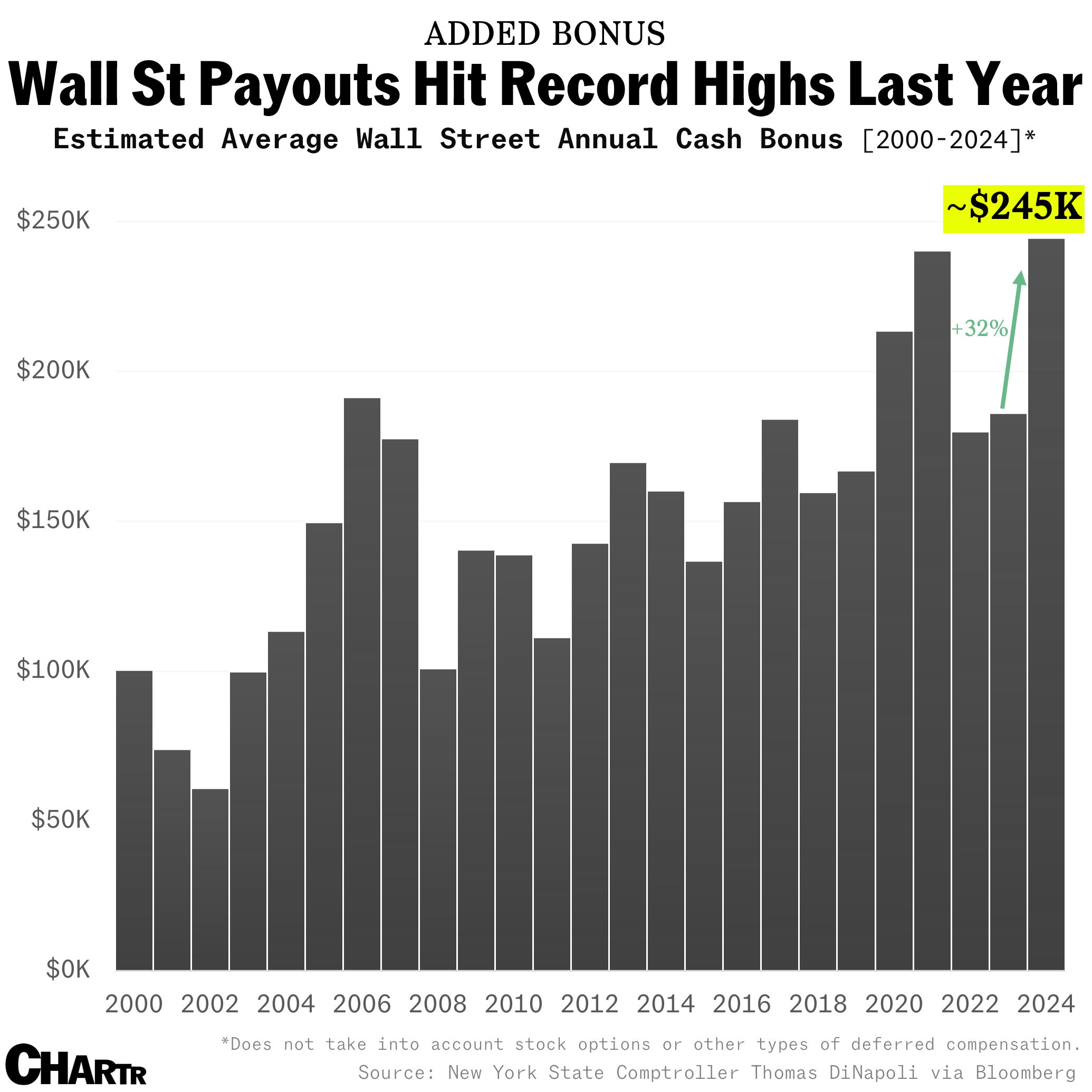
Wall Street bonuses hit record high 2024
Sherwood News

These bumper bonuses come after Wall Street's very strong performance in 2024, with profits at the 131 New York Stock Exchange member firms surging more than 90% last year. Despite the fact that New York now makes up a smaller share of America’s securities industry overall, DiNapoli reported that 1 in 11 jobs in the city are estimated to be tied to securities, either directly or indirectly. 

Rich people getting richer aside, DiNapoli outlined in a statement that the bonuses indicate the strength of the financial market, calling it “good news for New York’s economy and [its] fiscal position, which relies on the tax revenue it generates.”

Per Bloomberg, Wall Street accounted for 19% of New York’s state tax revenue from 2023-24.

More Power

See all Power
EU Commission Vice-President Virkkunen and Commissioner Jorgensen hold press conference

EU proposes “tech sovereignty package” to bolster domestic AI and chip industries

Europe is hastening its breakup with US tech as the Trump administration’s grip on American tech companies tightens.

power

White House releases watered-down executive order on AI

The White House released a weakened executive order on AI on Tuesday, a little more than a week after killing a previous version of the order after what was reportedly intense, direct lobbying of the Oval Office by tech executives.

The order’s most significant change to what was reported in late May is a shortened window of voluntary government review of new models from 90 days to 30 days.

After Anthropic’s Mythos model spooked companies and governments around the world, the White House was reportedly ready to respond with an executive order that would have given the government access to unreleased frontier models for up to 90 days before public release, to ensure safety.

Top AI companies were briefed on the proposed executive order, and a White House event with an extensive roster of tech executives was ready to go, but it was killed at the last minute, according to reports. Axios reported that last-minute lobbying by former White House AI and Crypto Czar David Sacks, along with other tech executives, helped convince President Trump to kill the order. Trump told reporters, “I didn’t like certain aspects of it. I postponed it.”

The now finalized order calls for the creation of an “AI cybersecurity clearinghouse” in concert with the AI industry, and directs national security agencies to develop and maintain a “classified benchmarking process” to review the capabilities of new frontier models.

After Anthropic’s Mythos model spooked companies and governments around the world, the White House was reportedly ready to respond with an executive order that would have given the government access to unreleased frontier models for up to 90 days before public release, to ensure safety.

Top AI companies were briefed on the proposed executive order, and a White House event with an extensive roster of tech executives was ready to go, but it was killed at the last minute, according to reports. Axios reported that last-minute lobbying by former White House AI and Crypto Czar David Sacks, along with other tech executives, helped convince President Trump to kill the order. Trump told reporters, “I didn’t like certain aspects of it. I postponed it.”

The now finalized order calls for the creation of an “AI cybersecurity clearinghouse” in concert with the AI industry, and directs national security agencies to develop and maintain a “classified benchmarking process” to review the capabilities of new frontier models.

power

Sen. Bernie Sanders: US government should own half of big AI companies in an “American AI Sovereign Wealth Fund”

Anti-AI sentiment appears to be on the rise — commencement speakers being booed at the mention of AI, local officials losing their jobs over support for data center deals, and public polling showing a continued unease surrounding AI use.

Senator Bernie Sanders (I-Vt.) knows how to read the room.

In an op-ed in The New York Times today, Sanders makes the case that today’s leading AI models were built using public works without permission or compensation:

“When a public resource generates wealth, the public should share in that wealth. A.I. is being built on a public resource far more valuable than oil: the accumulated knowledge, creativity and labor of mankind.”

Sanders plans on introducing legislation to create the “American AI Sovereign Wealth Fund.” This unusual proposal would issue a one-time tax of 50% of the big AI companies — such as OpenAI and Anthropic — paid to the US government in the form of stock. The fund would provide direct payments to Americans as it grows, much like Alaska’s “permanent fund,” which issues checks to its residents from 25% of all oil and mineral leases and sales.

While the idea of just handing over half of OpenAI or Anthropic to Uncle Sam sounds crazy, Sanders points out that AI leaders have been suggesting similar ideas recently as a potential solution to massive labor shifts caused by AI that could eliminate whole categories of jobs.

Additionally, President Trump has already signed an executive order to create a plan for a sovereign wealth fund. Trump has also been keen on the US getting a piece of the action, directing the US government to take public stakes in Intel, MP Materials, Lithium Americas, and Trilogy Metals.

Sanders also argues the public’s large stakes in these companies would give American taxpayers a seat at the table to “block decisions that hurt our citizens and to push for policies that help them.”

In an op-ed in The New York Times today, Sanders makes the case that today’s leading AI models were built using public works without permission or compensation:

“When a public resource generates wealth, the public should share in that wealth. A.I. is being built on a public resource far more valuable than oil: the accumulated knowledge, creativity and labor of mankind.”

Sanders plans on introducing legislation to create the “American AI Sovereign Wealth Fund.” This unusual proposal would issue a one-time tax of 50% of the big AI companies — such as OpenAI and Anthropic — paid to the US government in the form of stock. The fund would provide direct payments to Americans as it grows, much like Alaska’s “permanent fund,” which issues checks to its residents from 25% of all oil and mineral leases and sales.

While the idea of just handing over half of OpenAI or Anthropic to Uncle Sam sounds crazy, Sanders points out that AI leaders have been suggesting similar ideas recently as a potential solution to massive labor shifts caused by AI that could eliminate whole categories of jobs.

Additionally, President Trump has already signed an executive order to create a plan for a sovereign wealth fund. Trump has also been keen on the US getting a piece of the action, directing the US government to take public stakes in Intel, MP Materials, Lithium Americas, and Trilogy Metals.

Sanders also argues the public’s large stakes in these companies would give American taxpayers a seat at the table to “block decisions that hurt our citizens and to push for policies that help them.”

power

US regulators reportedly appear likely to approve Paramount’s Warner Bros. acquisition

US antitrust regulators appear to be leaning toward approval of Paramount’s $110 billion acquisition of rival Warner Bros. Discovery, according to a Semafor report.

The DOJ’s apparent positive analysis of the Hollywood megamerger follows a Tuesday meeting between Paramount CEO David Ellison and DOJ staffers including acting antitrust chief Omeed Assefi.

Per Semafor, that meeting included a significant number of questions about the would-be streaming giant’s theatrical release priorities. Ellison has pledged to release a “minimum” of 30 films for theaters between Paramount and WBD upon completion of the merger, and to maintain a 45-day theatrical window for films, followed by a three-month SVOD (digital rent or purchase) period before they land on Paramount+.

The DOJ has not yet approved the merger, and the agency’s current apparent analysis could shift.

It’s unclear what other topics were discussed at Tuesday’s meeting. Hollywood insiders critical of a Warner Bros. acquisition have also highlighted that any merger decreasing the number of content buyers would squeeze an already depressed entertainment labor market.

Per Semafor, that meeting included a significant number of questions about the would-be streaming giant’s theatrical release priorities. Ellison has pledged to release a “minimum” of 30 films for theaters between Paramount and WBD upon completion of the merger, and to maintain a 45-day theatrical window for films, followed by a three-month SVOD (digital rent or purchase) period before they land on Paramount+.

The DOJ has not yet approved the merger, and the agency’s current apparent analysis could shift.

It’s unclear what other topics were discussed at Tuesday’s meeting. Hollywood insiders critical of a Warner Bros. acquisition have also highlighted that any merger decreasing the number of content buyers would squeeze an already depressed entertainment labor market.

President Trump Hosts Crypto Summit At The White House

Report: White House AI oversight executive order DOA

After weeks of uncertainty, the White House’s plan to review frontier models before release appears dead.

Jon Keegan5/22/26

Latest Stories

Sherwood Media, LLC and Chartr Limited produce fresh and unique perspectives on topical financial news and are fully owned subsidiaries of Robinhood Markets, Inc., and any views expressed here do not necessarily reflect the views of any other Robinhood affiliate, including Robinhood Markets, Inc., Robinhood Financial LLC, Robinhood Securities, LLC, Robinhood Crypto, LLC, Robinhood Money, LLC, Robinhood U.K. Ltd, Robinhood Derivatives, LLC, Robinhood Gold, LLC, Robinhood Asset Management, LLC, Robinhood Credit, Inc., Robinhood Ventures DE, LLC and, where applicable, its managed investment vehicles.