Tech
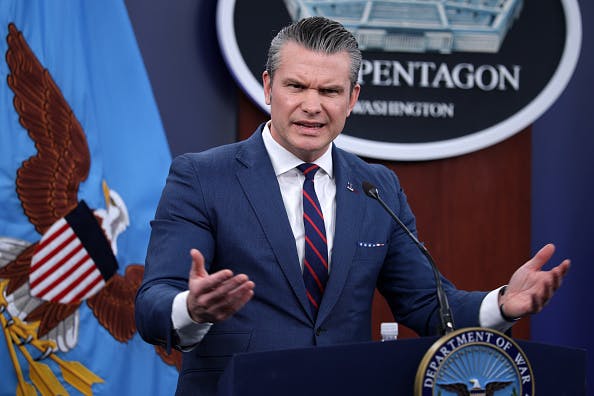
Secretary Hegseth And Chairman Caine Hold Pentagon Press Briefing On Iran Strikes
(Alex Wong/Getty Images)

A blow-by-blow catch-up on how Trump vs. Anthropic has unfolded

A consequential week punctuated by war highlights the deep rifts that exist between Silicon Valley and Washington.

Last week’s tense standoff between Anthropic and Defense Secretary Pete Hegseth focused on the issue of how the startup’s AI could be hypothetically used to surveil Americans or kill people. By the weekend, that hypothetical scenario became very real.

Tensions started after a tense meeting at the Pentagon, which resulted in Hegseth giving Anthropic CEO Dario Amodei an ultimatum: he had until Friday at 5:01 p.m. ET to get onboard with the Pentagon’s demands for full use of Claude for any legal purpose, or face the consequences. Here’s a quick timeline of how this fast-moving story unfolded:

  • Thursday 5:36 p.m. ET - Anthropic posted a statement from Amodei that the company will not acquiesce to Pentagon demands to allow the use of its Claude tool for any legal purpose.

  • Friday 3:47 p.m. ET - President Trump lashed out at the startup, calling it a “RADICAL LEFT, WOKE COMPANY,” and said he was directing all federal agencies to cease use of Anthropic’s software.

  • Friday 5:14 p.m. ET - In a post on X, Hegseth chided Anthropic’s refusal, and in an extraordinary move, said he would move to designate Anthropic “a Supply-Chain Risk to National Security,” effectively blacklisting the company’s tech from use by the US military or any contractors (like Palantir) working with the Pentagon on national security applications.

  • Friday 8:24 p.m. ET - In another blog post, Amodei defended Anthropic’s position and signaled that it may pursue legal action, calling the move “legally unsound.”

  • Friday 9:56 p.m. ET - OpenAI CEO Sam Altman posted on X that his company reached an agreement to deploy its models on the Pentagon’s classified network.

  • Saturday 1:15 a.m. ET - The American and Israeli attack on Iran commenced.

  • Saturday 8:21 p.m. ET - The Wall Street Journal reported that Anthropic’s Claude was used by the Pentagon to assess intelligence, identify targets, and simulate battle scenarios.

  • Sunday - Anthropic’s Claude app rose to the No. 1 spot on the iOS app store, dethroning ChatGPT.

The feud sent a chill through Silicon Valley, as companies wondered what control they would have going forward if the government decided it needed their tech.

More Tech

See all Tech
tech

After tussle with Pentagon, Anthropic’s $60 billion worth of recent investments might be at risk

The fallout from Anthropic’s dramatic split from the Pentagon is still being measured. For a domestic company to be labeled a “supply-chain risk to national security” by the US Defense secretary is unprecedented, as Anthropic noted in a post responding to Defense Secretary Pete Hegseth’s tweet.

Making it even more shocking is the fact that Anthropic appeared to be on track to have one of the largest and most-anticipated tech IPOs in American history.

Axios’s Dan Primack writes that the $60 billion in venture capital Anthropic just raised last month could very well be at risk. Primack argues that investors may get cold feet now that the company has run afoul of the Trump administration, and faces significant uncertainty as the industry waits to see what official acts follow Hegseth’s words.

Making it even more shocking is the fact that Anthropic appeared to be on track to have one of the largest and most-anticipated tech IPOs in American history.

Axios’s Dan Primack writes that the $60 billion in venture capital Anthropic just raised last month could very well be at risk. Primack argues that investors may get cold feet now that the company has run afoul of the Trump administration, and faces significant uncertainty as the industry waits to see what official acts follow Hegseth’s words.

tech

Google may not just power Apple’s Siri — it could host it, too

Apple has asked Google to look into running the upcoming AI Siri on its servers, The Information reports, following a previous agreement for Google’s Gemini model to underpin the new Siri in the first place.

Apple’s reliance on third parties for AI and cloud computing has helped it keep spending lower than its peers. But it also deepens the company’s dependence on rivals for critical AI infrastructure. Apple already relies heavily on Google and Amazon for cloud services. Hosting Siri on Google’s servers would expand that relationship.

Apple has invested in its own AI cloud system, Private Cloud Compute, meant to run sensitive queries on Apple-designed servers. But according to The Information, only about 10% of that capacity is in use, potentially signaling another AI execution problem for Apple.

Apple has invested in its own AI cloud system, Private Cloud Compute, meant to run sensitive queries on Apple-designed servers. But according to The Information, only about 10% of that capacity is in use, potentially signaling another AI execution problem for Apple.

tech

Good news: Tesla sales stabilized in Europe. Bad news: Europe’s not buying much.

The good news for Tesla: vehicle sales jumped in February in a number of early-reporting European countries.

The bad news: Europe remains a small market for Tesla, so stabilization there isn’t the boon it would be in bigger markets like the US and China, where its vehicle sales continue to struggle.

For what it’s worth, Tesla has been de-emphasizing vehicle sales as it pivots its ambitions to AI and autonomy.

For what it’s worth, Tesla has been de-emphasizing vehicle sales as it pivots its ambitions to AI and autonomy.

tech

Apple unveils $599 iPhone 17e with A19 chip

Apple unveiled the iPhone 17e on Monday, a lower-cost addition to its smartphone lineup starting at $599 with 256 gigabytes of storage — double the storage of the previous base model. The device features Apple’s A19 chip and MagSafe charging but is the same price as the previous iPhone 16e.

Bloomberg previously reported that Apple plans to market the model, which goes on sale March 11, to users in emerging markets and enterprise customers.

The launch comes as global smartphone shipments are projected to post their steepest decline ever this year, with memory shortages pushing up device costs and prices.

Latest Stories

Sherwood Media, LLC produces fresh and unique perspectives on topical financial news and is a fully owned subsidiary of Robinhood Markets, Inc., and any views expressed here do not necessarily reflect the views of any other Robinhood affiliate, including Robinhood Markets, Inc., Robinhood Financial LLC, Robinhood Securities, LLC, Robinhood Crypto, LLC, or Robinhood Money, LLC.