
Tech

ROBOT REVOLUTION

YouTube no longer requires you.

Toy Retro Robots
(Getty Images)

AI-created videos are quietly taking over YouTube

In a profound change from how YouTube looked even just six months ago, four of the top 10 YouTube channels by subscribers in May featured AI-generated material in every video.

Ryan Broderick, Adam Bumas

YouTube has never stayed still for long. 

The video powerhouse owned by Google started its life as a place to upload home movies, only to use its early scale to morph into a user-generated MTV, birthing an entire universe of homegrown celebrities. It’s since evolved in two competing directions: incentivizing longer, more professional videos to compete with Netflix but also shorter, more ephemeral videos to compete with TikTok.

And it looks as if it’s changing again. The age of AI has finally arrived for YouTube, and it could be its most existential shift yet.

Over the past few months, Garbage Day has tracked how a range of AI-generated videos have found increasing success on the platform, taking up attention and space over more professional creators. More than a few of them seemingly rely on inauthentic engagement to boost their attention — though, in a platform overrun with AI, it’s worth asking if that even matters.

At the same time, though, some of YouTube’s biggest success stories have shown less and less interest in the platform, focusing their efforts and promotion on places like TikTok and Instagram. All of this suggests a watershed moment for the internet’s biggest video site. 

In May, four of the top 10 YouTube channels with the most subscribers featured AI-generated material in every video. Not all the channels are using the same AI programs, and there are indications that some contain human-made elements, but none of these channels has ever uploaded a video that was made entirely without AI — and each has uploaded a constant stream of videos, which is crucial to their success.

While not all of the videos from these AI channels are identical, the most successful examples tend to find a theme and stick to it. Some, like “Chick of Honor,” use tools like Hailuo for the instantly established format of cute animals in visibly dangerous or tragic situations. Others, like “Masters of Prophecy,” upload AI-generated music videos for AI-generated songs, made with Suno to evoke ’80s synth nostalgia.

This is a profound change in how YouTube looked even just six months ago. In January, for instance, the most popular account making videos with AI got 2.5 million subscribers and 220 million views — barely in the top 20 for the month. In June, the top four AI channels combined to get more than 23 million subscribers and 800 million views. The algorithm clearly favors AI channels now, enough that they’re getting a much better ratio of views to subscriptions.

This does make some sense. Generative-AI-driven channels do fix one core problem YouTube has struggled with ever since it started pushing more professional video content: not every creator has the time, resources, or skills to make Netflix-level content. Google’s ad revenue split doesn’t exactly pay for the costs that come with making your channel more professional, while AI videos all tend to be a certain standard and cost sometimes cents to produce.

Generating content like this allows YouTubers to keep up with increasingly high demand from the platform’s algorithms, especially where YouTube Shorts are concerned. As the definition of Shorts has changed constantly to keep up with competitors like TikTok, YouTube has focused on their profitability much more than their appeal to creators. Starting in March, the platform changed the qualification of viewing a Short from watching it for a few seconds to any time the video starts or loops. 

According to DigiDay, this was done to make tracking engagement metrics for marketers easier, while individual creators still see the same revenue. Meanwhile, Shorts has also become a testing ground for Google’s many AI tools, whether that’s making clips with Veo or searching through them with Google Lens. Each popular AI-filled channel uploaded at least one Short in the month of May. Some, like “Chick of Honor,” uploaded entirely Shorts rather than full videos; others just made shorter clips of their videos and streams.

This all feeds into YouTube’s aspirations for TV domination, as well. A report from Nielsen last month shows that it’s maintained the highest share of all TV viewing for several months straight, and it’s been the top streaming service for more than a year. This enormous share is reflected in its profits, as recent estimates say the platform is set to surpass Disney as the world’s most profitable media company. YouTube has tried to present itself as a competitor to streaming services for years, showcasing users like Alan Chikin Chow, whose YouTube videos are made in a massive production studio. But AI-generated music channels can play just as easily on a TV without any of the production costs.
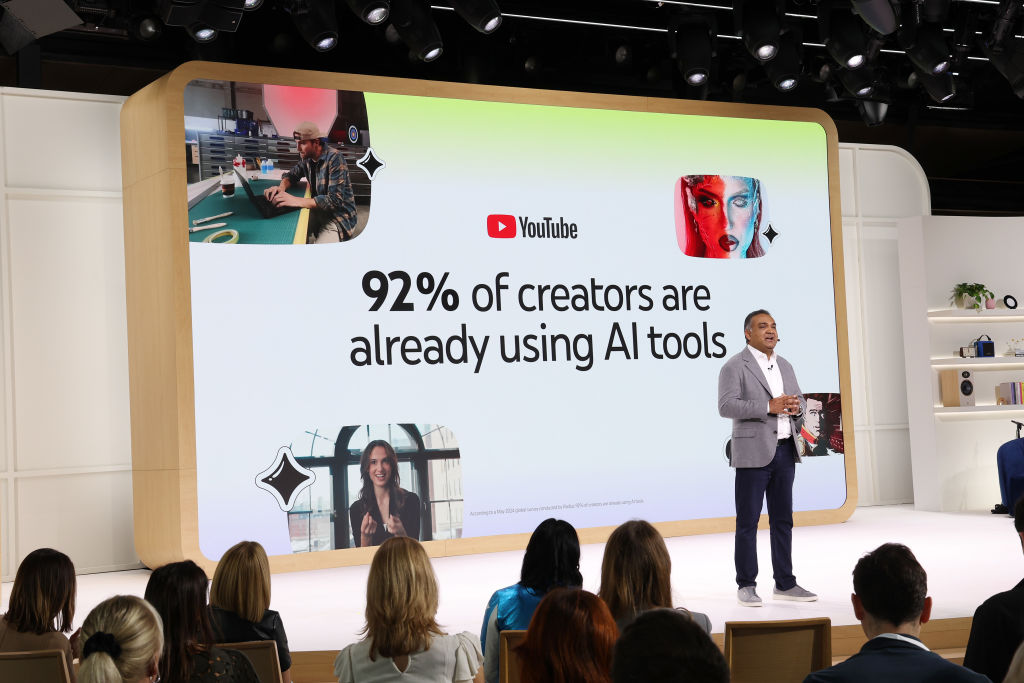
Made on YouTube 2024
YouTube CEO Neal Mohan speaks onstage at Made on YouTube at Pier 57 on September 18, 2024, in New York City (Kevin Mazur/Getty Images)

Masters of Prophecy is currently the fastest-growing channel across all of YouTube, going from a few hundred subscribers in February to over 30 million in June, and all of its content is AI-generated. But that growth looks suspicious, especially looking at how it began by going from less than 300 subscribers to more than 100,000 in a single day without any new videos, Shorts, or comments in that time. But again, on a platform increasingly powered — and populated — by AI, what does inauthentic growth even mean? At the end of the day, an AI bot isn’t going to buy a product from an advertiser.

It’s clear that YouTube doesn’t want to answer that question. In many ways, it feels like it’s hoping no one notices how popular AI content is. With a quiet misdirect, and if users (and more importantly, advertisers) don’t complain, everyone will just keep making money. 

But it also means that at some point in the near future, you’ll open up the app and suddenly realize there aren’t any humans on it anymore.


Garbage Day is an award-winning newsletter that focuses on web culture and technology, covering a mix of memes, trends, and internet drama. We also run a program called Garbage Intelligence, a monthly report tracking the rise and fall of creators and accounts across every major platform on the web. We’ll be sharing some of our findings here on Sherwood News. You can subscribe to Garbage Day here.


More Tech

See all Tech
tech
Tom Jones

Prediction markets have, predictably, been given a boost by the summer of sports

Major platforms like Kalshi and Polymarket have seen huge upticks in users of late, thanks in no small part to what’s felt like a recent sporting smorgasbord, with major competitions across hockey, basketball, and soccer soaking up fans’ time (and spending, clearly) at the outset of summer.

While gaming industry groups may not like it, there’s been a huge change in the methods people are using to put money on the big games, with everyone from fortunate NYC bar owners, to a far less fortunate Spanish supporter, turning to prediction markets to try and turn their sports know-how into cold, hard cash.

According to a new report from Adam Blacker for apptopia, that shift might have been even more seismic than imagined in the wake of the NBA and NHL finals and around the 2026 World Cup kicking off.

While gaming industry groups may not like it, there’s been a huge change in the methods people are using to put money on the big games, with everyone from fortunate NYC bar owners, to a far less fortunate Spanish supporter, turning to prediction markets to try and turn their sports know-how into cold, hard cash.

According to a new report from Adam Blacker for apptopia, that shift might have been even more seismic than imagined in the wake of the NBA and NHL finals and around the 2026 World Cup kicking off.

South by Southwest Conference and Festivals

Gold Tesla Cybercabs are piling up, but they’re not picking up passengers yet

Low-volume production started in April. Now people are noticing them more and more in the wild.

Rani Molla6/15/26
tech
Jon Keegan

Anthropic pulls Fable and Mythos access worldwide after Trump administration bars their use by foreign nationals

Only days after releasing two versions of its next-gen AI model, Anthropic has disabled them for users worldwide.

Anthropic says it received a Friday night order from the Trump administration to suspend access to the models for any foreign national (anywhere in the world) — a group that included some Anthropic employees. In response, the company turned off access to everyone.

Last week, the company released to the public its much-anticipated Claude Fable 5 model (and its restricted version Claude Mythos 5, which is still being tested with trusted partners). Anthropic said in a blog post announcing the action that officials cited national security concerns with the new models, while offering few specific details.

The post said that the government gave the company “verbal evidence of a potential narrow, non-universal jailbreak” of the public Fable 5 model. A jailbreak is a means by which users can evade restrictions built into the code to unlock prohibited functionality. Anthropic downplayed the significance of the attack, and said other major models, such as OpenAI’s GPT-5.5, could also be affected by the technique described.

Fears of these first Mythos-class models being misused are running high, after Anthropic warned the cybersecurity world in May that the advanced cyber capabilities of Mythos have rapidly discovered thousands of vulnerabilities in ubiquitous software, leading to the decision to restrict the full version of the model to a close group of trusted partners for testing.

This morning, Axios reported that Anthropic technical staff have flown to Washington to meet with White House officials to resolve the issue.

The Wall Street Journal is reporting that the Trump administration’s decision to take action against Anthropic was prompted by discussions that Amazon CEO Andy Jassy had with officials, including Treasury Secretary Scott Bessent. According to the report, Amazon researchers said they had been able to evade some of Fable 5’s security restrictions using specific prompts. Amazon is a major investor in Anthropic.

Anthropic is currently suing the US government to fight the Pentagon’s blacklisting of the company on national security grounds.

Last week, the company released to the public its much-anticipated Claude Fable 5 model (and its restricted version Claude Mythos 5, which is still being tested with trusted partners). Anthropic said in a blog post announcing the action that officials cited national security concerns with the new models, while offering few specific details.

The post said that the government gave the company “verbal evidence of a potential narrow, non-universal jailbreak” of the public Fable 5 model. A jailbreak is a means by which users can evade restrictions built into the code to unlock prohibited functionality. Anthropic downplayed the significance of the attack, and said other major models, such as OpenAI’s GPT-5.5, could also be affected by the technique described.

Fears of these first Mythos-class models being misused are running high, after Anthropic warned the cybersecurity world in May that the advanced cyber capabilities of Mythos have rapidly discovered thousands of vulnerabilities in ubiquitous software, leading to the decision to restrict the full version of the model to a close group of trusted partners for testing.

This morning, Axios reported that Anthropic technical staff have flown to Washington to meet with White House officials to resolve the issue.

The Wall Street Journal is reporting that the Trump administration’s decision to take action against Anthropic was prompted by discussions that Amazon CEO Andy Jassy had with officials, including Treasury Secretary Scott Bessent. According to the report, Amazon researchers said they had been able to evade some of Fable 5’s security restrictions using specific prompts. Amazon is a major investor in Anthropic.

Anthropic is currently suing the US government to fight the Pentagon’s blacklisting of the company on national security grounds.

Latest Stories

Sherwood Media, LLC and Chartr Limited produce fresh and unique perspectives on topical financial news and are fully owned subsidiaries of Robinhood Markets, Inc., and any views expressed here do not necessarily reflect the views of any other Robinhood affiliate, including Robinhood Markets, Inc., Robinhood Financial LLC, Robinhood Securities, LLC, Robinhood Crypto, LLC, Robinhood Money, LLC, Robinhood U.K. Ltd, Robinhood Derivatives, LLC, Robinhood Gold, LLC, Robinhood Asset Management, LLC, Robinhood Credit, Inc., Robinhood Ventures DE, LLC and, where applicable, its managed investment vehicles.
