Tech
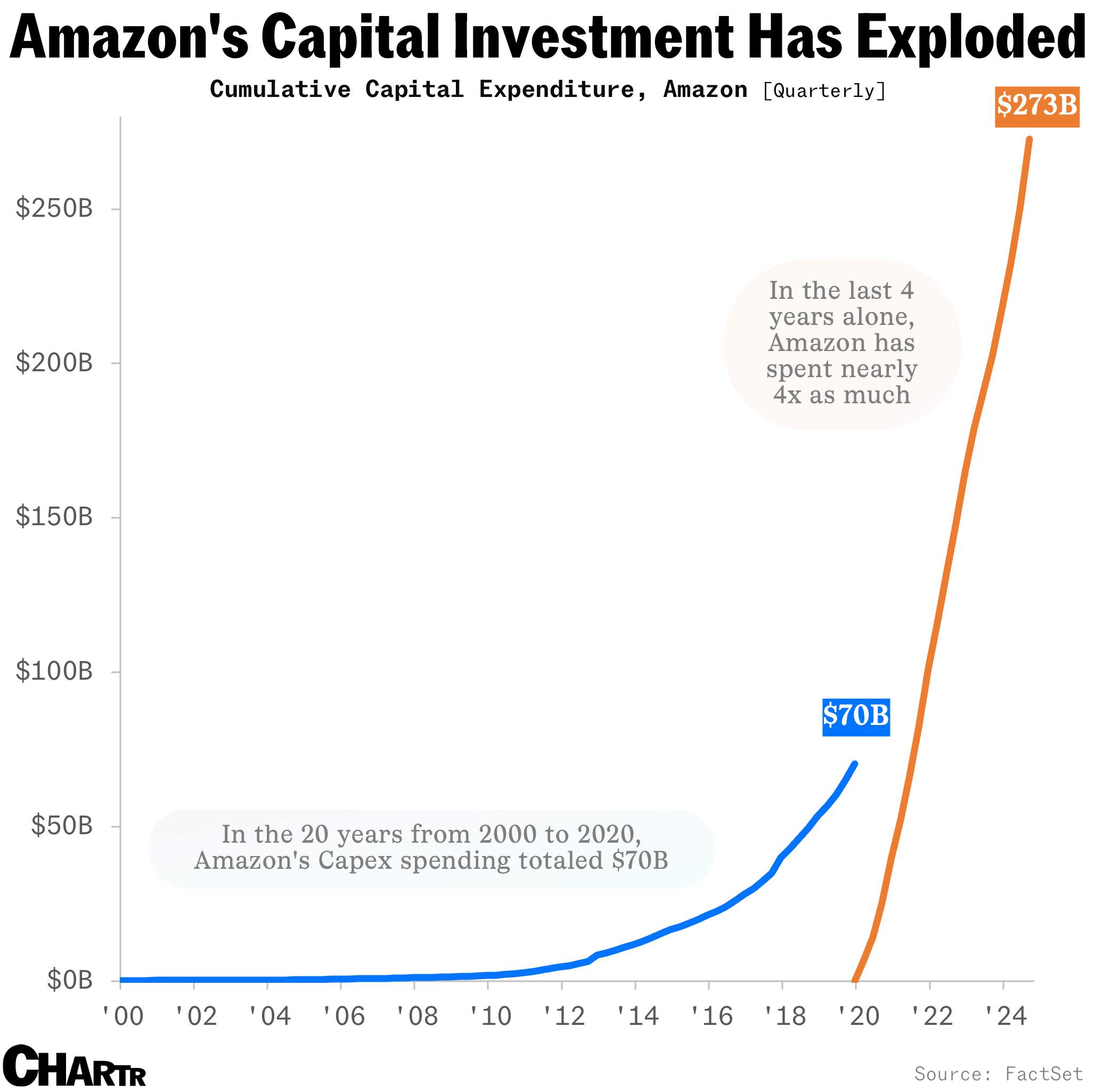
Amazon capital expenditures chart
Sherwood News

Amazon is spending billions to make sure it doesn’t fall behind in AI

The company’s $75 billion capital splurge shows no signs of slowing in 2025.

With Microsoft tightly intertwined with OpenAI, and Apple, Google, and Meta stuffing their own versions of AI into pretty much all their products, Big Tech is hard at work capturing as much value — or garnering as much hype — from AI as possible. Amazon’s latest move is a $4 billion bet on Anthropic, announcing the investment in the AI startup on Friday, doubling its total stake in OpenAI’s largest rival to $8 billion. (See here for a great explainer of the web of investments in AI companies.)

Amazon’s deal will see Anthropic use AWS chips for its foundational models, and it follows Anthropic’s June release of the latest version of its AI assistant, Claude. The company says Claude outperforms OpenAI’s GPT-4o and Google’s Gemini 1.5 Pro across a range of tasks: writing, coding, solving math problems, interpreting charts, transcribing text from images, and, apparently, understanding humor.

Of capital importance

The investment is a continuation of Amazon’s (and the rest of Big Tech’s) new strategy: spend billions of dollars to make sure you don’t fall behind in AI. That doesn’t just mean passive investments in startups. Indeed, for years, Big Tech was the epitome of the capital-light business model, driving profits from intangible assets like software. Now, the tech giants are pouring billions into physical stuff, including massive data centers and custom chips.

The four tech giants — Amazon, Microsoft, Meta, and Alphabet — spent nearly a combined $60 billion on capital investments in Q3, up 59% from last year. By the end of 2024, this figure is expected to surpass a total of $200 billion, with Amazon leading at $75 billionmost of which supports AWS and its AI business. AWS, while accounting for just 16% of Amazon’s revenue in 2023, generated two-thirds of the company’s operating profit.

Amazon’s spending spree shows no signs of slowing, with the company expecting to splurge even more in 2025. In the latest earnings call, CEO Andy Jassy called the company’s relentless spending a “once-in-a-lifetime type of opportunity.”

More Tech

See all Tech
tech

Google’s YouTube to launch cheaper streaming packages that could potentially compete with Netflix

Google’s YouTube announced today that it will launch 10 genre-specific packages early next year that will cost less than its existing $82.99-per-month YouTube TV.

While the company didn’t specify how much these new packages will cost, they’re expected to come in well under the price of the full YouTube TV bundle. That could put its price point in line with other major streaming services like those offered by Apple, Disney, and Netflix. YouTube already commands the largest share of TV viewership in the US, and lower-priced subscription options could widen its lead even further.

That’s unwelcome news for other streamers, particularly Netflix, which has faced investor pressure since reports emerged about its acquisition of Warner Bros. Discovery.

Paramount has since launched a hostile counterbid, but Netflix’s stock continues to struggle. Shares are down nearly 2% today.

While the company didn’t specify how much these new packages will cost, they’re expected to come in well under the price of the full YouTube TV bundle. That could put its price point in line with other major streaming services like those offered by Apple, Disney, and Netflix. YouTube already commands the largest share of TV viewership in the US, and lower-priced subscription options could widen its lead even further.

That’s unwelcome news for other streamers, particularly Netflix, which has faced investor pressure since reports emerged about its acquisition of Warner Bros. Discovery.

Paramount has since launched a hostile counterbid, but Netflix’s stock continues to struggle. Shares are down nearly 2% today.

tech

Elon Musk tells Google executive that “Waymo never really had a chance against Tesla”

Not one for modesty, Tesla CEO Elon Musk responded to a post on X by Jeff Dean, chief scientist at Google DeepMind, by saying, “Waymo never really had a chance against Tesla.” He added, “This will be obvious in hindsight.”

Dean had noted that Waymo vehicles have driven riders 96 million miles autonomously without a driver, alluding to the fact that Tesla’s Robotaxi service still requires safety operators in the front seat in both its locations.

Tesla currently operates about 30 Robotaxi vehicles in Austin and 120 in the Bay Area, while Waymo had more than 2,500 across the country (at least 200 in Austin and 1,000 in the Bay Area) as of late November. Musk has said Tesla would remove safety monitors in Austin and that it would scale to 500 vehicles there and 1,000 in the Bay Area by year-end, but the clock is ticking on reaching those goals.

Tesla, of course, is more focused on the 6.7 billion miles its vehicles have driven with Full Self-Driving tech, driver assistance software that requires a driver be present and paying attention. The idea is that, with a software update, millions of Teslas could be turned into potential robotaxis.

Read more on Tesla and Waymo’s battle for driverless supremacy here.

tech

Amazon announces major AI investment in India a day after Microsoft

Amazon said today that it plans to invest more than $35 billion in India by 2030, adding to the nearly $40 billion it has invested in the country so far. The latest investment is focused on AI-driven digitization, boosting exports, and expanding employment, the company said.

The news comes just after Microsoft revealed it would spend $17.5 billion on the subcontinent from 2026 to 2029 to accelerate the nation’s AI infrastructure.

India has become a strategic battleground for global tech firms thanks to its rapidly growing digital economy, vast developer base, and government support for AI infrastructure. Together, the back-to-back announcements underscore how aggressively both cloud giants are ramping up their global AI spending as they race to build — and profit from — the next generation of computing.

India has become a strategic battleground for global tech firms thanks to its rapidly growing digital economy, vast developer base, and government support for AI infrastructure. Together, the back-to-back announcements underscore how aggressively both cloud giants are ramping up their global AI spending as they race to build — and profit from — the next generation of computing.

Latest Stories

Sherwood Media, LLC produces fresh and unique perspectives on topical financial news and is a fully owned subsidiary of Robinhood Markets, Inc., and any views expressed here do not necessarily reflect the views of any other Robinhood affiliate, including Robinhood Markets, Inc., Robinhood Financial LLC, Robinhood Securities, LLC, Robinhood Crypto, LLC, or Robinhood Money, LLC.