Tech
tech

America is officially spending more on building data centers than offices

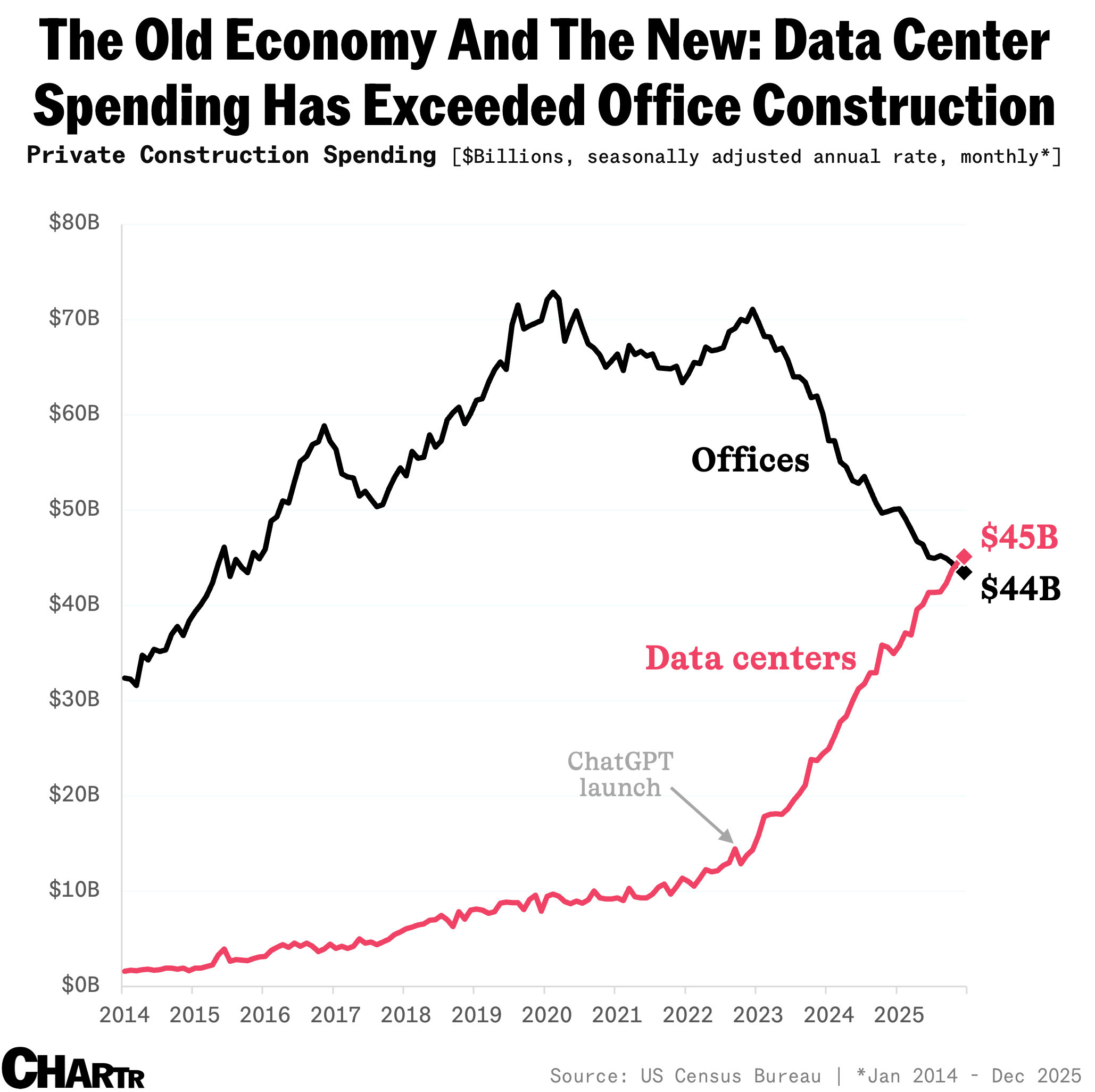
It’s finally happened: spending on data center construction surpassed offices for the first time at the end of last year. America’s construction spending on data centers reached a record annualized rate of $45 billion in December, crossing paths with declining private office outlays at $44 billion, per US Census Bureau data.
Data center spending
Sherwood News

Recently, research from CBRE found that data center capacity under construction actually fell from 6.35 megawatts in 2024 to 5.99 megawatts by the end of 2025 — but the bottleneck doesn’t appear to be demand, but more mundane supply issues, with deal implementation at the local level, including slow permitting and constrained supply chains, seemingly causing the slowdown.

Indeed, considering how hyperscaler clients are trying to secure power capacity, it’s hard to imagine the data center line not expanding its lead in the chart above. Just last week, Meta signed a five-year AI infrastructure deal with Nebius worth up to $27 billion.

And with skyrocketing demand, construction costs are jumping, too — helping construction firms to become the best-performing non-Iran-related segment of the stock market this year, as my colleague Matt Phillips pointed out: Tech giants including Microsoft and Oracle can’t get data centers built fast enough. Construction stocks are ripping on the demand.

More Tech

See all Tech
tech

With Apple Business, Apple is packaging its ecosystem for the office

Apple today announced its most coherent push yet to turn its ecosystem into a workplace platform. Apple Business, a “new all‑in‑one platform for businesses of all sizes,” bundles device management, email, cloud storage, support, and payments into a single system.

Businesses already rely heavily on iPhones and Macs, but stitching together Apple’s tools has historically required third-party software and IT overhead. Apple is now trying to make that setup more turnkey — a move that could open up new ways to make money through services, support, and payments.

Businesses already rely heavily on iPhones and Macs, but stitching together Apple’s tools has historically required third-party software and IT overhead. Apple is now trying to make that setup more turnkey — a move that could open up new ways to make money through services, support, and payments.

tech

Anthropic’s Claude can now control your computer through prompts from your phone

Anthropic has added a new feature to let Claude control your computer and accept prompts from your phone — and investors think this is extremely bad news for traditional software companies.

The ability to remotely control your AI agent (which has full access to your computer) is one of the key features of OpenClaw (aka MoltBot) that AI enthusiasts are currently obsessing over.

Anthropic’s Claude Code is already a huge hit with enterprise customers and software developers, and adding these remote agent features will be pretty significant.

Software stocks are tanking on the news, as the prospect of millions of people employing powerful agents to run 24/7 on their computers from their phones may very well mean fewer humans will pay to use those software products. Mainstays like Adobe, Atlassian, Hubspot, Figma, and Microsoft were all down significantly in early trading, with the iShares Expanded Tech Software ETF currently down nearly 4%, significantly worse than the wider market, and the S&P 500 Index off only 0.4%.

That puts IGV’s return relative to the S&P 500 over the last week back into negative territory — a reversal from earlier in March, when software had actually proved to be something of a safe haven during the volatility of the US-Iran war. This morning, at least, it seems to be back to being a punching bag.

Anthropic’s Claude Code is already a huge hit with enterprise customers and software developers, and adding these remote agent features will be pretty significant.

Software stocks are tanking on the news, as the prospect of millions of people employing powerful agents to run 24/7 on their computers from their phones may very well mean fewer humans will pay to use those software products. Mainstays like Adobe, Atlassian, Hubspot, Figma, and Microsoft were all down significantly in early trading, with the iShares Expanded Tech Software ETF currently down nearly 4%, significantly worse than the wider market, and the S&P 500 Index off only 0.4%.

That puts IGV’s return relative to the S&P 500 over the last week back into negative territory — a reversal from earlier in March, when software had actually proved to be something of a safe haven during the volatility of the US-Iran war. This morning, at least, it seems to be back to being a punching bag.

tech

Amazon’s Zoox to increase San Francisco and Las Vegas footprint and expand service to Austin and Miami this year

Amazon’s self-driving unit, Zoox, has plans to debut its robotaxi service in Austin and Miami this year, where it’s currently testing, the company announced today. It also said it would be expanding its footprint in existing service areas in San Francisco (where there is limited public use) and adding more stops along the strip in Las Vegas, where it’s currently open to the public. In San Francisco, that means quadrupling coverage to include the Marina, North Beach, Chinatown, and Pacific Heights in addition to the SoMa and Mission districts where it is currently operating.

The news follows a spate of other announcements from the purpose-built, steering-wheel-less robotaxi company, including expansions into a total of 10 markets for testing and a partnership with Uber, in addition to its longtime tech relationship with Nvidia. Like many robotaxi companies, Zoox is teaming up with other self-driving tech companies and platforms in order to grow.

tech

Tesla’s European sales rise for the first time in more than a year but still lag BYD

New Tesla registrations jumped 12% in February from a year earlier to 17,664 units across the European Union, the United Kingdom, and the European Free Trade Association, according to new data from the European Automobile Manufacturers’ Association. China’s BYD once again beat out the American EV maker, posting 17,954 registrations in February, up 162% from a year earlier. BYD and Tesla each represented 1.8% of the European new car market last month.

The February data is a notable shift for Tesla, which saw its first monthly jump in the region since December 2024. Tesla has struggled in Europe since CEO Elon Musks ascension to the Trump administration and his forays into European politics in support of far-right parties. Tesla also posted gains in China in February, which is a much larger market for the carmaker.

Latest Stories

Sherwood Media, LLC produces fresh and unique perspectives on topical financial news and is a fully owned subsidiary of Robinhood Markets, Inc., and any views expressed here do not necessarily reflect the views of any other Robinhood affiliate, including Robinhood Markets, Inc., Robinhood Financial LLC, Robinhood Securities, LLC, Robinhood Crypto, LLC, Robinhood Derivatives, LLC, or Robinhood Money, LLC. Futures and event contracts are offered through Robinhood Derivatives, LLC.