Tech
CHINA-US-DIPLOMACY
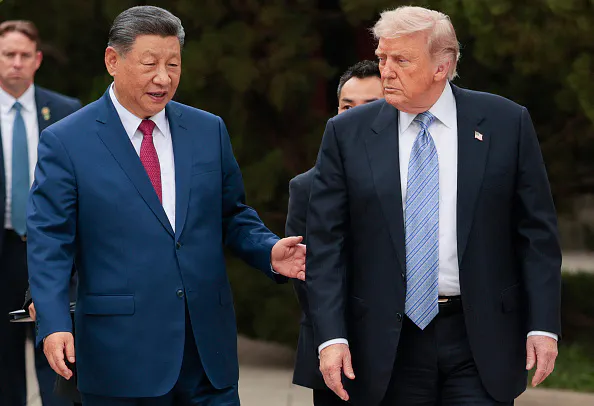
US President Donald Trump (R) walks with China's President Xi Jinping (L) as he leaves after a visit to Zhongnanhai Garden in Beijing on May 15, 2026. (Photo: Evan Vucci / POOL / AFP via Getty Images)

Anthropic really doesn’t want the US to help China with AI

Anthropic made its case for freezing China out of the AI race as much as possible in a new policy paper. The company warned that letting China catch up to US AI companies could risk AI-powered mass surveillance and huge risks to monitoring AI safety.

Anthropic may be in the midst of an existential legal battle with the US government, but that hasn’t stopped it from weighing in on how the US should deal with China when it comes to AI.

In a 5,500 word policy paper posted Thursday, Anthropic issued a dire warning for US leaders — the US must do everything in its power to stop China from catching up in AI.

Democratic AI

Anthropic paints a picture of two possible scenarios:

1. 🇺🇸 🥇 The US keeps its 12-24 month lead on Chinese AI

In the first scenario where the US keeps its lead, a mix of tough export controls on advanced AI chips, protection against “distillation attacks,” and industry-wide transparency help build a bulwark against China’s race to build powerful, home-grown AI.

The paper argues that would give the US a military and national security edge against our largest adversary, and would have the effect of becoming a magnet for top AI talent around the world.

The leader of the industry gets to set the norms for transparency and safety, and it is crucial for the US to be in that position, according to the paper.

2. 🇨🇳 ⚖️ China catches up to US-built frontier models

If American companies just see China as another market for their advanced AI chips, Anthropic sees a number of negative outcomes for the world. China could close the 12-24 month gap between its best models and US-built frontier models that experts currently see.

China’s “AI-enabled techno-authoritarianism” could be used to power mass surveillance, enhancing its already strict control over its citizens.

Having just warned the world of the potential cyber risks from its forthcoming Mythos model, Anthropic fears such an advanced tool would be used for offensive cyberattacks.

AI is accelerating research and development, and more capable models would help China make faster advances in all fields. China is focused on integrating its domestic AI tech into society to help speed advances, and even if it didn’t have the most advanced models, China could export its tools around the world:

“If the CCP integrates near-frontier AI systems quicker and more effectively into China’s economy and the CCP security apparatus, and drives global adoption of subsidized, low-cost AI, then it could secure advantages over democracies that overcome an intelligence deficit.”

Export controls work

The term “export controls” appears 16 times in Anthropic’s paper, and it spends a lot of ink arguing for their efficacy and necessity.

Enforcing strict export controls on the most advanced chips — like those from Nvidia — keeps China at a disadvantage as it struggles to match advanced chip manufacturing and design from companies based in liberal democracies like ASML(the Netherlands), AMD (US), TSMC(Taiwan), and Samsung (South Korea). Anthropic argues that the innovations created by these companies could only happen in democratic countries.

China still has a ways to go on chips. It reportedly has a working prototype of an chip fab that employs extreme ultra-violet lithography (EUV), a technology currently only mastered by one company – ASML. Faster chips would result in more powerful AI.

What grows in the shadows

Anthropic, OpenAI and other AI labs have tradition of releasing detailed and transparent technical papers that describe capabilities and detail safety risks. The paper notes that more and more Chinese model releases have not matched this level of transparency, and are starting to keep models proprietary. This could greatly increase the risk of AI models being used to help develop chemical, biological, or nuclear weapons.

President Trump just returned from his trip to China, along with Nvidia CEO Jensen Huang. It’s not clear yet exactly what was discussed relating to AI and chips. But for now, Anthropic will be keeping an eye on its rear view mirror as China’s models improve.

More Tech

See all Tech
Tesla Robotaxi

Tesla finally reported un-redacted information about its Robotaxi crashes

There have been a total of 17 crashes so far among its Texas Robotaxis. Read about them all here.

tech

Alphabet sold $3.6 billion in Japanese yen bonds — a record for a foreign company — likely to help its AI capex binge

We now have the value for Alphabet’s Japanese yen bond raise — 576.5 billion yen, or $3.6 billion — and it’s a record for a foreign issuer in Japan. The deal was spread across seven tranches with maturities ranging from 3 to 40 years, allowing the company to lock in rates as low as 1.965%.

The latest deal comes on the heels of Alphabet’s massive US and European bond deals, where the company has tapped global markets for nearly $60 billion in fresh capital over the last few months. In a filing earlier this week, the search giant said it would use the proceeds for “general corporate purposes.” That likely means fueling its AI infrastructure build-out, which has pushed its projected 2026 capex bill to a staggering $190 billion.

tech
Rani Molla

Bloomberg: Relationship between OpenAI and Apple has deteriorated and legal action may be imminent

The two-year-old alliance between Apple and OpenAI has deteriorated, Bloomberg reports, with the AI giant now consulting legal counsel about issuing a potential breach of contract notice.

OpenAI executives allege that Apple failed to adequately integrate and promote ChatGPT on the iPhone, causing the AI firm to lose out on billions a year in subscriptions and hurt its brand, according to the report.

Meanwhile, Apple has expressed concerns over OpenAI’s privacy protection, and has been miffed that OpenAI has been working on its own hardware with former Apple design lead Jony Ive.

More recently, Apple, which has trailed its peers in developing AI, has decided to offer users their choice of AI models, rather than aligning exclusively with OpenAI’s.

Meanwhile, Apple has expressed concerns over OpenAI’s privacy protection, and has been miffed that OpenAI has been working on its own hardware with former Apple design lead Jony Ive.

More recently, Apple, which has trailed its peers in developing AI, has decided to offer users their choice of AI models, rather than aligning exclusively with OpenAI’s.

tech
Jon Keegan

Report: Mythos is used to crack MacOS

Apple’s MacOS has long been considered to have some of the strongest cybersecurity protections in the industry.

But researchers using a preview release of Anthropic’s Mythos AI model were able to take control of a Mac, in a significant example of the unreleased AI model’s cyber capabilities, according to a report from The Wall Street Journal.

It took two security researchers five days to pull off the feat, which chained together bugs to corrupt the Mac’s memory, per the report. The researchers told the Journal that human expertise was required to use Mythos, and it would not be able to execute the attack on its own. The researchers reportedly said some of the Mythos hype was “overblown.”

Apple said it was taking the bug report “very seriously” and has not yet issued a fix.

It took two security researchers five days to pull off the feat, which chained together bugs to corrupt the Mac’s memory, per the report. The researchers told the Journal that human expertise was required to use Mythos, and it would not be able to execute the attack on its own. The researchers reportedly said some of the Mythos hype was “overblown.”

Apple said it was taking the bug report “very seriously” and has not yet issued a fix.

Latest Stories

Sherwood Media, LLC and Chartr Limited produce fresh and unique perspectives on topical financial news and are fully owned subsidiaries of Robinhood Markets, Inc., and any views expressed here do not necessarily reflect the views of any other Robinhood affiliate, including Robinhood Markets, Inc., Robinhood Financial LLC, Robinhood Securities, LLC, Robinhood Crypto, LLC, Robinhood Money, LLC, Robinhood U.K. Ltd, Robinhood Derivatives, LLC, Robinhood Gold, LLC, Robinhood Asset Management, LLC, Robinhood Credit, Inc., Robinhood Ventures DE, LLC and, where applicable, its managed investment vehicles.