Tech
tech
Rani Molla

As Apple moves production from China to India, Trump reiterates that he wants it in the US

Despite a cooling trade war with China, where Apple produces a big chunk of its products, the iPhone maker is still feeling the heat from the Trump administration.

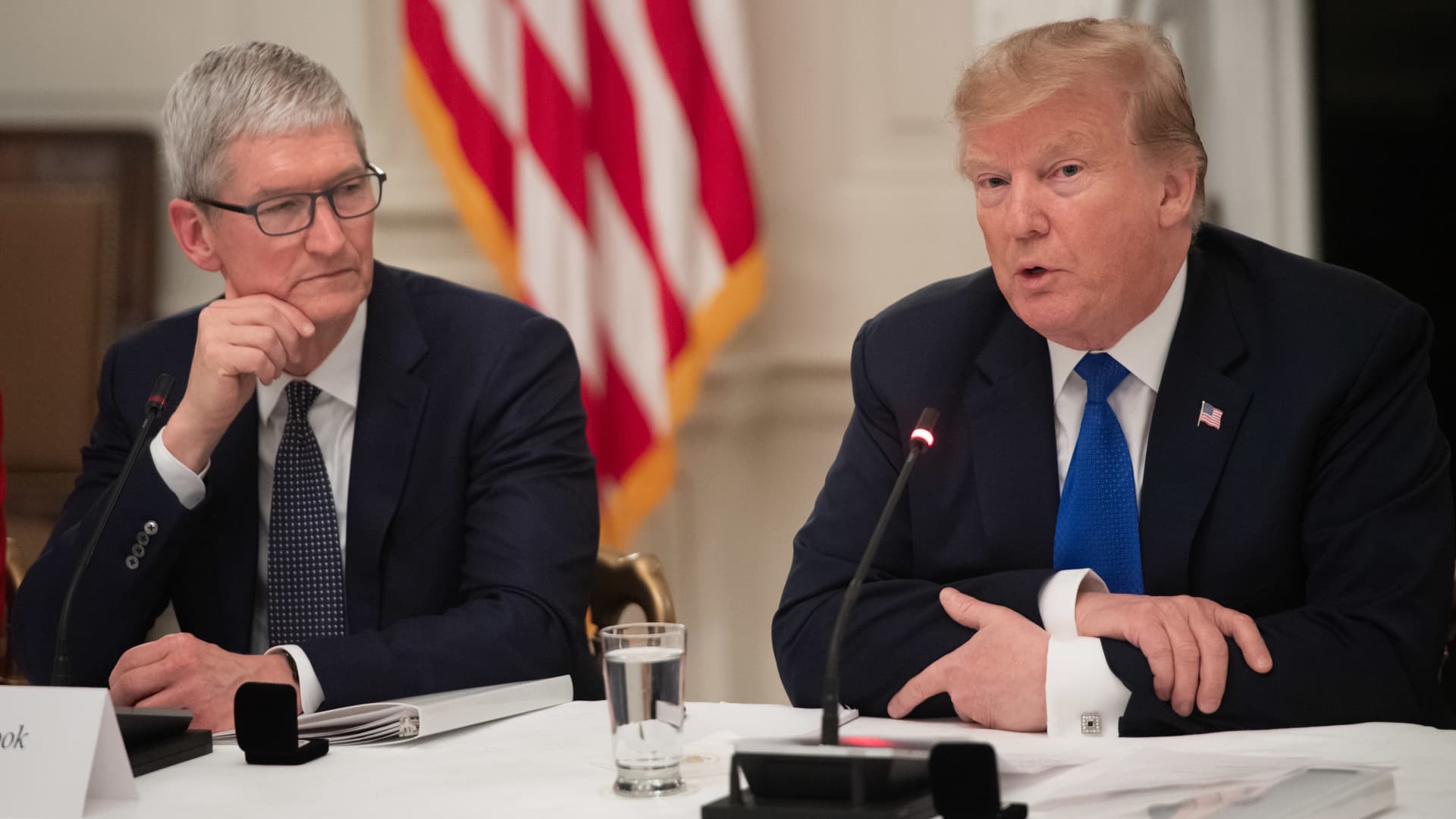
Today, President Trump said he told Apple CEO Tim Cook yesterday he had a “little problem” with him, according to a CNBC report.

To avoid sky-high tariffs in China, Apple had reportedly planned to move production to India next year for all 60 million iPhones it sells in the US. On the company’s latest earnings call, Cook said, “For the June quarter, we do expect the majority of iPhones sold in the US will have India as their country of origin.”

Of course, the administration’s intention with the tariffs was to move iPhone and other tech production to the US — something analysts have previously said isn’t really possible and would also be prohibitively expensive. That’s not deterring Trump.

“I said to him, ‘My friend, I treated you very good. You’re coming here with $500 billion, but now I hear you’re building all over India.’ I don’t want you building in India,” Trump said he told Cook, referencing Apple’s commitment to spend $500 billion on US expansion over his administration.

“I said to Tim, I said, ‘Tim look, we’ve treated you really good, we put up with all the plants that you build in China for years — now you’ve got to build us. We’re not interested in you building in India. India can take care of themselves... We want you to build here,’” Trump said.

Trump said Apple would be “upping” its US production but didn’t give details.

To avoid sky-high tariffs in China, Apple had reportedly planned to move production to India next year for all 60 million iPhones it sells in the US. On the company’s latest earnings call, Cook said, “For the June quarter, we do expect the majority of iPhones sold in the US will have India as their country of origin.”

Of course, the administration’s intention with the tariffs was to move iPhone and other tech production to the US — something analysts have previously said isn’t really possible and would also be prohibitively expensive. That’s not deterring Trump.

“I said to him, ‘My friend, I treated you very good. You’re coming here with $500 billion, but now I hear you’re building all over India.’ I don’t want you building in India,” Trump said he told Cook, referencing Apple’s commitment to spend $500 billion on US expansion over his administration.

“I said to Tim, I said, ‘Tim look, we’ve treated you really good, we put up with all the plants that you build in China for years — now you’ve got to build us. We’re not interested in you building in India. India can take care of themselves... We want you to build here,’” Trump said.

Trump said Apple would be “upping” its US production but didn’t give details.
More Tech

See all Tech
tech

SpaceX filings reportedly show no one can fire Elon Musk except Elon Musk

The only thing stopping Elon Musk from being chairman and CEO of SpaceX is Elon Musk, according to Reuters, which viewed an excerpt of the company’s IPO filing.

The document outlines a dual-class share structure giving Musk control via super-voting stock. The filing says he “can only be removed from our board or these positions by the vote of Class B holders” — shares he’ll control after the listing. It adds that if he keeps those shares, he could “continue to control the election and removal of a majority of our board.”

At a typical public company — even founder-led ones with dual-class structures — a CEO can be fired by the board of directors, which represents shareholders and can vote to remove them over issues such as corporate performance, strategy, or misconduct.

The unusual SpaceX setup means Musk is unlikely to face the kind of CEO succession pressure he’s dealt with at Tesla. Musk, of course, is not a typical CEO, and the value of his companies has long been closely tied to his presence.

To be sure, SpaceXs confidential IPO filing isnt in its final form yet — while the filing is still in the confidential phase, the company will be going back and forth with the SEC, which will review it and suggest or require changes.

At a typical public company — even founder-led ones with dual-class structures — a CEO can be fired by the board of directors, which represents shareholders and can vote to remove them over issues such as corporate performance, strategy, or misconduct.

The unusual SpaceX setup means Musk is unlikely to face the kind of CEO succession pressure he’s dealt with at Tesla. Musk, of course, is not a typical CEO, and the value of his companies has long been closely tied to his presence.

To be sure, SpaceXs confidential IPO filing isnt in its final form yet — while the filing is still in the confidential phase, the company will be going back and forth with the SEC, which will review it and suggest or require changes.

tech

OpenAI’s models are officially coming to Amazon

Amazon is finally getting in on the hottest ticket in tech.

After Microsoft announced yesterday that it has agreed to give up its exclusive rights to sell OpenAI’s models, Amazon, as expected, will start offering them to customers — something Amazon Web Services CEO Matt Garman says users have been asking for “for a really long time.” Some models are available now in preview, and the most powerful GPT versions will show up “in the coming weeks.”

This is a big shift in the AI cloud wars. Microsoft’s early bet on OpenAI gave Azure an edge by locking up the most in-demand models. Now that exclusivity is gone, Amazon and other competitors can finally offer them too, closing a key gap and competing more directly for AI customers.

This is a big shift in the AI cloud wars. Microsoft’s early bet on OpenAI gave Azure an edge by locking up the most in-demand models. Now that exclusivity is gone, Amazon and other competitors can finally offer them too, closing a key gap and competing more directly for AI customers.

tech

Ship-tracking app surges as Iran war continues

As Middle East peace talks stretch on, with Tehran reportedly offering to reopen the Strait of Hormuz if the US lifts its blockade and the war ends, the owner of shipping intelligence platform MarineTraffic revealed that the app has gained millions of new users since the conflict began.

MarineTraffic’s user count jumped to 8.5 million this April, up from 3.5 million a year ago, the cofounder of its parent company, Kpler, said in an interview with the Financial Times. Paid subscribers, often workers within companies and governments looking for more data on supply chains and commodities trading, rose 11,000 in the same period.

Kpler, which also owns shipping intelligence platform FleetMon, draws its data from a range of sources, including the Automatic Identification System, satellites, and more than 500 people on-site, like port terminal operators.

Per Appfigures data, MarineTraffic is estimated to have raked in almost $1 million across March and April in app revenue (through April 27), more than double the ~$346,500 from the same months last year. Across the full year, Kpler expects to earn between $300 million and $400 million in annual recurring revenues.

tech
Tom Jones

Google will supply AI models to Pentagon in classified deal, per The Information

Google has become the latest tech company to ink an agreement to supply the Department of Defense (War) with AI, having reportedly closed a classified deal that allows the Pentagon to use its AI for “any lawful government purpose,” according to The Information.

The Information initially reported talks between the Alphabet-owned company and the US government around two weeks ago, following the messy breakdown of the relationship between Anthropic and the Trump administration — and the rushed OpenAI deal that took its place.

The move has reportedly sparked opposition among Google employees, with The Washington Post reporting that over 600 workers signed a letter to CEO Sundar Pichai to ask him to bar the Defense Department from using the company’s AI models for any classified work.

The Information initially reported talks between the Alphabet-owned company and the US government around two weeks ago, following the messy breakdown of the relationship between Anthropic and the Trump administration — and the rushed OpenAI deal that took its place.

The move has reportedly sparked opposition among Google employees, with The Washington Post reporting that over 600 workers signed a letter to CEO Sundar Pichai to ask him to bar the Defense Department from using the company’s AI models for any classified work.

Latest Stories

Sherwood Media, LLC produces fresh and unique perspectives on topical financial news and is a fully owned subsidiary of Robinhood Markets, Inc., and any views expressed here do not necessarily reflect the views of any other Robinhood affiliate, including Robinhood Markets, Inc., Robinhood Financial LLC, Robinhood Securities, LLC, Robinhood Crypto, LLC, Robinhood Derivatives, LLC, or Robinhood Money, LLC. Futures and event contracts are offered through Robinhood Derivatives, LLC.