
Tech
Boxing
(CSA-Printstock/Getty Images)
Clear skies, ready for takeoff

Bluesky engagement seems to be punching way above its weight

While Meta pushes every Instagram user to Threads and X tries to shore up a disintegrating user base, the plucky indie social network is picking up steam because people actually seem to be using it.

Jon Keegan

It’s a crazy time for news publishers trying to share their stories on social media. Just a few years ago, Twitter and Facebook were the two big platforms to reach a huge audience of social-media users. Since Elon Musk’s purchase of Twitter and transformation into X, a mass migration of users has fled the platform, and the social-media landscape has splintered into pieces. Now, in addition to X, there is Meta’s Threads and Twitter spin-off Bluesky. But something interesting is happening with audience engagement on Bluesky.

Among this group of text-based platforms, X is still a juggernaut, with 535 million users overall. Both Threads and Bluesky have been adding over a million users per day recently, but Threads’ 275 million users dwarfs Bluesky’s 23 million.

Neglecting news

Meta has stepped back from positioning itself as a source for news, and across Instagram, Facebook, and Threads, news content does not get the same algorithmic boost that it used to. Elon Musk this week appeared to confirm that posts on X with links off the platform are deprioritized, which he referred to as “lazy linking”:

But over on Bluesky, news has no such algorithmic speed bump. Users have been noticing that while Bluesky’s audience is a mere sliver of X and Threads’ user bases, it has been delivering as much engagement as the bigger platforms, and in some cases eclipsing them. “Engagement” refers to how much users interact with any given piece of content, measured in likes, replies, or reposting a story.

At least anecdotally, medium-sized to large publishers have begun to report that internal data gives Bluesky a pretty remarkable edge.
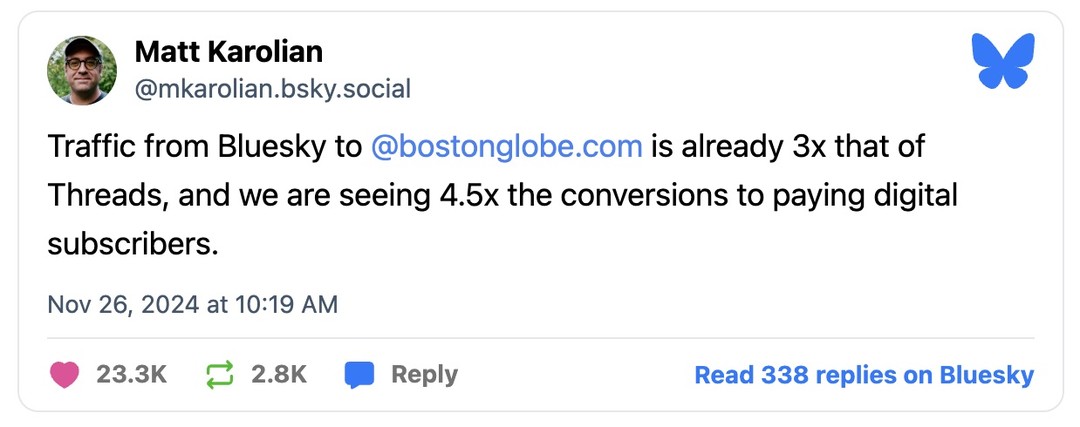
bluesky-bostonglobe.com
@mkarolian.bsky.social

Let’s take a look at how engagement varies from platform to platform for some big news stories published by The New York Times, CNN, and The Wall Street Journal. But first, let’s look at the audience size for these publishers on each platform.

Engagement per million users

We picked three recent stories that were at least a day old, covered a few different topics, and were published by the official accounts for The New York Times, The Wall Street Journal, and CNN on X, Threads, and Bluesky.

To control for the vastly different size of the platforms, we assigned each story an “engagement per million users” score:

(Likes + reposts + replies) / (total number of users on platform / 1 million) = engagement per million users.

Of course, there are some limitations to this analysis. This experiment doesn’t control for the many, many variables that affect user-engagement numbers. For example, it doesn’t account for the weight of each type of engagement (a “like” is easier than a reply). Also, this does not account for the different political vibe of each platform, which could lead to certain stories getting very different reactions on different platforms. But when you plot out these scores, you do see much more engagement for the same stories on Bluesky.

Getting a consistent measure of active users on each platform is tricky. Using monthly active users as the devisor in this equation would be a more accurate way to measure this engagement rate, but we don’t have hard numbers for each platform. X says that it has 535 million “global monetizable monthly active users,” but Musk recently said that there are about 300 million daily active users. So even if that is accurate, X numbers might look close to Threads, as Meta says they have 275 million monthly active users.

Given that these are still generally similar orders of magnitude to overall user numbers, plugging in those estimates doesn’t meaningfully change what the chart shows: Bluesky sure looks hot right now.

Another possible explanation is that because Bluesky is new, it is probably just full of more fresh, engaged users. After all, X is carrying 18 years’ worth of users, and as a private company it doesn’t have to share as much detail about its users with regulators and investors.

News publishers are eager to find platforms that can get their stories in front of readers without fighting opaque algorithmic rules, so this increased engagement may lure more publishers to the platform.

With an eye on Bluesky’s skyrocketing growth, the other platforms may be taking notice. Just last week, Meta rolled out a flurry of features like allowing a non-algorithmic “followers” feed to be the default, and rolling out “starter packs,” which have been hugely popular on Bluesky.


More Tech

See all Tech
tech

Anthropic has surged past OpenAI in capturing business spending on generative AI software

Last quarter, Anthropic attracted the lion’s share of trackable business spending on generative AI software, according to new data from Ramp, a fintech company that provides corporate cards and expense-management software for small firms and Fortune 500 companies alike.

The data showed that in Q1 Anthropic saw 37% of spending, its biggest share yet, versus 33% for OpenAI. Notably, the dataset doesn’t capture spending on Google or Microsoft.

OpenAI, which makes ChatGPT, still leads in overall adoption at 81% of AI buyers, but Anthropic is catching up, at nearly 63% in March. Overall, more than half of Ramp’s customers currently pay for AI, up from just 18% two years ago.

Anthropic’s enterprise tools, including Claude Code and Cowork, have been making waves among the business class, sending its revenue soaring.

Anthropic’s revenue share is even higher among companies spending on AI for the first time.

“Anthropic has definitely been on a tear,” Ara Kharazian, Ramp’s economist, told Sherwood. “Its increase in adoption rates has been driven by its ability to sell to less technical users and smaller contracts than it typically has.”

It's notable that midway through the first quarter, Anthropic had a falling-out with one of its biggest customers, the US government, which near the end of February decided to shun Anthropic's products and lean into working with OpenAI.

tech

Report: Google ditches its objection to defense work, pitches Gemini to Pentagon

In 2018, Google employees protested against the company’s tech being used for the US military’s Project Maven — a drone targeting program — reminding the company of its “don’t be evil” motto.

After the controversy, the company declined to renew the contract with the Pentagon, drawing a bright line between Big Tech and the national security establishment.

What a difference a few years makes.

Google is now actively working to get its Gemini AI model to be used in classified national security settings, according to a new report from The Information. Seeking a similar deal to the one OpenAI hashed out with the Pentagon, Google reportedly wants a contract that allows use of Gemini in classified work, but with a prohibition on mass domestic surveillance and autonomous lethal weapons.

But Google is playing catch-up in a major way. Amazon and Microsoft both have been widely used for classified defense work, and contractors are already experienced in working with their cloud systems, while Google’s services have never been used in classified work.

What a difference a few years makes.

Google is now actively working to get its Gemini AI model to be used in classified national security settings, according to a new report from The Information. Seeking a similar deal to the one OpenAI hashed out with the Pentagon, Google reportedly wants a contract that allows use of Gemini in classified work, but with a prohibition on mass domestic surveillance and autonomous lethal weapons.

But Google is playing catch-up in a major way. Amazon and Microsoft both have been widely used for classified defense work, and contractors are already experienced in working with their cloud systems, while Google’s services have never been used in classified work.

1 in 5

We knew Tesla had been off-loading its struggling “apocalypse-proof” Cybertrucks onto CEO Elon Musk’s other companies, but now we know just how many.

The EV company sold about one in five Cybertrucks registered in the US in the fourth quarter to Musk’s other ventures, according to Bloomberg, citing data from S&P Global Mobility. The lion’s share went to SpaceX, which accounted for 1,279 of the 7,071 total registrations, while another 60 went to xAI (now part of SpaceX), Neuralink, and The Boring Company. All told, these inter-company sales represent roughly $100 million in value, and a vital lifeline for a vehicle that has failed to gain traction with the public, forcing Tesla to scale back production.

Musk’s companies have continued to scoop up the stainless steel behemoths this year, with another 158 Cybertruck purchases in January and 67 in February.

tech

TSMC CEO on Tesla and Intel’s Terafab: “There are no shortcuts”

Tesla CEO Elon Musk has reportedly asked the chip industry suppliers for his Terafab chipmaking project to move at “light speed” in an effort to help Tesla and SpaceX manufacture the AI chips they need.

On the company’s last earnings call, Musk said chip supply would be the “limiting factor” for Tesla’s growth in about three or four years. During a presentation for the Terafab last month, Musk said, “We either build the Terafab or we don’t have the chips.” More established chipmaker Intel has since joined the effort.

Still, the worlds largest chipmaker isnt convinced that “light speed” is physically possible. Speaking on an earnings call this morning, TSMC Chairman and CEO CC Wei offered a blunt assessment of Terafabs ambitious timeline: “There are no shortcuts.” According to Wei, the physics of a modern foundry, which he says takes roughly five years to build and ramp, remains the ultimate speed limit, regardless of the customers urgency. “Thats a fundamental of the foundry industry,” he said.

Wei noted that Tesla remains a TSMC customer.

Latest Stories

Sherwood Media, LLC produces fresh and unique perspectives on topical financial news and is a fully owned subsidiary of Robinhood Markets, Inc., and any views expressed here do not necessarily reflect the views of any other Robinhood affiliate, including Robinhood Markets, Inc., Robinhood Financial LLC, Robinhood Securities, LLC, Robinhood Crypto, LLC, Robinhood Derivatives, LLC, or Robinhood Money, LLC. Futures and event contracts are offered through Robinhood Derivatives, LLC.
