
Tech
ByteDance photo
Photo by Cheng Xin/Getty Images
GOING VERTICAL

ByteDance is now worth $300 billion, a fraction of rival Meta, despite growing faster

Meta took 18 years to hit $100 billion in annual revenue. ByteDance has done it in just over a decade.

Claire Yubin Oh

TikTok’s parent company ByteDance valued itself at $300 billion in a recent buyback offer, marking one of the highest valuations ever for the Chinese tech company, The Wall Street Journal reported over the weekend. That’s roughly double what AI giant OpenAI is worth, and ~5x that of e-commerce upstart Shein.

The continued uptick in the company’s valuation is perhaps no surprise given the speed of its ascent, with ByteDance’s revenue growing another ~30% last year. That took it over the $100 billion mark, a feat which only one other social media platform has achieved (Meta), and it’s showing few signs of slowing down: a report from The Information detailed that ByteDance has grown 35% in the first half of this year, which could put it on track to hit $145-150 billion in sales for 2024.
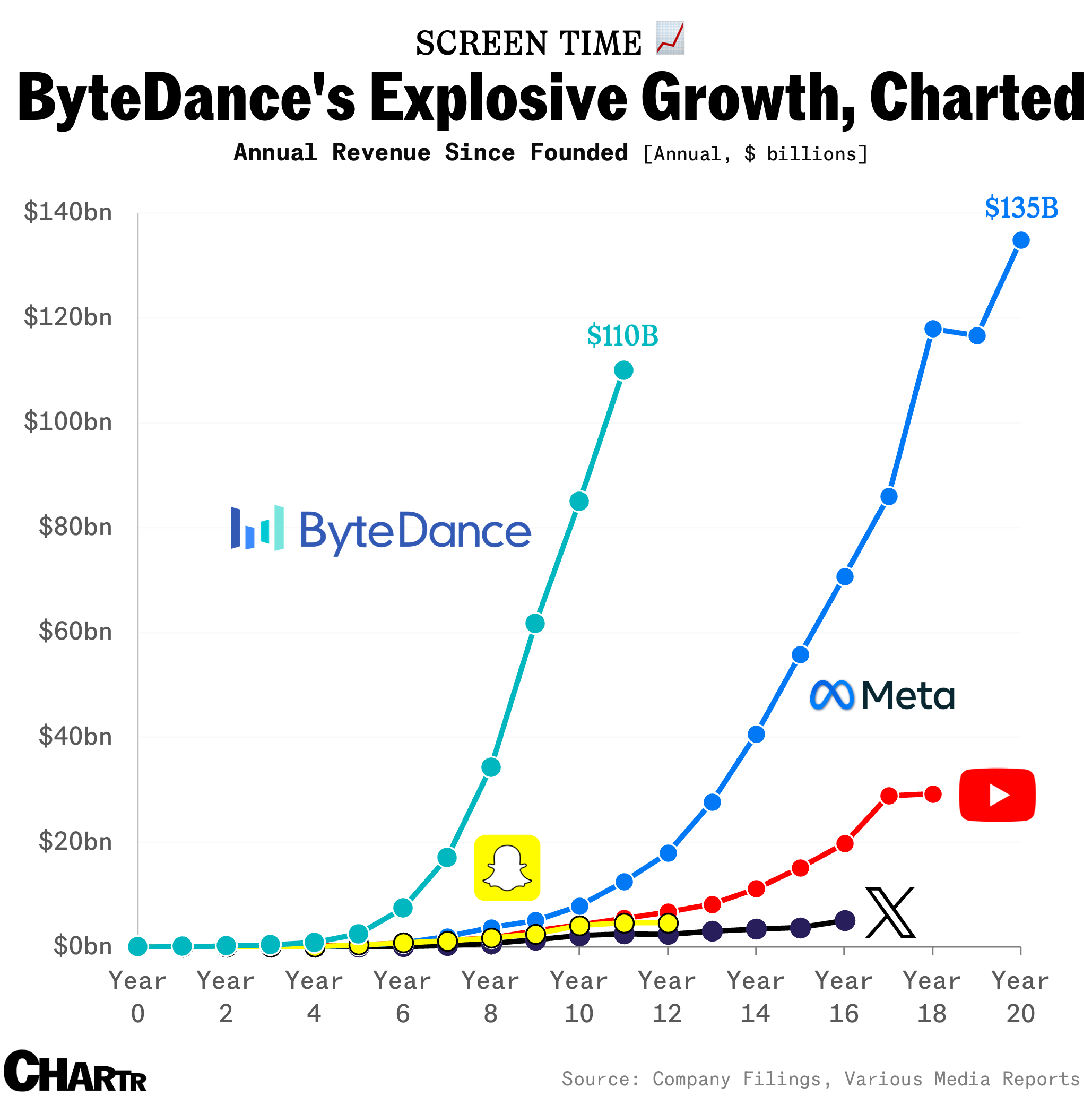
ByteDance revenue vs. Meta
Sherwood News

With Reuters reporting that ByteDance has no IPO plans in sight, the buyback program is a way of providing the company’s shareholders — who are sitting on a potential goldmine — with liquidity. The recent deal is the third buyback program since 2022. The round in December 2023 boosted its valuation to $268 billion.

Going vertical

You could argue that ByteDance’s valuation is not that high on a relative basis. Meta’s market cap (~$1.4 trillion) is more than 10x its latest full-year of revenue — ByteDance’s is just 2.7x its own. That reflects a few differences, including the fact that ByteDance is not a pure advertising company in quite the same way Meta is, generating a substantial portion of its sales from e-commerce (which likely produces a slimmer margin).

It might also partly reflect the prospect of a looming TikTok ban in the US, where the app has 170 million users. Largely in the context of national security concerns, President Biden signed a law this April that gave ByteDance until early January to sell TikTok or face a ban. Former president Trump once favored the pending ban but recently reversed his stance

More Tech

See all Tech
tech

FT: Anthropic staff helping the NSA use Mythos for offensive cyberattacks

Anthropic’s Mythos AI model was deemed too dangerous to release to the public, with the company citing its ability to orchestrate novel cyberattacks.

And that’s just what the National Security Agency is doing, with the help of Anthropic staff embedded at the agency, according to a report from the Financial Times.

Only a small number of companies and US allies have been given access to the advanced model, which means America’s adversaries have not had the chance to shore up their defenses against the AI model’s new offensive capabilities.

The arrangement is especially unusual as the Pentagon has deemed Anthropic’s AI a national security supply chain risk — effectively blacklisting it for defense work — in response to the company’s refusal to allow its technology to be used for any legal application, which could include autonomous killing or mass surveillance. Anthropic is currently suing the US government to fight the determination.

Only a small number of companies and US allies have been given access to the advanced model, which means America’s adversaries have not had the chance to shore up their defenses against the AI model’s new offensive capabilities.

The arrangement is especially unusual as the Pentagon has deemed Anthropic’s AI a national security supply chain risk — effectively blacklisting it for defense work — in response to the company’s refusal to allow its technology to be used for any legal application, which could include autonomous killing or mass surveillance. Anthropic is currently suing the US government to fight the determination.

tech

Longtime Tesla bear JPMorgan upgraded Tesla and raised its price target to $475 from $145

For more than a decade, JPMorgan was Wall Streets most stubborn Tesla skeptic, anchored by auto analyst Ryan Brinkman’s strict focus on traditional car fundamentals and near-term delivery numbers.

But JPM recently handed coverage of the stock to a new analyst, Rajat Gupta, who is throwing that playbook out the window. In a note Friday, the firm upgraded Tesla to neutral from underweight and raised its price target 228% to $475 from $145. (The analyst consensus on FactSet is $403.) Instead of focusing on the company’s struggling vehicle business, the new analyst is orienting himself more toward Tesla’s idea of the future, now modeling Tesla’s physical AI and robotaxi fleets all the way out to the year 2040.

Here are the main reasons for the capitulation:

  • Looking past the car lot: Gupta argues that Tesla is at the forefront of physical AI, entering uncharted TAMs” and therefore deserves the benefit of the doubt to be valued on LT earnings potential rather than near-term speed bumps.

  • Unmatched vertical integration: Teslas control over everything from battery cells to custom silicon gives it a massive moat. JPM notes this starting point advantage is unmatched at an industrial level scale” and “still somewhat under-appreciated and misunderstood.

  • The AWS flywheel effect: Deploying Optimus robots inside its own factories should not only lower COGS for the base automotive business, but more importantly, help validate the product at an industrial scale.” Gupta called it “a classic flywheel effect, somewhat analogous to AWS and Kiva at AMZN.

For Tesla bulls who have argued for years that this is an AI company and not a carmaker, JPM’s sudden $3.9 trillion valuation model is the ultimate validation.

skynet terminator

Anthropic ponders self-improving AI

Anthropic says Claude already writes 80% of its code. A new post asks what happens when the models can improve themselves — and whether anyone could stop them.

tech

ChatGPT hit 1 billion users nearly twice as fast as TikTok did

It took Facebook and Instagram around eight years; it took YouTube just over six; even TikTok, which at the time felt like it was a global sensation almost as soon as it arrived, took more than half a decade.

Now, though, the mobile version of ChatGPT has positively left the biggest platforms (and all of your other favorite apps) in the dust, hitting 1 billion monthly active users in just three years, per new data from market intelligence firm Sensor Tower, as more users turn to OpenAI’s chatbot each month.

ChatGPT 1 billion users chart
Sherwood News

While rival Anthropic might be pulling ahead in terms of annualized recurring revenue, enterprise customer adoption, and valuation, the app version of Claude, a market-leading chatbot on several counts, has clocked only 56 million monthly active users in the quarter to date.

In fact, according to Abe Yousef, a senior insights analyst at Sensor Tower, ChatGPT’s monthly active user count for the quarter to date outweighs the figures for Claude, Gemini (472 million), Doubao (106 million), Dola (78 million), DeepSeek (68 million), Meta AI (61 million), Grok (50 million), Perplexity (44 million), and Copilot (31 million)... combined.

ChatGPT made a pretty big splash in the tech world when it landed toward the end of 2022, but there’s no question that the mobile versions — which launched on iOS in May 2023, then on Android a couple months later — helped to catapult the chatbot into the mainstream proper.

Latest Stories

Sherwood Media, LLC and Chartr Limited produce fresh and unique perspectives on topical financial news and are fully owned subsidiaries of Robinhood Markets, Inc., and any views expressed here do not necessarily reflect the views of any other Robinhood affiliate, including Robinhood Markets, Inc., Robinhood Financial LLC, Robinhood Securities, LLC, Robinhood Crypto, LLC, Robinhood Money, LLC, Robinhood U.K. Ltd, Robinhood Derivatives, LLC, Robinhood Gold, LLC, Robinhood Asset Management, LLC, Robinhood Credit, Inc., Robinhood Ventures DE, LLC and, where applicable, its managed investment vehicles.

