

Tech
tech

China’s startup ecosystem is dead

A total of 260 companies have been founded this year in China, a nation of more than 1.4 billion people, according to data published today in a Financial Times deep dive into the country’s startup woes. 

That’s not a typo. From peak to trough, the number of companies being founded in China has dropped 99.5% from more than 51,000, according to the statistics, which came from data provider IT Juzi. 

“The whole industry has just died before our eyes,” a company executive in Beijing told the FT. The reasons are myriad: China’s equity markets are stagnant, its economy is slowing, the property bubble has popped, and it was hurt deeply by Covid-19. US investors are also pulling money out of the country as geopolitical tensions have risen.

One venture capital insider said: “Five years ago, the venture capital and private equity guys were masters of the universe… Now they’re depressed.”

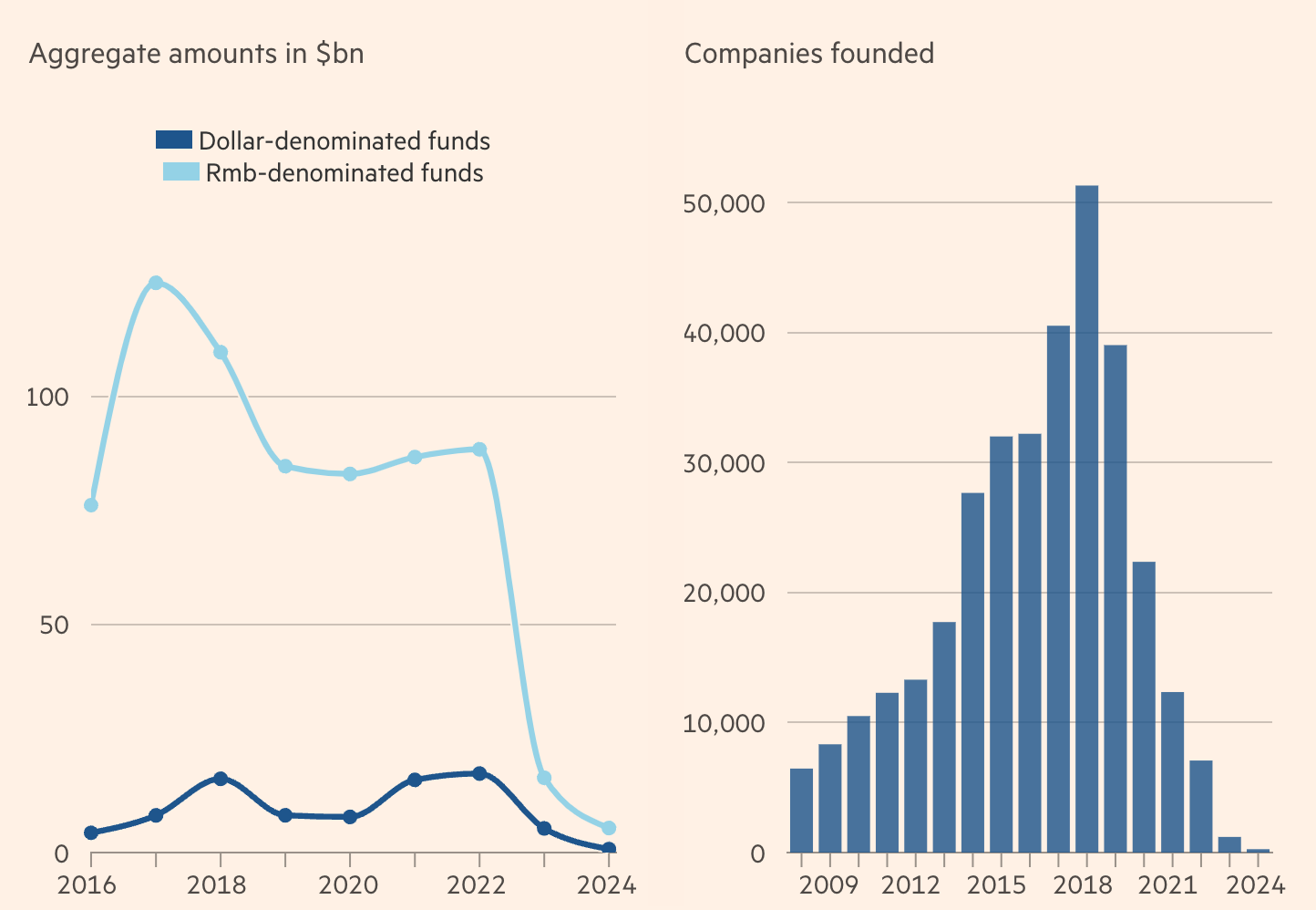
“The whole industry has just died before our eyes,” a company executive in Beijing told the FT. The reasons are myriad: China’s equity markets are stagnant, its economy is slowing, the property bubble has popped, and it was hurt deeply by Covid-19. US investors are also pulling money out of the country as geopolitical tensions have risen.

One venture capital insider said: “Five years ago, the venture capital and private equity guys were masters of the universe… Now they’re depressed.”

More Tech

See all Tech
tech

Report: OpenAI may tailor a version of ChatGPT for UAE that prohibits LGBTQ+ content

In June of last year, OpenAI CEO Sam Altman appeared in Abu Dhabi, UAE, alongside Nvidia CEO Jensen Huang to announce “Stargate UAE,” a project that includes a 1-gigawatt AI data center in Abu Dhabi, and a commitment to invest in the Stargate USA project.

OpenAI has announced that it is interested in jumping on the “sovereign AI” train, helping countries roll out their own AI services that reflect their own language, culture, and version of history.

Today, Semafor is reporting that OpenAI is in talks to develop a tailored version of ChatGPT for the UAE that would align with the kingdom’s conservative social laws and speech restrictions, such as disallowing discussion of LGBTQ+ content. The UAE-owned MGX investment firm is an investor in OpenAI.

The company announced its OpenAI for Countries initiative in May of last year, which aims to “help interested governments build sovereign AI capability in coordination with the U.S. government — rooted in democratic values, open markets, and trusted partnerships.”

The UAE is a monarchy with a history of human rights violations.

OpenAI has announced that it is interested in jumping on the “sovereign AI” train, helping countries roll out their own AI services that reflect their own language, culture, and version of history.

Today, Semafor is reporting that OpenAI is in talks to develop a tailored version of ChatGPT for the UAE that would align with the kingdom’s conservative social laws and speech restrictions, such as disallowing discussion of LGBTQ+ content. The UAE-owned MGX investment firm is an investor in OpenAI.

The company announced its OpenAI for Countries initiative in May of last year, which aims to “help interested governments build sovereign AI capability in coordination with the U.S. government — rooted in democratic values, open markets, and trusted partnerships.”

The UAE is a monarchy with a history of human rights violations.

Allen & Co Brings Together Media And Tech Titans In Sun Valley

Analysts think Amazon’s sky-high capex is a good thing, even if there’s “shock value” for investors

That said, several analysts also lowered their price targets for Amazon the day after its downbeat earnings report.

tech

Big Tech’s $1.1 trillion cloud computing backlog

Now that the big dogs of cloud computing have all reported their quarterly earnings, we can step back and get a sense of the searing demand that AI is driving toward their businesses.

Amazon, Google, and Microsoft each reported hundreds of billions in RPO (remaining performance obligations) — signed contracts for cloud computing services that can’t yet be filled and haven’t yet hit the books.

Collectively, the big three cloud providers reported a $1.1 TRILLION backlog of revenue.

This gargantuan demand could be good news for the “neoscalers” like CoreWeave and Nebius. But even CoreWeave is reporting a substantial backlog of its own — $55 billion last quarter.

tech

Big Tech capital expenditure soared in 2025. It’s going up another 50% in 2026.

Last quarter was one for the record books when it came to Big Tech’s purchases of property and equipment. Combined, Amazon, Alphabet, Microsoft, and Meta spent nearly $400 billion on capex, sans leases, in total last year, mostly in service of building out the AI infrastructure that they hope will furnish their futures.

And 2026 is only getting more expensive.

The four are expected to spend 50% more in 2026 than in 2025: roughly $600 billion. Amazon said it’s on the hook for $200 billion in capex this year, while Google expects to spend between $175 billion and $185 billion. Not too far behind, Meta estimated its 2026 capex would be $115 billion to $135 billion. Microsoft didn’t give an estimate, but analysts have its 2026 calendar year capex at around $114 billion. However, it should be noted that analysts’ expectations for 2026 were way lower than the reality for the rest.

Latest Stories

Sherwood Media, LLC produces fresh and unique perspectives on topical financial news and is a fully owned subsidiary of Robinhood Markets, Inc., and any views expressed here do not necessarily reflect the views of any other Robinhood affiliate, including Robinhood Markets, Inc., Robinhood Financial LLC, Robinhood Securities, LLC, Robinhood Crypto, LLC, or Robinhood Money, LLC.
