
Tech
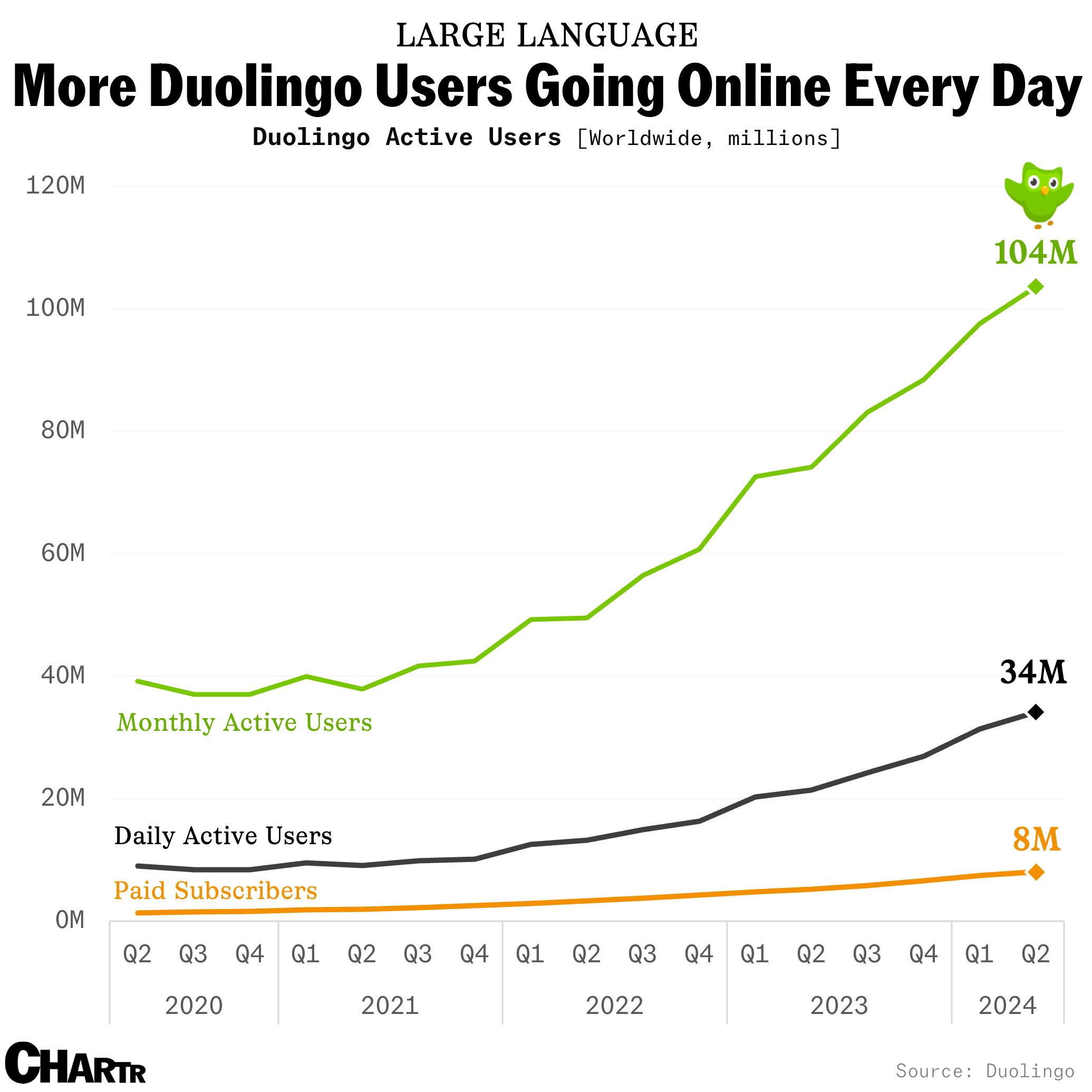
Duolingo now has more than 100 million monthly active users
Sherwood News

Duolingo notifications: persistent, annoying, and oh-so-effective

The language-learning app now has more than 100 million monthly active users

Dua Lipa. Brazilian butt lifts. Clapping back in the comments.

Not a slam poem about the digital age, but rather some of the unconventional marketing strategies employed by the world’s leading mobile learning platform… by way of a green owl mascot with a penchant for intimidation.

Owl for one...

Duolingo — the app that encourages users to learn languages by completing short daily lessons — has exploded in popularity since its founding in 2011. In that time, it’s built a uniquely offbeat online presence, as well as a reputation for persistent notifications and overt gamification.

The company’s latest earnings, released Wednesday, reported its 5th consecutive profitable quarter, with total bookings of ~$190 million and net income of over $24 million, a more than 6x increase on the same period a year prior. It also saw Duolingo hit a significant milestone: 100 million monthly active users (MAUs).
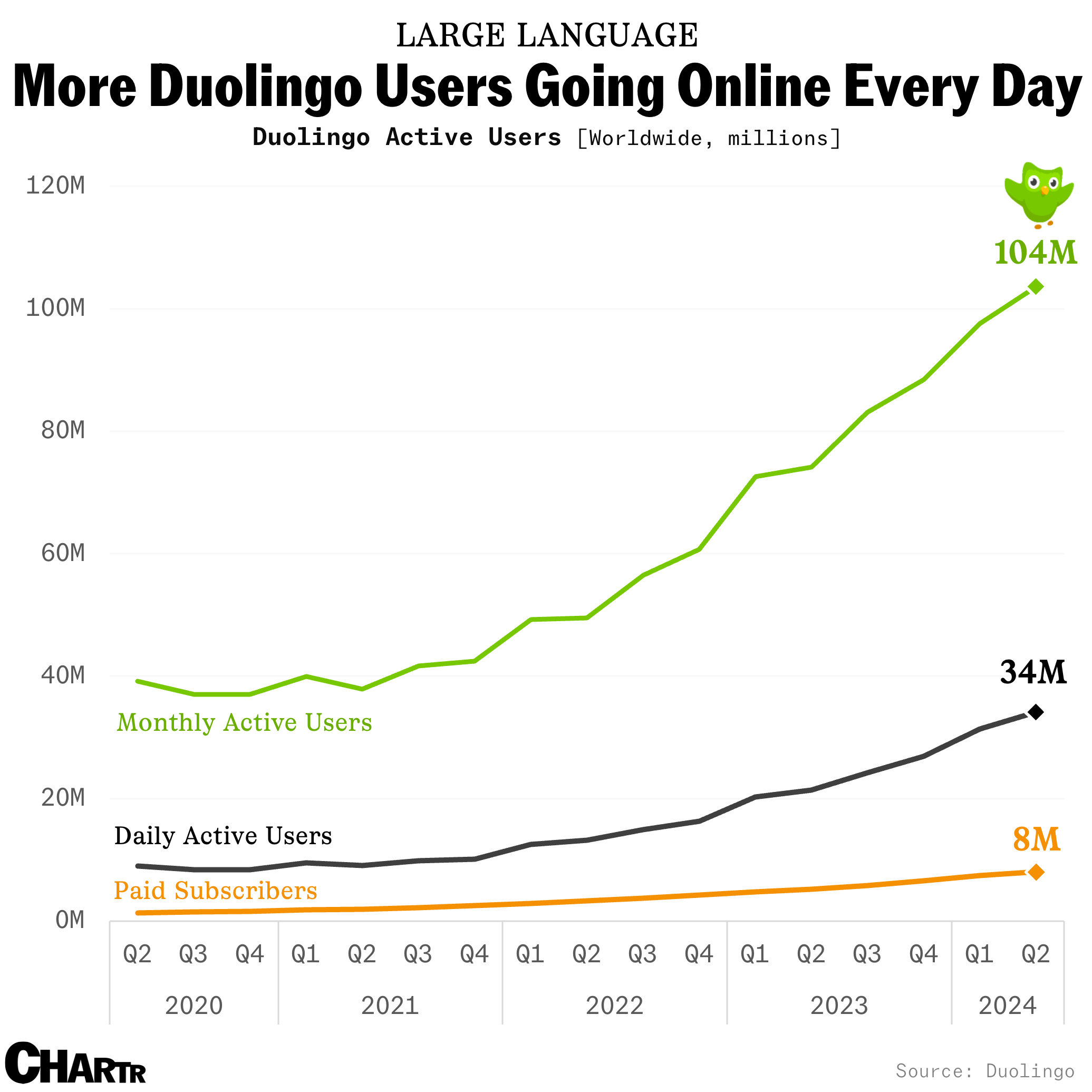
Duolingo now has more than 100 million monthly active users
Sherwood News

Although the Q2 report sent Duolingo shares up more than 10% on the news, it’s been a bumpy year for the stock, which is still down 21% year-to-date. Analysts have pointed to a deceleration in growth for its vital daily active user count in the previous quarter as a reason why investors might be tentative to go all-in on lingo.

…and one for Owl

With users as its lifeblood, retaining aspiring polyglots, and eventually converting them to paying customers, is critical. That’s a tactic that Duolingo has down to a fine art, thanks to its 'make learning fun' approach to language tuition and heavily gamified user interface.

From the perspective of a Duolingo novice, the outline of how “studying” works on the app might seem more fitting to an arcade than a learning platform: users gain XP (experience points) as they learn, they can win gems, they keep hold of hearts, and, of course, they must return to the app day-after-day if they are to maintain their all-important streak.

It’s perhaps no surprise, then, that Duolingo is beloved by video game-raised Gen Z. For all its addictive hooks, though, the company’s quirky social media page is what’s really cemented the brand’s identity in the zeitgeist.
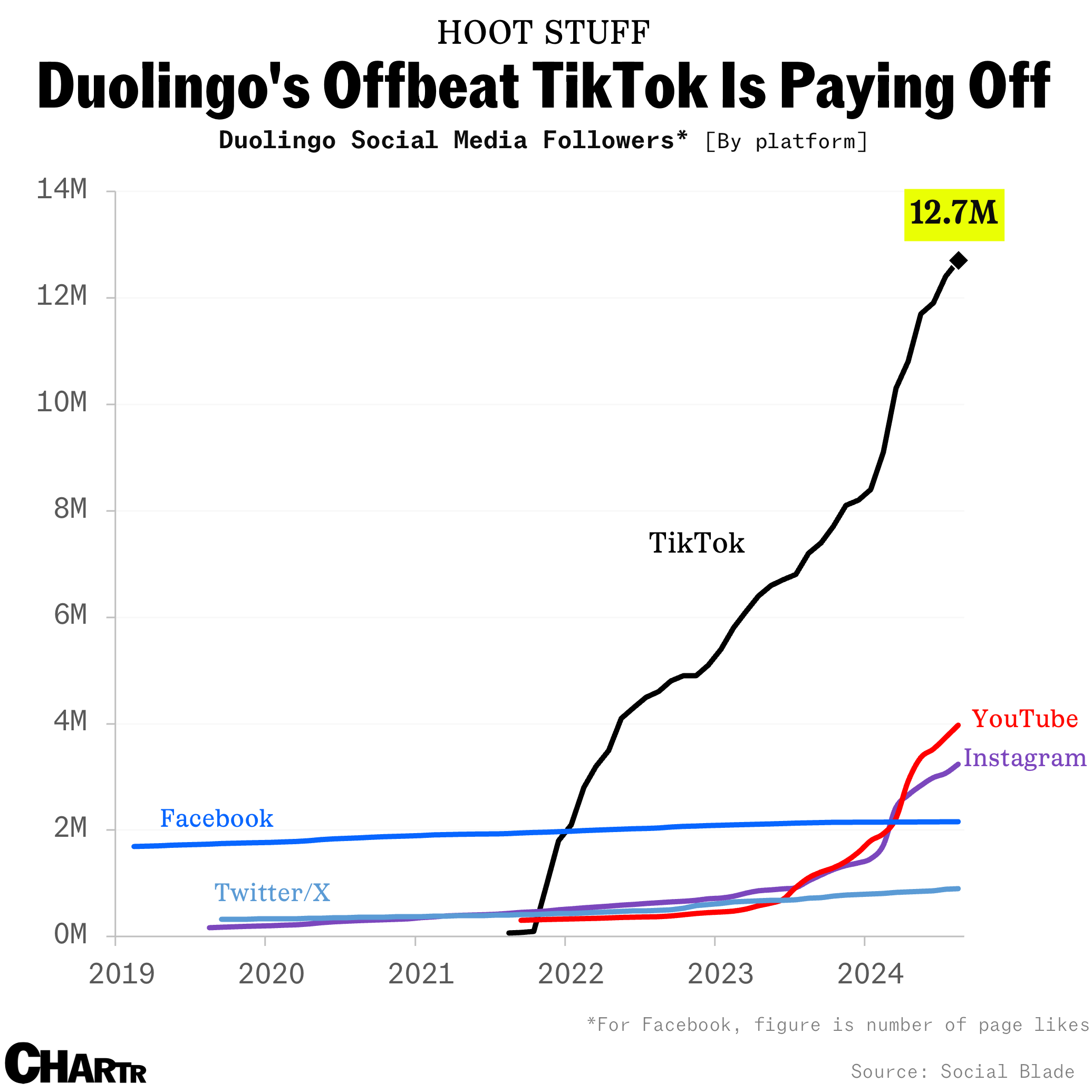
Duolingo’s TikTok follower count is soaring
Sherwood News

Sharp-tongued

Although it’s existed as a language-learning platform for over a decade, Duolingo’s foray into “unhinged” marketing began in 2021, when a 23-year-old graduate asked if they could make videos for the brand’s inactive TikTok account.

Since then, Duolingo has developed an online presence that at once straddles being timely, suggestive, and threatening — which younger audiences seemingly can’t help but respond to, with the company stating in a 2022 blog post that ~60% of all its US learners were under 30. As such, Duolingo’s TikTok followers continue to boom with its eccentric content, growing by 76% in the past year alone.

A masterclass in the marketing power of direct audience engagement and the cringe-inducing phenomenon of “trendjacking” (see: Duolingo chiming in on “brat summer” for some reason), Duolingo uses its image to push its primary objective, which ultimately pays its bills: getting people to use the app every single day.

Remember me?

This year’s Super Bowl wasn’t short of weird ads, but none were stranger than a five-second animation of a green owl producing its own face from its backside with the adage: “do your duolingo”.

If that wasn’t enough, the commercial was accompanied by a push notification for its US app users stating, “No buts, do a lesson now.” This kind of reminder was likely met with little surprise from Duolingo veterans, who are now used to being scolded by what Kelli María Korducki at Business Insider recently described as “the world’s meanest app”.

Indeed, people who download Duolingo for the sake of learning a language are often taken aback by the blackmail-adjacent tactics used by the app to keep them on-track. If you’re completing daily lessons, you will receive encouragement (“Your health is full again!”). But, if you’re inactive for too long, Duolingo’s messages start to sour: “You’re falling behind!”; “These reminders don’t seem to be working”; “It looks like you've learned how to say 'quitter' in Portuguese."

Still, whatever anyone might think of its “evil Duolingo owl” persona and broader marketing tactics, they seem to work.
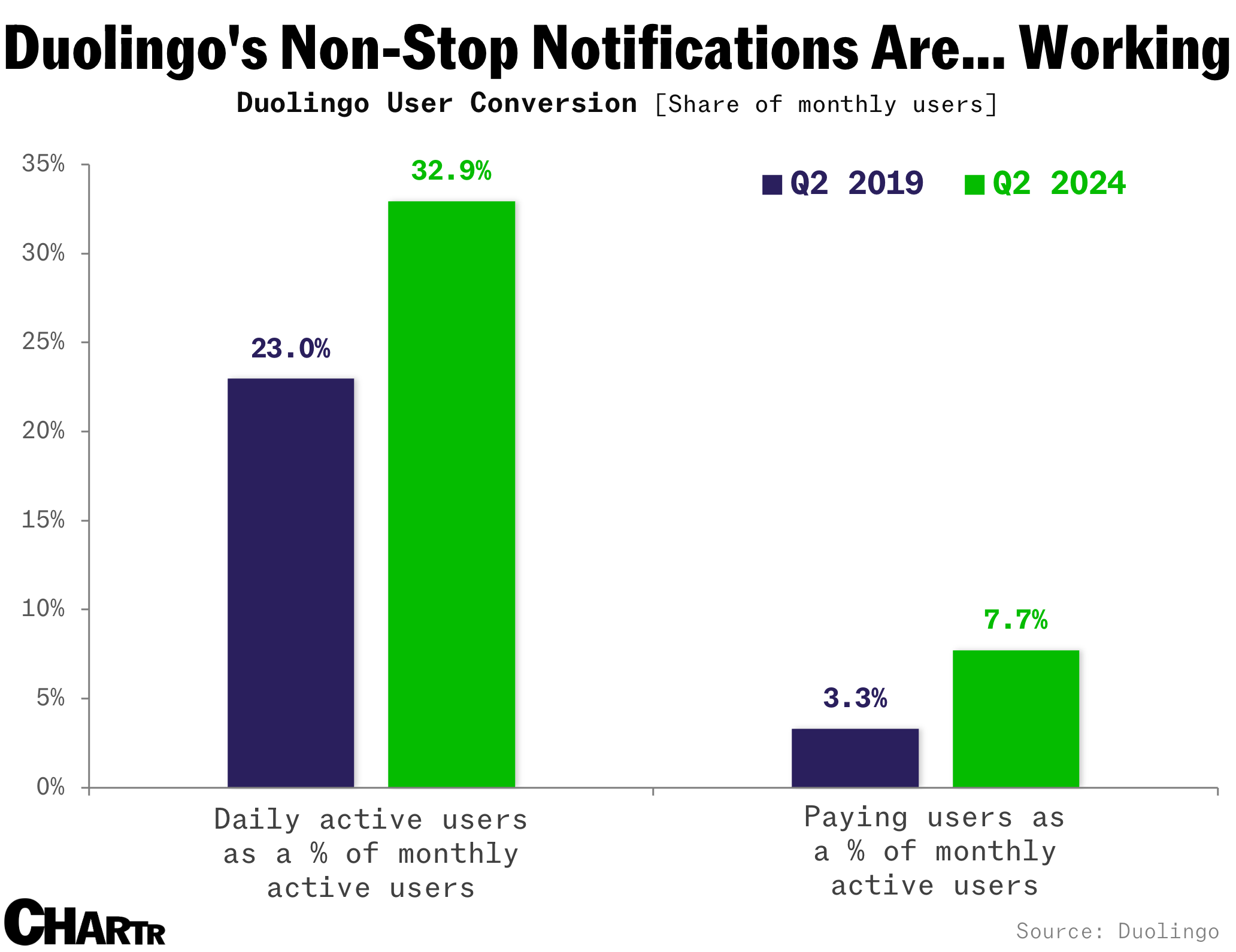
Duolingo conversion rates are rising
Sherwood News

Pushed for cash

Turns out, Duolingo’s guilt-tripping is getting results. In the company’s most recent quarter, ~33% of MAUs were reported as using the app daily, up nearly a full 10 percentage points on the same quarter 5 years ago. The proportion of MAUs that pay for the service has more than doubled over the same period.

The successful conversion of ad-tiered to paying users makes Duolingo one of the most effective freemium models in the industry. And, beyond its ad-free, $12.99-monthly Super Duolingo tier is an even more advanced service: Duolingo Max, which incorporates AI-generated features for an extra $17 a month.

Language model

Indeed, Duolingo was one of the first major customers of OpenAI’s GPT-4, and since March 2023 it has rolled out “highly-personalized language lessons” using the technology, including chatbots and an “explain my answer” feature. In January, the company cut 10% of its contractor jobs, which was blamed at least in part on the use of AI.

It’s impossible to predict what language learning might look like in years to come, and perhaps highly gamified, AI-driven apps will be the (somewhat depressing) future. But, at least we don’t have to wonder what it would be like if the Duolingo bot becomes so advanced that it develops feelings — the owl already hates you for missing your lessons.


More Tech

See all Tech
tech
Tom Jones

Prediction markets have, predictably, been given a boost by the summer of sports

Major platforms like Kalshi and Polymarket have seen huge upticks in users of late, thanks in no small part to what’s felt like a recent sporting smorgasbord, with major competitions across hockey, basketball, and soccer soaking up fans’ time (and spending, clearly) at the outset of summer.

While gaming industry groups may not like it, there’s been a huge change in the methods people are using to put money on the big games, with everyone from fortunate NYC bar owners, to a far less fortunate Spanish supporter, turning to prediction markets to try and turn their sports know-how into cold, hard cash.

According to a new report from Adam Blacker for apptopia, that shift might have been even more seismic than imagined in the wake of the NBA and NHL finals and around the 2026 World Cup kicking off.

While gaming industry groups may not like it, there’s been a huge change in the methods people are using to put money on the big games, with everyone from fortunate NYC bar owners, to a far less fortunate Spanish supporter, turning to prediction markets to try and turn their sports know-how into cold, hard cash.

According to a new report from Adam Blacker for apptopia, that shift might have been even more seismic than imagined in the wake of the NBA and NHL finals and around the 2026 World Cup kicking off.

South by Southwest Conference and Festivals

Gold Tesla Cybercabs are piling up, but they’re not picking up passengers yet

Low-volume production started in April. Now people are noticing them more and more in the wild.

Rani Molla6/15/26
tech
Jon Keegan

Anthropic pulls Fable and Mythos access worldwide after Trump administration bars their use by foreign nationals

Only days after releasing two versions of its next-gen AI model, Anthropic has disabled them for users worldwide.

Anthropic says it received a Friday night order from the Trump administration to suspend access to the models for any foreign national (anywhere in the world) — a group that included some Anthropic employees. In response, the company turned off access to everyone.

Last week, the company released to the public its much-anticipated Claude Fable 5 model (and its restricted version Claude Mythos 5, which is still being tested with trusted partners). Anthropic said in a blog post announcing the action that officials cited national security concerns with the new models, while offering few specific details.

The post said that the government gave the company “verbal evidence of a potential narrow, non-universal jailbreak” of the public Fable 5 model. A jailbreak is a means by which users can evade restrictions built into the code to unlock prohibited functionality. Anthropic downplayed the significance of the attack, and said other major models, such as OpenAI’s GPT-5.5, could also be affected by the technique described.

Fears of these first Mythos-class models being misused are running high, after Anthropic warned the cybersecurity world in May that the advanced cyber capabilities of Mythos have rapidly discovered thousands of vulnerabilities in ubiquitous software, leading to the decision to restrict the full version of the model to a close group of trusted partners for testing.

This morning, Axios reported that Anthropic technical staff have flown to Washington to meet with White House officials to resolve the issue.

The Wall Street Journal is reporting that the Trump administration’s decision to take action against Anthropic was prompted by discussions that Amazon CEO Andy Jassy had with officials, including Treasury Secretary Scott Bessent. According to the report, Amazon researchers said they had been able to evade some of Fable 5’s security restrictions using specific prompts. Amazon is a major investor in Anthropic.

Anthropic is currently suing the US government to fight the Pentagon’s blacklisting of the company on national security grounds.

Last week, the company released to the public its much-anticipated Claude Fable 5 model (and its restricted version Claude Mythos 5, which is still being tested with trusted partners). Anthropic said in a blog post announcing the action that officials cited national security concerns with the new models, while offering few specific details.

The post said that the government gave the company “verbal evidence of a potential narrow, non-universal jailbreak” of the public Fable 5 model. A jailbreak is a means by which users can evade restrictions built into the code to unlock prohibited functionality. Anthropic downplayed the significance of the attack, and said other major models, such as OpenAI’s GPT-5.5, could also be affected by the technique described.

Fears of these first Mythos-class models being misused are running high, after Anthropic warned the cybersecurity world in May that the advanced cyber capabilities of Mythos have rapidly discovered thousands of vulnerabilities in ubiquitous software, leading to the decision to restrict the full version of the model to a close group of trusted partners for testing.

This morning, Axios reported that Anthropic technical staff have flown to Washington to meet with White House officials to resolve the issue.

The Wall Street Journal is reporting that the Trump administration’s decision to take action against Anthropic was prompted by discussions that Amazon CEO Andy Jassy had with officials, including Treasury Secretary Scott Bessent. According to the report, Amazon researchers said they had been able to evade some of Fable 5’s security restrictions using specific prompts. Amazon is a major investor in Anthropic.

Anthropic is currently suing the US government to fight the Pentagon’s blacklisting of the company on national security grounds.

Latest Stories

Sherwood Media, LLC and Chartr Limited produce fresh and unique perspectives on topical financial news and are fully owned subsidiaries of Robinhood Markets, Inc., and any views expressed here do not necessarily reflect the views of any other Robinhood affiliate, including Robinhood Markets, Inc., Robinhood Financial LLC, Robinhood Securities, LLC, Robinhood Crypto, LLC, Robinhood Money, LLC, Robinhood U.K. Ltd, Robinhood Derivatives, LLC, Robinhood Gold, LLC, Robinhood Asset Management, LLC, Robinhood Credit, Inc., Robinhood Ventures DE, LLC and, where applicable, its managed investment vehicles.
