
Tech

Frozen Dead Guys

The audacious and expensive world of cryogenics

US-NORWAY-TRADITION-DEATH-FESTIVAL-OFFBEAT
Dan Thomas of Parker, Colorado, is dressed as the late Bredo Morstol during Frozen Dead Guy Days festival. (Photo by Jason Connolly / AFP)

Efforts to cheat death could advance real-world science

10,000 people gather to celebrate “Frozen Dead Guy Days,” the Super Bowl of cryogenic fans.

On February 28 “Grandpa Bredo” turned 124. He’s been cryogenically frozen for 34 years.

Last month, 10,000 or so people gathered where Bredo Morstoel’s body resides, in Estes Park, Colorado, to celebrate the guy who “Frozen Dead Guy Days” has rallied around for more than two decades. The macabre event is a celebration of death (coffin races, a band dressed as mummies) and horror (Estes Park is not coincidentally the site of the hotel that inspired “The Shining”). But this year Frozen Dead Guy Days also served as an educational outreach event for the world’s oldest cryogenic-freezing company, Alcor.

A 52-year-old nonprofit with 230 patients in cold storage and 1,400 signed up to join them, Alcor stepped in last year to freeze the body of Grandpa Bredo, giving him a first-class upgrade from a shed tended by locals in the nearby town of Nederland, to one of its stainless-steel pods, before ferrying him to Estes Park. There, they built the first and only cryo-dedicated museum around it and made Frozen Dead Guy Days its Super Bowl. 

While the (un)beating heart of the fest has stayed mostly the same, Alcor has made a couple of additions to educate, and upsell, the cryo-curious. Attendees are encouraged to take a tour of Alcor’s International Cryonics Museum, where they’ll find a promo code for 25% off freezing services. And in the middle of FDGD’s main event, the coffin races (teams carry a coffin with a teammate inside around an obstacle course), Alcor now does a demonstration of the first phases of its freezing process. Spoiler alert: it’s not the most sentimental sendoff and involves a lot of ice.
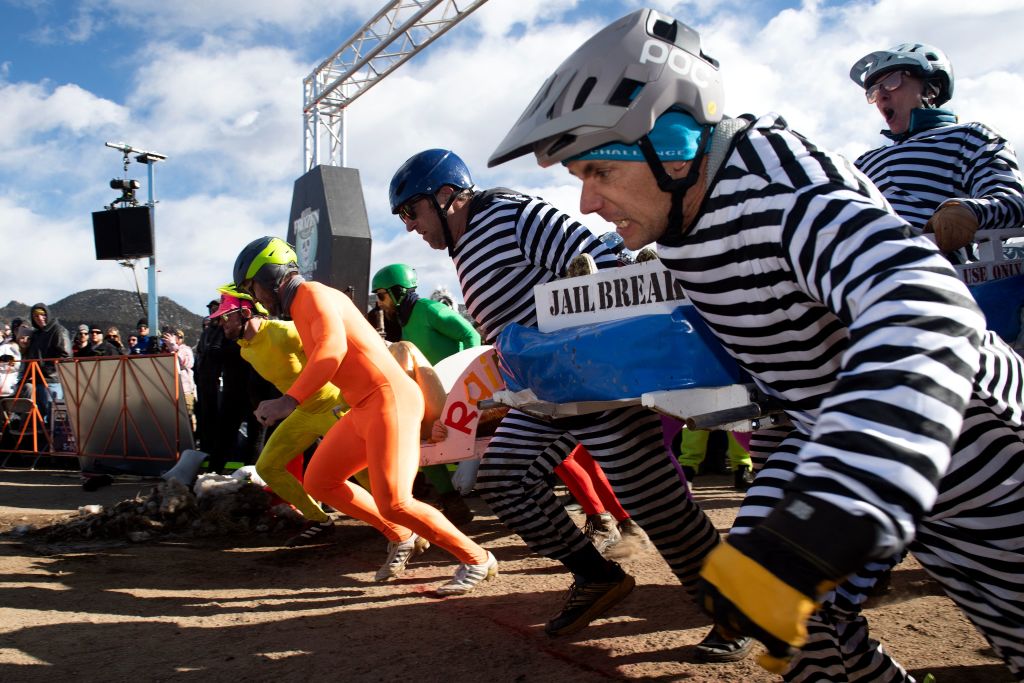
US-NORWAY-TRADITION-DEATH-FESTIVAL-OFFBEAT
The coffin race during the Frozen Dead Guy Days festival. (Jason Connolly/AFP via Getty Images)

Alcor charges $220,000 for full-body preservation and $80,000 for just the brain, plus a monthly fee of up to  $100. Adding Alcor as their  life-insurance beneficiary is how many patients afford the huge sum . That’s much more than Alcor’s competitors: the Cryonics Institute charges between $28,000 and $35,000, and up to $60,000 in fees for extras, as well as annual or one-time dues. Russia-based KrioRus’s charges are said to be similar: $36,000 for whole-body freezing and $15,000 for the brain. 

Alcor says it uses that extra money to ensure its patients long-term care. $140,000 of the $220,000 fee is placed  in a trust for costs such as  refilling the pod’s liquid nitrogen. The trust, managed by Morgan Stanley, was worth $15 million as of 2021. Alcor told Sherwood it could actually lose money on individual patients after the costs of the supplies and crew are tallied up.

Cryogenic facilities have one other source of funds: patients who pay to freeze their pets. About 100 cats, dogs, and other animals are frozen at Alcor. Members can opt to pay as much as $130,000 to fully freeze their furry companions with “no guarantees or representations that the science will be advanced enough to provide any form of revival of a pet during an owner’s lifetime.” 
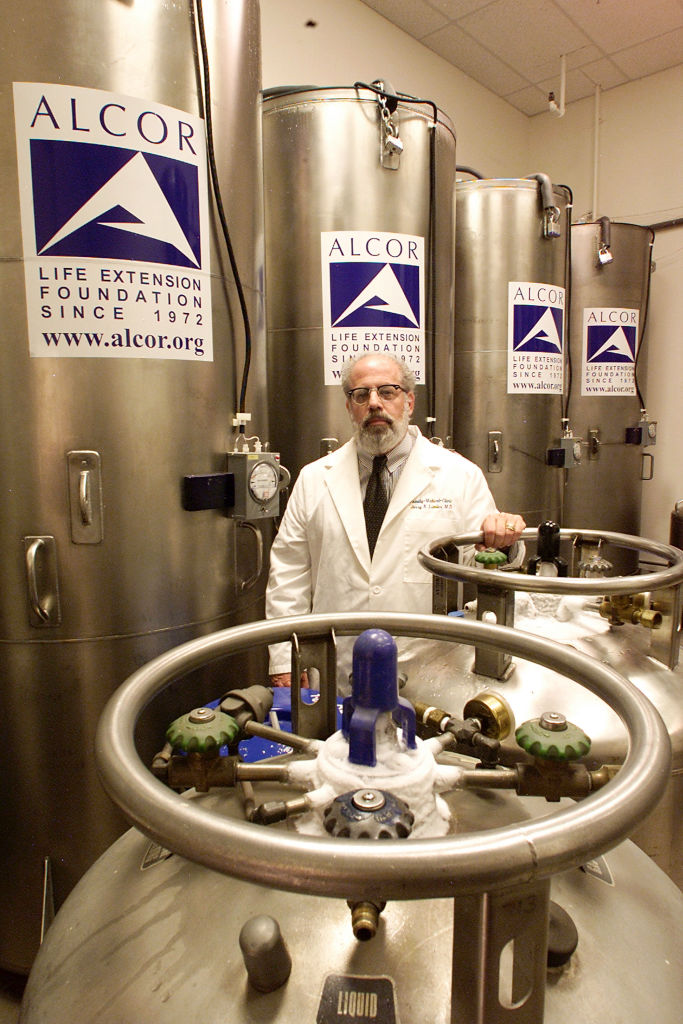
Alcor Life Extension Foundation
Former President and CEO of Alcor Life Extension Foundation Dr. Jerry Lemler, poses in the Patient Care Bay. (Jeff Topping/Getty Images)

That “no guarantees” language is a mainstay of cryo companies’ marketing materials because no one who’s been frozen has been reanimated, at least not yet, and there’s no certainty anyone ever will be. For some, the eventual, potential promise of coming back to life is enough incentive to shell out hundreds of thousands. 

Not everyone who signs up expects to be revived. Billionaire entrepreneur Peter Thiel has called his decision to be frozen by Alcor an “ideological statement,” though he doesn’t expect it will bring him back to life.

“If you’re 10% successful, you change medicine, even if you never get to the ultimate goal of a brain becoming conscious again.”


Alcor co-CEO and President James Arrowood told Sherwood that he estimates “10–20% are on one end of the spectrum, where they absolutely think that this will work someday and maybe there’ll be consciousness in a meaningful way,” and there’s another “20% of people who think it probably will never work at all, but want to contribute to the science advancements that occur as a result of the research.” As for the majority, Arrowood put their sentiment like this: “There’s a 0.0001% chance it’ll work but if it will work and I can benefit science in the meantime…why not.”

The cryogenic-afterlife industry also likely gets a halo effect (pun intended) from other longevity-chasing trends. OpenAI CEO Sam Altman has signed up to have his brain embalmed by startup Nectome, which Altman said may eventually upload it to the cloud. Just getting on Nectome’s waitlist costs $10,000. 

Other techpreneurs want to avoid the afterlife altogether. Venture capitalist Bryan Johnson spends $2 million a year trying to opt out of death through hundreds of supplements, MRI scans, microneedling treatments, and, in one experiment, a blood-plasma transfusion from his son. Amazon founder Jeff Bezos and Meta boss Mark Zuckerberg have taken a more passive approach, investing millions in anti-aging research. 

The money that immortality-chasers pour into longevity trends, both as consumers and patrons, is furthering real-world scientific progress. Even cryogenic freezing is less “Star Trek” than it sounds: human embryos are already cryopreserved as part of in-vitro fertilization. In the future, cryogenic freezing could help store human organs, keeping them viable longer for transfers. It could also save and revive endangered species.

Even if the millions spent trying to cheat death doesn’t achieve its intended goal and none of the bodies are ever reanimated, the scientific contribution could improve the world for the living. Or as Arrowood told Sherwood, “If you’re 10% successful, you change medicine, even if you never get to the ultimate goal of a brain becoming conscious again.”

More Tech

See all Tech
tech

Tesla’s made-in-China vehicle sales jumped 36% in April

Tesla’s sales of made-in-China vehicles — sold across China, Europe, and other international markets — rose 36% year over year to 79,478 units in April. The increase marks a sixth straight month of annual growth in sales of vehicles made in the world's largest manufacturing economy, suggesting the EV maker’s overseas business may be stabilizing after a difficult stretch.

That said, China wholesale deliveries fell from March, even as overall new energy vehicle sales rose 7% during the period.

Later this month, China Passenger Car Association will report China-only sales, offering a clearer picture of performance in its second-largest market.

Later this month, China Passenger Car Association will report China-only sales, offering a clearer picture of performance in its second-largest market.

tech

Anthropic’s scramble for compute now includes rival xAI

Another day, another major partnership with an AI rival. This time, Anthropic signed a deal with SpaceX’s xAI to access compute from its Colossus 1 data center to help it improve capacity for its Claude Pro and Claude Max subscribers. Just yesterday, The Information reported that Anthropic planned to spend $200 billion on Google Cloud services over the next five years. As Sherwood News’ Luke Kawa wrote:

“Anthropic has been a victim of its own success: the popularity of Claude Code and Cowork have revealed compute constraints and left users frustrated by caps. In response, the Claude developer has embarked upon a mad scramble for compute, striking or expanding deals with CoreWeave, Amazon, Google, and Broadcom.”

Now, it’s adding xAI to the list — even as the Elon Musk company builds a competing model.

In less terrestrial news, xAI said that as part of the agreement, Anthropic “expressed interest in partnering to develop multiple gigawatts of orbital AI compute capacity.”

“Anthropic has been a victim of its own success: the popularity of Claude Code and Cowork have revealed compute constraints and left users frustrated by caps. In response, the Claude developer has embarked upon a mad scramble for compute, striking or expanding deals with CoreWeave, Amazon, Google, and Broadcom.”

Now, it’s adding xAI to the list — even as the Elon Musk company builds a competing model.

In less terrestrial news, xAI said that as part of the agreement, Anthropic “expressed interest in partnering to develop multiple gigawatts of orbital AI compute capacity.”

tech

SpaceX and Tesla’s Terafab could cost $119 billion — far more than expected

The initial phase of SpaceX and Tesla’s joint chip production effort, called Terafab, could cost $55 billion, with additional phases adding up to $119 billion in capital investment, Reuters reports, citing a notice posted on a Texas county website. Ultimately the goal of Terafab is to build enough in-house AI chip capacity to supply both companies.

The price tag is also higher than expected. Morgan Stanley had previously estimated Terafab would cost $34 billion to $45 billion.

Fortunately for Tesla, whose capex is expected to skyrocket this year, much of the early spending will sit on SpaceX’s balance sheet.

Here’s Musk on the last earnings call:

“SpaceX is going to take care of like the initial phase of the scaled up Terafab... Any kind of intercompany thing has to be approved by both the SpaceX and Tesla board of directors. It’s got to go through a conflict resolution. It’s going to have, unfortunately, a lot of complexity because we’ve got to make sure Tesla shareholders are served and SpaceX shareholders are served, and strike the right balance there.”

The price tag is also higher than expected. Morgan Stanley had previously estimated Terafab would cost $34 billion to $45 billion.

Fortunately for Tesla, whose capex is expected to skyrocket this year, much of the early spending will sit on SpaceX’s balance sheet.

Here’s Musk on the last earnings call:

“SpaceX is going to take care of like the initial phase of the scaled up Terafab... Any kind of intercompany thing has to be approved by both the SpaceX and Tesla board of directors. It’s got to go through a conflict resolution. It’s going to have, unfortunately, a lot of complexity because we’ve got to make sure Tesla shareholders are served and SpaceX shareholders are served, and strike the right balance there.”

tech

Apple to let users choose between Anthropic, Google, and OpenAI models

Apple has been inching toward letting outside AI power its devices — and now it’s going further.

The company plans to let users choose between rival AI models across iOS 27, due this fall, expanding beyond ChatGPT to include players like Google and Anthropic, Bloomberg reports. The difference this time: deeper integration, with outside models powering features like Siri, writing tools, and image generation across the system.

Currently, Apple’s voice assistant, Siri, gives users the ability to query ChatGPT, but doing so requires a clunky extra step and usage has been poor. Meanwhile, Apple’s own AI tools have fallen short. (Apple has decided to use Google’s Gemini to power Siri in the future.) It’s not clear users care which AI is under the hood — as long as it works.

Currently, Apple’s voice assistant, Siri, gives users the ability to query ChatGPT, but doing so requires a clunky extra step and usage has been poor. Meanwhile, Apple’s own AI tools have fallen short. (Apple has decided to use Google’s Gemini to power Siri in the future.) It’s not clear users care which AI is under the hood — as long as it works.

Latest Stories

Sherwood Media, LLC produces fresh and unique perspectives on topical financial news and is a fully owned subsidiary of Robinhood Markets, Inc., and any views expressed here do not necessarily reflect the views of any other Robinhood affiliate, including Robinhood Markets, Inc., Robinhood Financial LLC, Robinhood Securities, LLC, Robinhood Crypto, LLC, Robinhood Derivatives, LLC, or Robinhood Money, LLC. Futures and event contracts are offered through Robinhood Derivatives, LLC.
