
Tech
A little more conversation: Company executives can't stop talking about AI

A little more conversation: Company executives can't stop talking about AI

A little more conversation

Interestingly, executives at top companies seem to be doing the exact opposite — they can’t stop talking about AI, perhaps hoping that if they position their companies as “AI forward” they may be more attractive to investors (see Nvidia becoming the latest company to join the $1 trillion club).
A little more conversation: Company executives can't stop talking about AI

Data collated by Goldman Sachs reveals that artificial intelligence has been cropping up more and more in the quarterly earnings calls of Russell 3000 companies, as businesses like Mark Zuckerberg’s Meta line up to explain to investors how AI will play a pivotal role in the wider world and within their organizations… in the future at least.

Tried and tested

That’s a lot of corporate chatter, but how much are companies actually using AI? The answer depends somewhat on your perspective.

McKinsey’s latest report into AI, published in early August, reveals that 79% of people surveyed have had at least some exposure to the tools, although only 22% of respondents say that they personally are regularly using it in their own work. For tools that (mostly) haven’t even celebrated a first birthday yet, that feels like quite a lot.

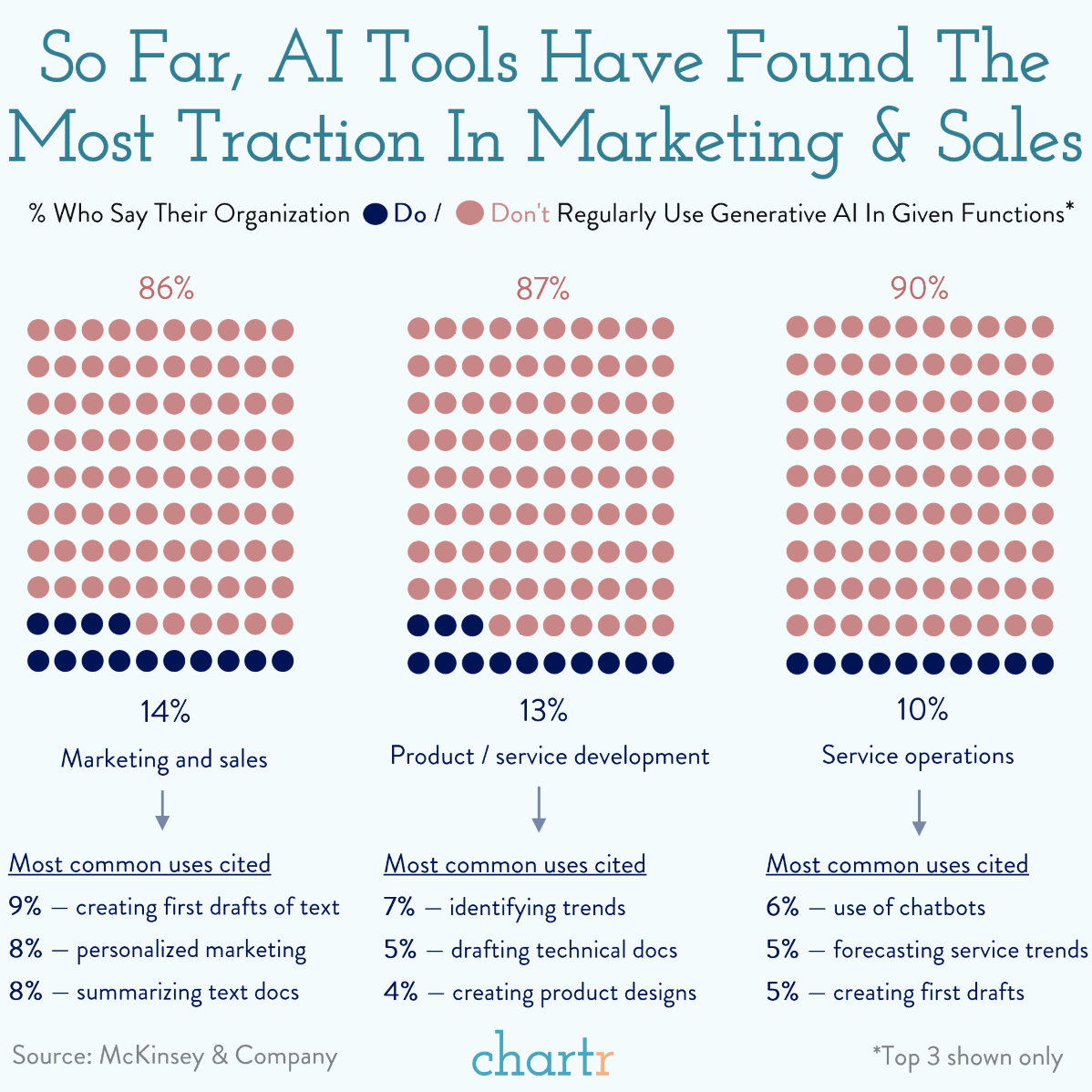
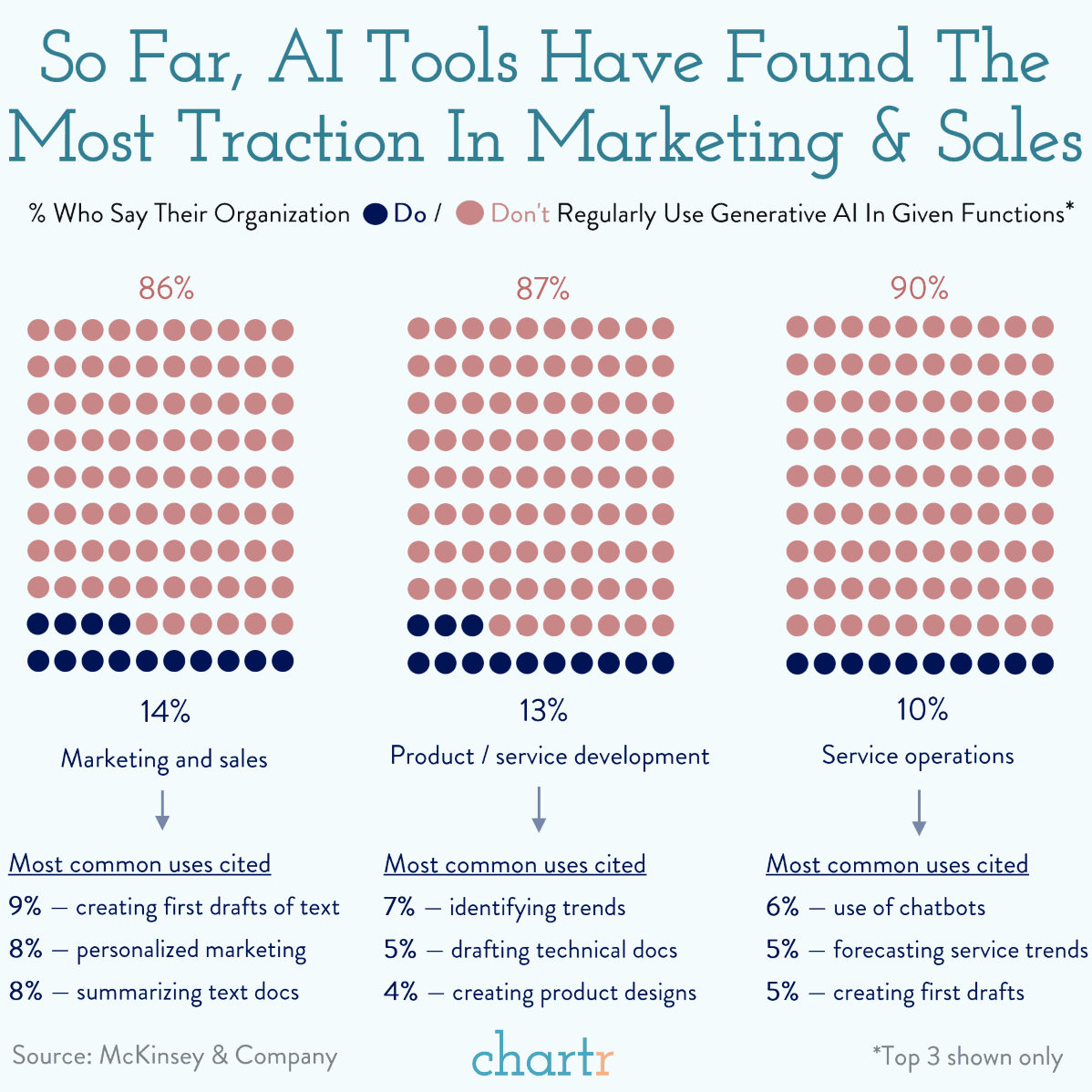
The people using it most are your pals in marketing and sales, with 14% of respondents reporting that their organizations were regularly using generative AI in that function, more than any other.
A little more conversation: Company executives can't stop talking about AI

The most common uses cited in the survey were for creating first drafts of text, personalizing marketing materials, identifying trends or communicating with customers with chatbots. AI isn't quite doing iRobot stuff yet, but taking the sting out of some of the more "boring" corporate tasks will always have its place.

We aren’t in Kansas anymore

Clearly, the answer to the question “have we had peak AI?” is a resounding, definitive “no”. The buzz around ChatGPT specifically may have slightly diminished, but that’s only because its mind boggling initial success has birthed — literally — thousands of competitors.

One website, accurately called theresanaiforthat.com, currently tracks more than 6,900 different tools. There’s AI to summarize your emails, edit your videos, build your website, design your house, write your dating profile, plan your vacation, edit your code, test new hairstyles on you, create personalized stories for children, be your personal assistant… or even just be your friend who is “always on your side”. There’s even one that creates a chatbot so you can "talk" to a PDF document(?), and there's quite a few to make charts and analyze data. Luckily for us, they aren’t very good... yet.


More Tech

See all Tech
South by Southwest Conference and Festivals

The number of Tesla Robotaxis on the road has been going down

That’s the wrong direction for a business trying to scale its autonomous vehicles.

tech

Intel shares soar on report of Google chip deal, possible future Nvidia business

Shares of Intel soared in early trading on a report that Google and Nvidia are considering turning to the chipmaker as a backup supplier to TSMC, as surging demand continues to outpace supply.

The Information reports that Google has placed an order with Intel to manufacture more than 3 million of its increasingly popular tensor processing unit chips in 2028.

According to the report, Nvidia is currently testing to see if Intel could manufacture its next-gen Feynman chips.

Taiwan-based TSMC has enjoyed a huge lead in the market of manufacturing advanced chips for Apple, Nvidia, and others.

Intel has been struggling to fight its way back into the AI chip business, but has made headway with the help of the Trump administration, which sought to shore American chipmaking with a $8.9 billion investment of taxpayer money, and several high-profile deals.

The Information reports that Google has placed an order with Intel to manufacture more than 3 million of its increasingly popular tensor processing unit chips in 2028.

According to the report, Nvidia is currently testing to see if Intel could manufacture its next-gen Feynman chips.

Taiwan-based TSMC has enjoyed a huge lead in the market of manufacturing advanced chips for Apple, Nvidia, and others.

Intel has been struggling to fight its way back into the AI chip business, but has made headway with the help of the Trump administration, which sought to shore American chipmaking with a $8.9 billion investment of taxpayer money, and several high-profile deals.

tech

Corning surges after multibillion-dollar fiber-optic deal with Amazon

On Monday, Amazon announced a multiyear, multibillion-dollar deal to buy optical fiber from 175-year-old glassmaker Corning to power and connect its rapidly expanding US artificial intelligence data centers. Shares of Corning popped more than 9% on the news.

Corning said the investments would create 1,000 new, highly skilled jobs at Corning's manufacturing facilities in North Carolina.

This isn’t Corning’s first Big Tech rodeo. Last month the stock jumped when Nvidia invested $500 million in Corning warrants, and the stock ripped in January following a deal with Meta to provide fiber-optic cable connections for its AI data centers.

tech

London’s robotaxi war is “months” away as Uber opens waitlist to battle Alphabet’s Waymo

Starting today, Uber users in London can join an in-app waitlist to be matched with a self-driving vehicle, with a commercial launch planned for the coming months. Riders who opt in could be picked up by a Ford Mustang Mach-E powered by UK-based AI startup Wayve. The rides will initially operate with a human safety driver and will cost the same as an UberX, Uber Electric, or Uber Comfort ride.

The move turns London into the next ground zero for a robotaxi showdown, pitting Uber against its US partner, Alphabets Waymo. While the two companies cooperate stateside — allowing users to hail Waymo rides via the Uber app in Phoenix, Austin, and Atlanta — they are locked in a turf war abroad. Uber is hedging its bets to own the future of ride-hailing, with more than 30 AV partnerships around the world and plans to roll out Wayve-powered robotaxis across 10 global markets.

Waymo, which is available in 11 US markets, is also aggressively pushing its own international expansion and has already deployed about 100 autonomous Jaguars for testing on London streets ahead of a planned commercial launch this year. With the UK fast-tracking its autonomous vehicle regulations, London is set to be the ultimate proving ground to see if Uber’s strategy of funding Waymos rivals can beat Alphabets in-house tech.

Latest Stories

Sherwood Media, LLC and Chartr Limited produce fresh and unique perspectives on topical financial news and are fully owned subsidiaries of Robinhood Markets, Inc., and any views expressed here do not necessarily reflect the views of any other Robinhood affiliate, including Robinhood Markets, Inc., Robinhood Financial LLC, Robinhood Securities, LLC, Robinhood Crypto, LLC, Robinhood Money, LLC, Robinhood U.K. Ltd, Robinhood Derivatives, LLC, Robinhood Gold, LLC, Robinhood Asset Management, LLC, Robinhood Credit, Inc., Robinhood Ventures DE, LLC and, where applicable, its managed investment vehicles.
