


Firefox will soon let users block AI features in its browser
As Google Chrome and Microsoft Edge ramp up AI offerings, Firefox is betting people will want an off switch.
When the nonprofit Mozilla Foundation launched Firefox back in 2004, its mission was to provide the online world with a secure, open-source alternative to the web’s then dominant browser, Microsoft’s Internet Explorer.
Cut to a little over two decades later, and Firefox is still trying to set itself apart in the crowded browser landscape. On Monday, Mozilla announced in a blog post that a new “AI control” update to Firefox will enable users to toggle individual AI features on and off, such as translations, enhanced tab grouping, and its built-in AI chatbot.
Bot-com bubble?
The preference settings will be available on Firefox 148, which launches on February 24, and will allow users to “block current and future generative AI features” and “review and manage” these at their discretion. The pivot toward opting in for AI comes at a time when leading browsers are increasingly building the tech into their products as the default.
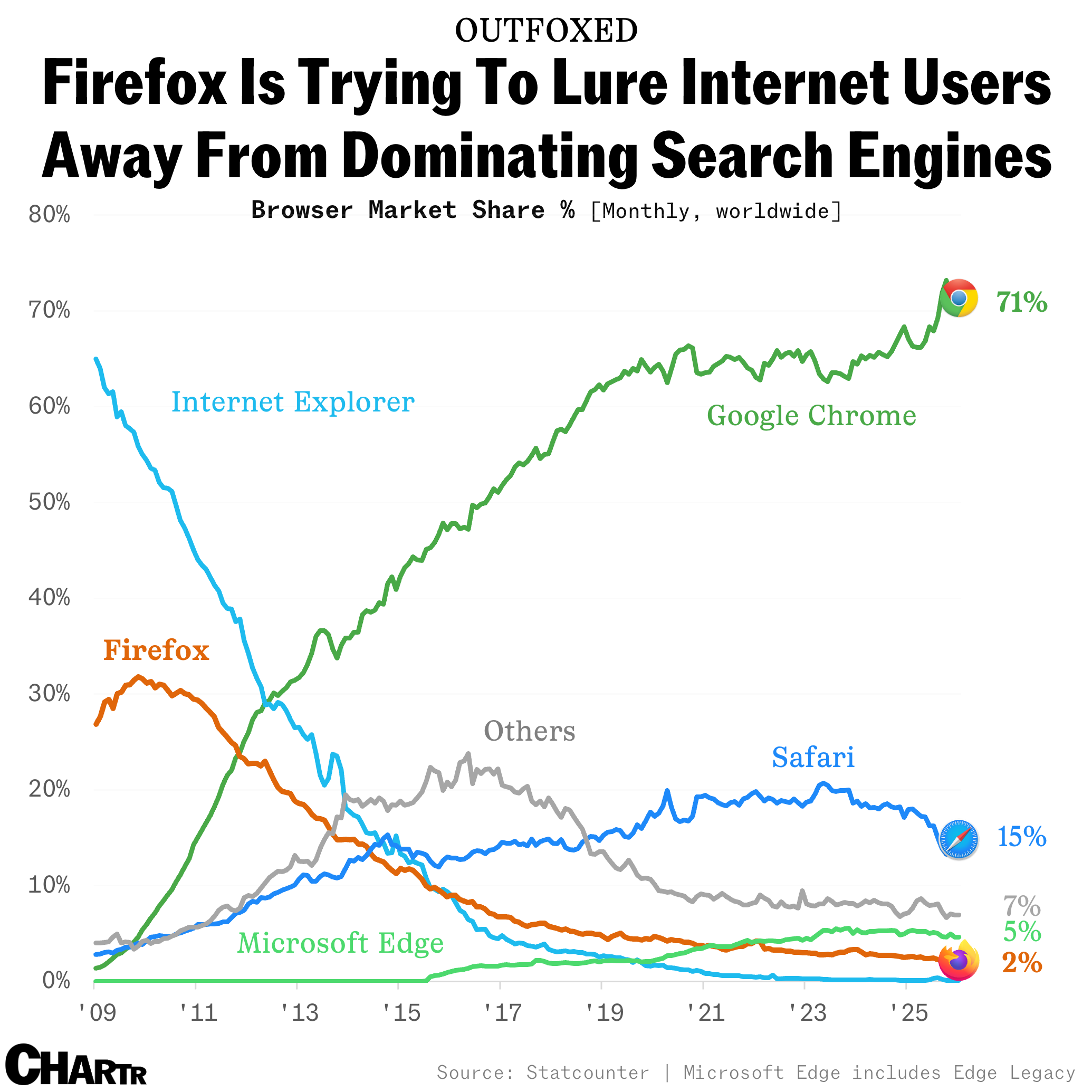
Just last week, Google unveiled plans to embed more Gemini-powered AI features into Chrome — the biggest web browser today by some way, commanding an almost monopolistic ~71% share of the market, per Statcounter. These features include image generator tool Nano Banana, an “Auto browse” ability, and a chatbot panel in its viewing window.
While Microsoft retired Internet Explorer in 2022 after a precipitous drop in usage, the company’s hoping that an experimental AI-powered Copilot Mode in its Edge browser will help it catch up with competitors. Apple’s Safari, the second-biggest web browser by market share at (a still much smaller) 15%, has also recently outlined plans to offer AI-powered searches.
Before this new announcement, even Firefox itself had spent the past year trying to draw consumers with newfangled AI tools, like its “shake to summarize” iPhone feature, released last September. Rather than fighting a losing battle against tech giants like Google, maybe Mozilla now thinks that appealing to the cohort that wants less to do with artificial intelligence might help it to win back at least some search engine purists.



