
Tech
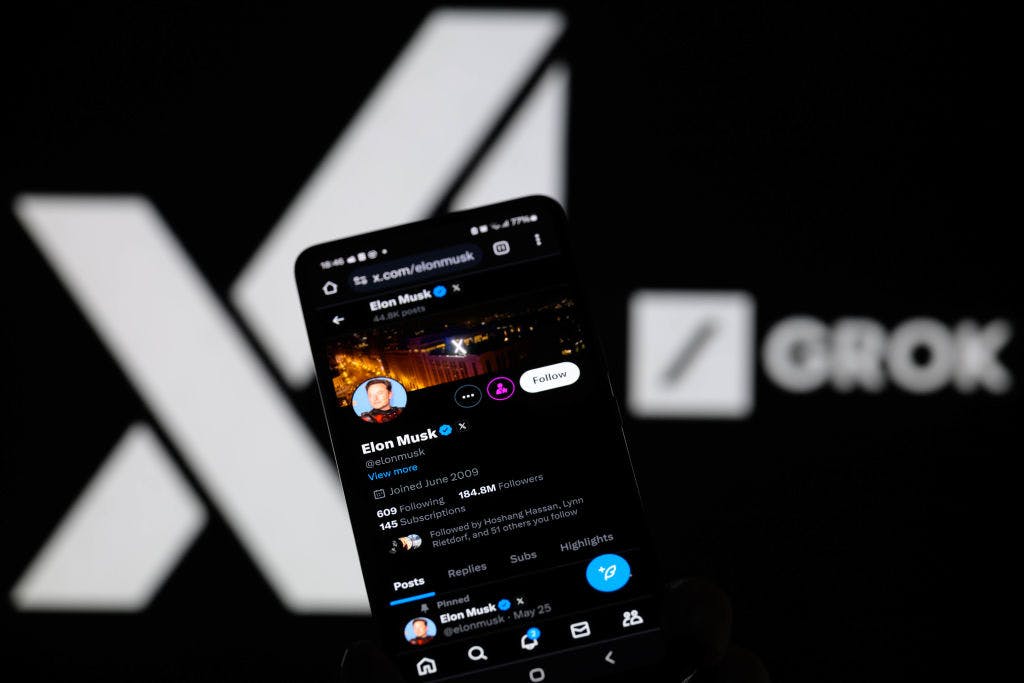
Grok X Ai - Photo Illustration
Elon Musk’s X profile (Jonathan Raa/Getty Images)

Grok has been climbing Apple and Google’s app store rankings amid calls to remove it for sexualized images

Critics have pointed out that Apple and Google have removed other apps for less.

Rani Molla

As uproar has grown around sexualized deepfakes of women and children through Grok’s image generation tools, so has the xAI chatbot’s popularity.

The issue became popularized in late December, as users on X tagged Grok to make it digitally undress people. More recently, as Grok’s outsized volume of deepfakes has become more heavily publicized — social media and deepfake researcher Genevieve Oh found that 85% of Grok’s images are sexualized and its posts dwarf other deepfake sites — people have been calling for action.

Europe and India have announced probes over the images. The UK’s prime minister has vowed to take action, and three Democratic US senators have asked Apple and Google to remove X and Grok from their app stores, NBC reports.

In response to the outrage, Grok has restricted its image generation tool on X to paid users but has left the Grok stand-alone app and website largely untouched.

At the same time, Grok has been climbing the Apple and Google app store rankings. Grok is currently No. 4 in the iOS App Store, having moved up from 44th the day after Christmas. On the Google Play Store, it’s now ranked No. 13 overall, up from 62.

Many social media users have pointed out that back in 2018, Apple removed Tumblr from its store for sexualized images of children. In the AI era, Google and Apple have removed a number of smaller apps for offering sexually exploitative content generation, but Grok and X remain.

Last year, xAI CEO Elon Musk filed a lawsuit alleging that Apple favored its partner OpenAI’s ChatGPT on the App Store.


More Tech

See all Tech
tech

Report: Microsoft tries to get back in the AI coding game with new model

Microsoft wants to fight its way back into the AI coding field by releasing a new model next week at its annual Microsoft Build developer conference, The Information reports.

The company is expected to announce a new family of models as Microsoft AI CEO Mustafa Suleyman seeks to shore up the company’s own AI offerings and gradually wean it off OpenAI’s technology over the remainder of their $13 billion partnership.

Microsoft was initially well positioned to meet software developers with AI-enhanced tools. It owns GitHub, the most popular platform for hosting and sharing code, and GitHub’s Copilot AI-powered coding tool was released months before OpenAI’s ChatGPT debuted in 2022.

But it fumbled one of the biggest first-mover advantages in history as Anthropic’s Claude Code, OpenAI’s Codex, and Cursor rolled out coding tools that developers loved.

Microsoft was initially well positioned to meet software developers with AI-enhanced tools. It owns GitHub, the most popular platform for hosting and sharing code, and GitHub’s Copilot AI-powered coding tool was released months before OpenAI’s ChatGPT debuted in 2022.

But it fumbled one of the biggest first-mover advantages in history as Anthropic’s Claude Code, OpenAI’s Codex, and Cursor rolled out coding tools that developers loved.

Ojai outside

Waymo to launch free robotaxi rides in its new Ojai vans

The new vehicles are less expensive — which is important for the service to really scale.

tech

Report: Tesla’s Robotaxi trainers don’t think it’s ready for prime time

If you listen to Tesla CEO Elon Musk, you might think rapid expansion of the company’s Robotaxi service is right around the corner. If you listen to the people tasked with reviewing the footage and training its AI, that future is a long way off.

An in-depth report from Reuters that interviewed nine former “data labelers” and a former Tesla self-driving engineer paints a picture of highly massaged safety stats, vehicles failing to execute basic driving functions, and a behind-the-scenes reality where the supposedly “autonomous” tech relies heavily on the exact kind of localized, labor-intensive mapping and training Musk has publicly mocked. The skepticism runs so deep that one former insider told reporters they wouldn’t ride in a Robotaxi “if you f---ing paid me.”

Currently, the service is operating about 30 unsupervised vehicles across three Texas cities — a much more circumscribed execution than Musk had initially planned. The problem, for Tesla, is that the success of its Robotaxi business is now integral to the company’s value proposition.

An in-depth report from Reuters that interviewed nine former “data labelers” and a former Tesla self-driving engineer paints a picture of highly massaged safety stats, vehicles failing to execute basic driving functions, and a behind-the-scenes reality where the supposedly “autonomous” tech relies heavily on the exact kind of localized, labor-intensive mapping and training Musk has publicly mocked. The skepticism runs so deep that one former insider told reporters they wouldn’t ride in a Robotaxi “if you f---ing paid me.”

Currently, the service is operating about 30 unsupervised vehicles across three Texas cities — a much more circumscribed execution than Musk had initially planned. The problem, for Tesla, is that the success of its Robotaxi business is now integral to the company’s value proposition.

Latest Stories

Sherwood Media, LLC and Chartr Limited produce fresh and unique perspectives on topical financial news and are fully owned subsidiaries of Robinhood Markets, Inc., and any views expressed here do not necessarily reflect the views of any other Robinhood affiliate, including Robinhood Markets, Inc., Robinhood Financial LLC, Robinhood Securities, LLC, Robinhood Crypto, LLC, Robinhood Money, LLC, Robinhood U.K. Ltd, Robinhood Derivatives, LLC, Robinhood Gold, LLC, Robinhood Asset Management, LLC, Robinhood Credit, Inc., Robinhood Ventures DE, LLC and, where applicable, its managed investment vehicles.
