
Tech
Meta Connect developer conference
Mark Zuckerberg (Andrej Sokolow/Getty Images)
ZUCK BUCKS

How much money do Facebook, Instagram, Reddit, Pinterest, and Snapchat make from you?

Most social media platforms squeeze a few bucks a month out of users — Meta’s ability to monetize your scrolling is on a completely different level.

David Crowther

We’ve all been on the internet long enough to know that when the product is free, you are the product. Some people are understandably very angry about Big Tech hoarding our data to prey on our conscious (or more commonly our subconscious) insecurities and desires. Most of us don’t care enough to stop.

But how much is your doomscrolling actually worth to the Mark Zuckerbergs and Evan Spiegels of the world? That answer, of course, depends on a few key factors.

Users from lower-income countries tend to be a lot less valuable to advertisers. But which platform you’re on matters a lot, too. Just this week, Reddit said its revenue was booming thanks to AI-powered ads. Pinterest shares, meanwhile, are sinking this morning on the exact opposite — AI’s influence underwhelmed investors. At Snap, it was the same story, with shares diving 17% on Wednesday as the company is somehow barely growing while its peers leap forward.

For all three of those companies, the average revenue per active user (ARPU) was about $2.40 to $2.80 a month for a user in the US or North America. (They define their geographies slightly differently.) So, not a whole lot to split them.

But what about Meta?

Mark Zuckerberg’s social media giant is a little harder to pin down, after it inconveniently decided to stop splitting out its daily active users by geography. But, based on our best estimate that it has 250 million daily active users in the US and Canada (more on this below), combined with the fact that Meta reported $20 billion in ad revenue in the US and Canada, implies that the typical Meta user is worth somewhere around 10x as much: about $26 and change.
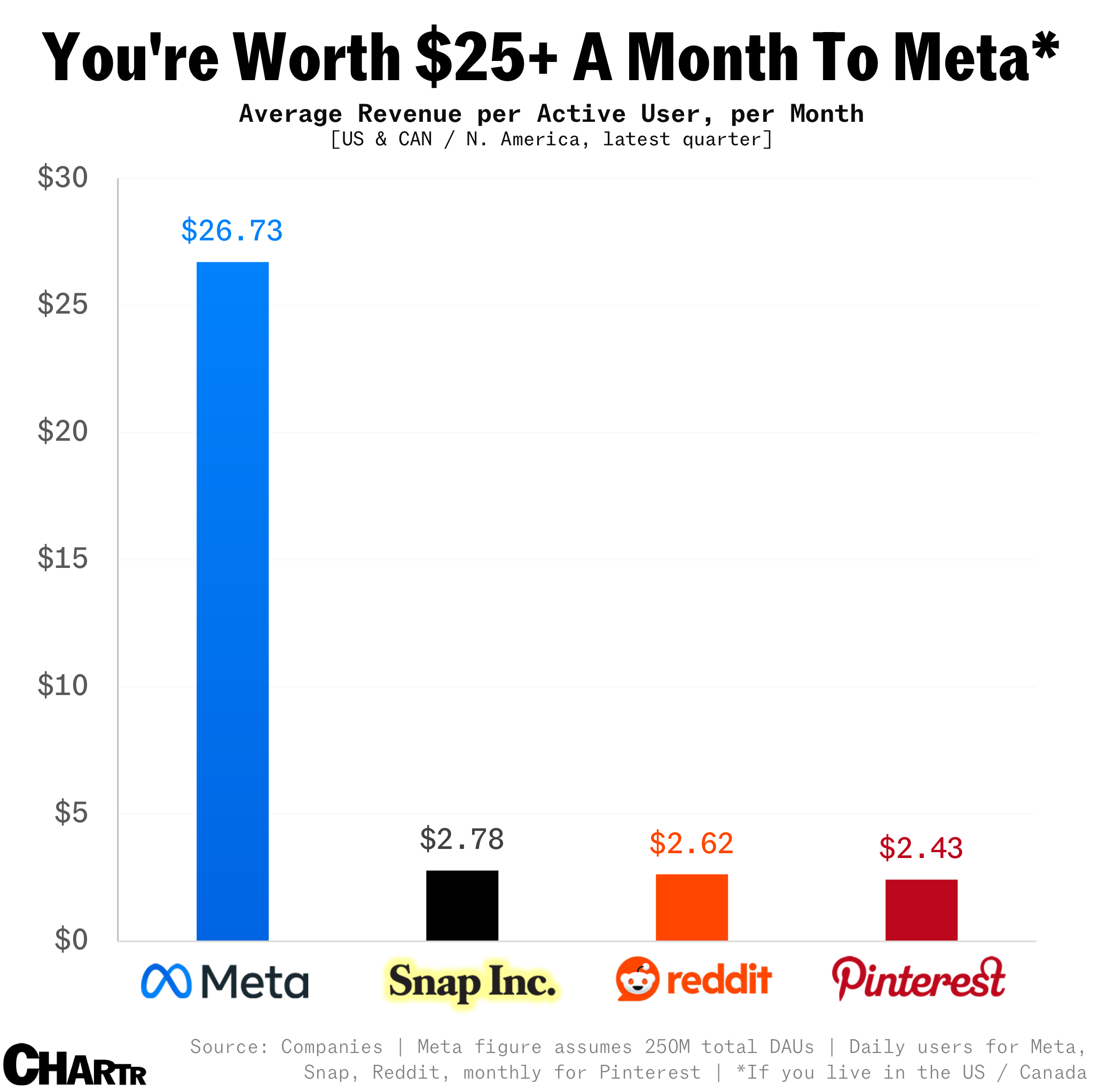
Meta average revenue per user
Sherwood News

Put another way, Meta is making more money from you than Netflix charges for its most expensive tier ($24.99).

Of course, Meta does have both Facebook and Instagram to monetize your eyeballs, but even if we split the figure in half, it’s miles ahead of its peers.


Napkin math-ing Meta’s DAUs

So, Meta doesn’t tell us exactly how many unique daily active users it has in the US and Canada — but we can make a decent guess based on a few facts we do have.

Per a filing for the last quarter of 2023, the company said it had 205 million daily active Facebook users in the US and Canada. That number had been growing in the quarters previous to it.
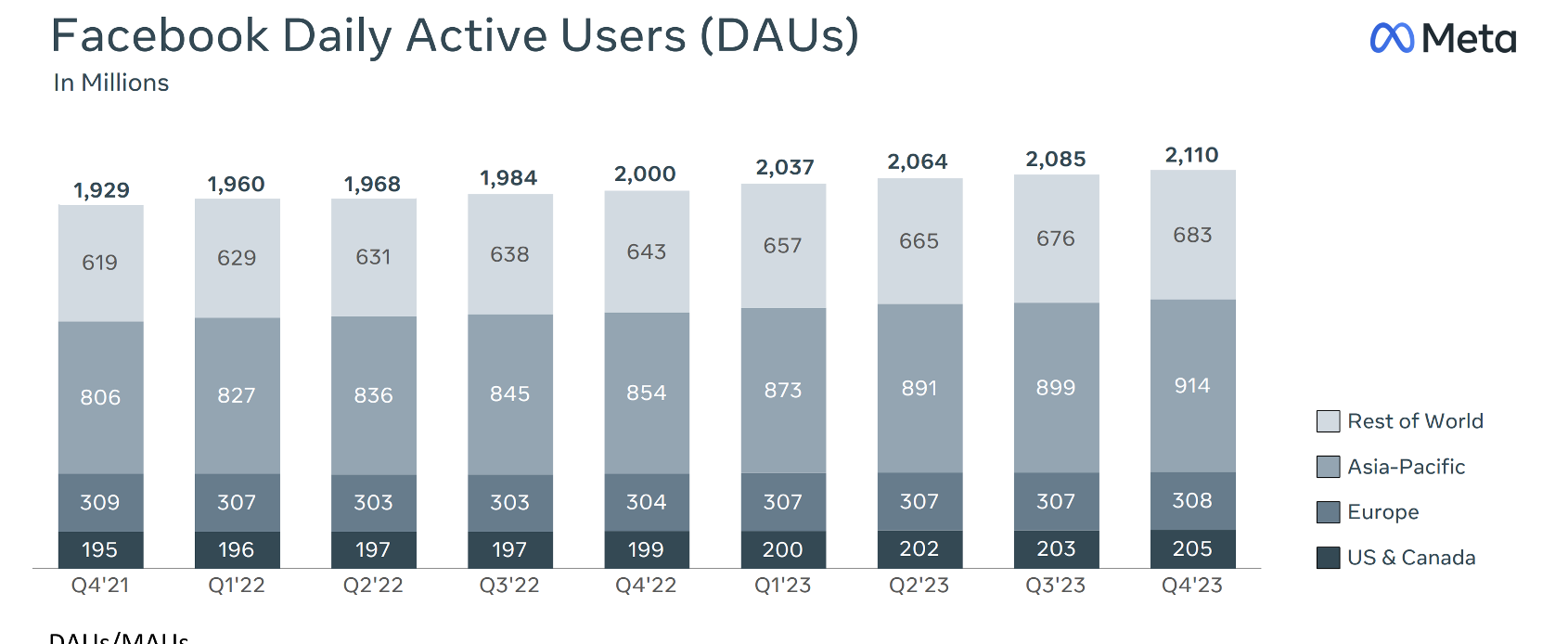
Facebook DAUs
Facebook

Now, we could charitably say that those figures were likely to continue growing. However, companies tend to like showing things when numbers are going up, so the fact Meta no longer discloses them gives some weight to the idea that it might have gone backwards since. Also, with 205 million active users, there just can’t be that many adults left in the US and Canada who have internet access and aren’t yet on Facebook. So, let’s say that the Facebook figure has stayed broadly flat at 205 million.

Now we need to account for Instagram. Or, more specifically, the daily active Instagram users that aren’t already included in the Facebook figure.

Per a Pew Research survey from last year, the number of people who say they use Instagram has been rising, but is still below Facebook overall, with ~50% of US adults saying they use Instagram.

Given that we knew Facebook had 205 million DAUs at a similar time to when 68% of people told Pew they used Facebook, we can make an educated guess that there might be ~150 million Instagram DAUs in the US and Canada. (Here we’re assuming a fair amount about the relative uptakes of both and placing a lot of weight on the Pew survey, but intuitively it feels broadly correct, and is in the ballpark of other estimates.)

Now, assuming there’s a decent amount of overlap — say, 70% — between the two services (some estimates suggest it might be as high as 80%, but gut feeling tells us that younger users don’t want to be seen dead on Facebook, so that feels a little high) and we arrive at our final figure: an incremental ~45 million DAUs.

Put it all together and we’re estimating that Meta has 250 million unique daily active users in the US and Canada.

Let’s sense check that: there are about 265 million adults in the US, and another ~35 million in Canada, so ~300 million in total. Our math suggests that about 80% to 85% of those use a Meta platform every day.


More Tech

See all Tech
tech

Alphabet sold $3.6 billion in Japanese yen bonds — a record for a foreign company — likely to help its AI capex binge

We now have the value for Alphabet’s Japanese yen bond raise — 576.5 billion yen, or $3.6 billion — and it’s a record for a foreign issuer in Japan. The deal was spread across seven tranches with maturities ranging from 3 to 40 years, allowing the company to lock in rates as low as 1.965%.

The latest deal comes on the heels of Alphabet’s massive US and European bond deals, where the company has tapped global markets for nearly $60 billion in fresh capital over the last few months. In a filing earlier this week, the search giant said it would use the proceeds for “general corporate purposes.” That likely means fueling its AI infrastructure build-out, which has pushed its projected 2026 capex bill to a staggering $190 billion.

tech
Rani Molla

Bloomberg: Relationship between OpenAI and Apple has deteriorated and legal action may be imminent

The two-year-old alliance between Apple and OpenAI has deteriorated, Bloomberg reports, with the AI giant now consulting legal counsel about issuing a potential breach of contract notice.

OpenAI executives allege that Apple failed to adequately integrate and promote ChatGPT on the iPhone, causing the AI firm to lose out on billions a year in subscriptions and hurt its brand, according to the report.

Meanwhile, Apple has expressed concerns over OpenAI’s privacy protection, and has been miffed that OpenAI has been working on its own hardware with former Apple design lead Jony Ive.

More recently, Apple, which has trailed its peers in developing AI, has decided to offer users their choice of AI models, rather than aligning exclusively with OpenAI’s.

Meanwhile, Apple has expressed concerns over OpenAI’s privacy protection, and has been miffed that OpenAI has been working on its own hardware with former Apple design lead Jony Ive.

More recently, Apple, which has trailed its peers in developing AI, has decided to offer users their choice of AI models, rather than aligning exclusively with OpenAI’s.

tech
Jon Keegan

Report: Mythos is used to crack MacOS

Apple’s MacOS has long been considered to have some of the strongest cybersecurity protections in the industry.

But researchers using a preview release of Anthropic’s Mythos AI model were able to take control of a Mac, in a significant example of the unreleased AI model’s cyber capabilities, according to a report from The Wall Street Journal.

It took two security researchers five days to pull off the feat, which chained together bugs to corrupt the Mac’s memory, per the report. The researchers told the Journal that human expertise was required to use Mythos, and it would not be able to execute the attack on its own. The researchers reportedly said some of the Mythos hype was “overblown.”

Apple said it was taking the bug report “very seriously” and has not yet issued a fix.

It took two security researchers five days to pull off the feat, which chained together bugs to corrupt the Mac’s memory, per the report. The researchers told the Journal that human expertise was required to use Mythos, and it would not be able to execute the attack on its own. The researchers reportedly said some of the Mythos hype was “overblown.”

Apple said it was taking the bug report “very seriously” and has not yet issued a fix.

tech
Jon Keegan

Survey: 70% of Americans don’t want data centers in their community

America loves a good boogeyman, and data centers have become one.

It was once easy for the hyperscalers to sidle up to state legislators, utility executives, and local officials with the promise of jobs and the high-tech glow of AI for their economically challenged areas without much local opposition.

But now the script has been flipped, and public opposition to data centers is starting to solidify. A new Gallup survey asked 1,000 Americans for their thoughts on data centers, the first such survey for the polling company. Among the findings:

  • 70% of survey respondents opposed local construction of AI data centers.

  • Opposition to local data centers was much stronger than opposition to local nuclear power plants.

  • Dislike for data centers is bipartisan — majorities of both Democrats and Republicans were opposed to data centers, but more so for Democrats.

  • Among those opposed to data centers, the impact on the environment and energy usage were top concerns.

Local communities and state governments around the US have introduced bans or moratoriums on data center construction. Senators have also introduced similar legislation in Congress.

Last month, Maine Governor Janet Mills vetoed legislation that would have enacted the first statewide bill to pause data center construction.

But now the script has been flipped, and public opposition to data centers is starting to solidify. A new Gallup survey asked 1,000 Americans for their thoughts on data centers, the first such survey for the polling company. Among the findings:

  • 70% of survey respondents opposed local construction of AI data centers.

  • Opposition to local data centers was much stronger than opposition to local nuclear power plants.

  • Dislike for data centers is bipartisan — majorities of both Democrats and Republicans were opposed to data centers, but more so for Democrats.

  • Among those opposed to data centers, the impact on the environment and energy usage were top concerns.

Local communities and state governments around the US have introduced bans or moratoriums on data center construction. Senators have also introduced similar legislation in Congress.

Last month, Maine Governor Janet Mills vetoed legislation that would have enacted the first statewide bill to pause data center construction.

Latest Stories

Sherwood Media, LLC and Chartr Limited produce fresh and unique perspectives on topical financial news and are fully owned subsidiaries of Robinhood Markets, Inc., and any views expressed here do not necessarily reflect the views of any other Robinhood affiliate, including Robinhood Markets, Inc., Robinhood Financial LLC, Robinhood Securities, LLC, Robinhood Crypto, LLC, Robinhood Money, LLC, Robinhood U.K. Ltd, Robinhood Derivatives, LLC, Robinhood Gold, LLC, Robinhood Asset Management, LLC, Robinhood Credit, Inc., Robinhood Ventures DE, LLC and, where applicable, its managed investment vehicles.
