
Tech
Internet Explorer: The fall of the iconic browser

Internet Explorer: The fall of the iconic browser

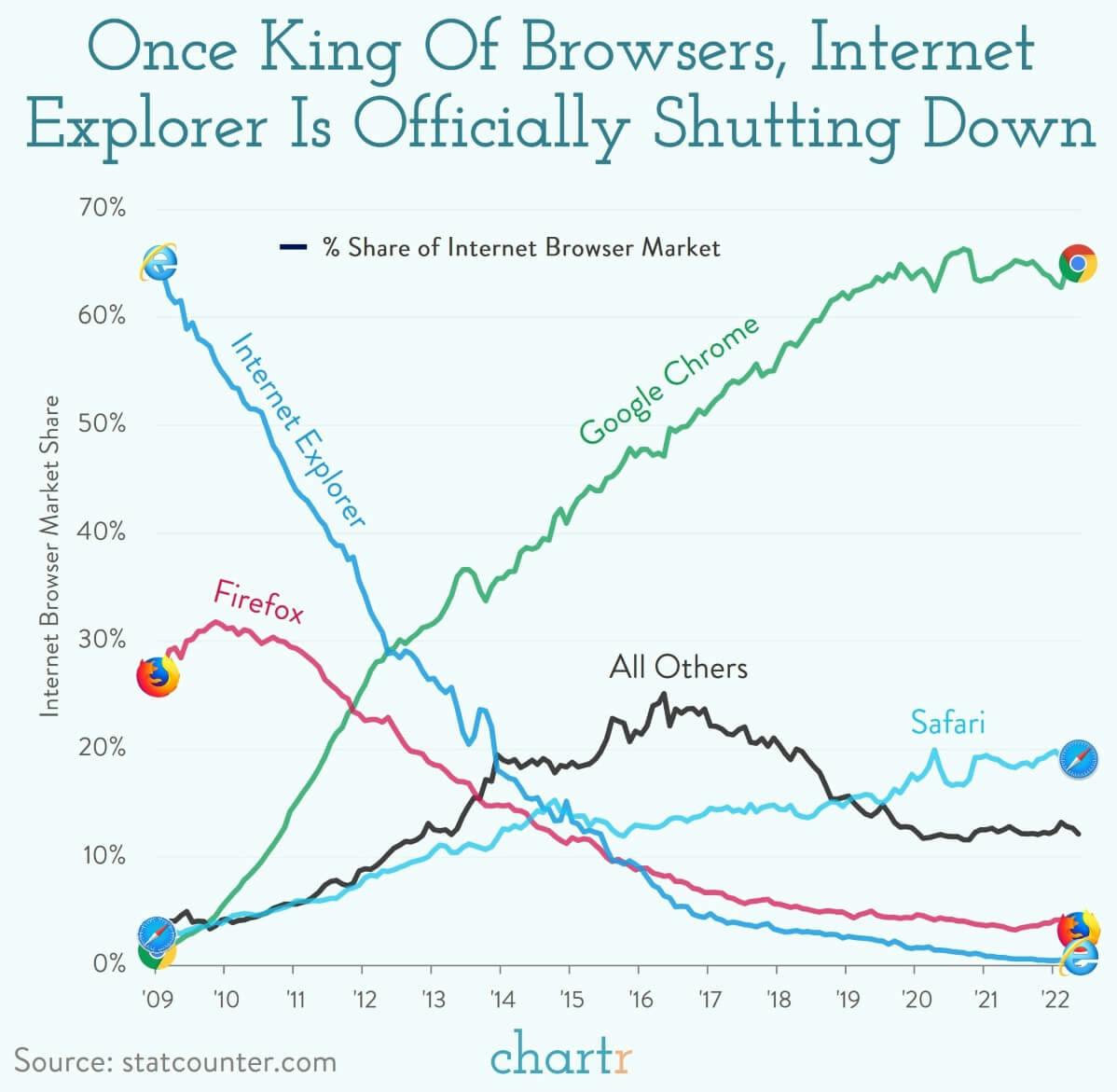
Internet Explorer is hanging up its bookmarks, as Microsoft support for the once dominant browser ends today, some 27 years since it was first introduced.

Internet Explorer's market share was estimated at one point to be as high as 90%, primarily because of the success of the Windows operating system, which often stipulated users use Internet Explorer — a practice that got Microsoft in trouble with the Justice Department in the late '90s.

Closer to the Edge

The writing has been on the wall for Internet Explorer for some time, as Microsoft has pushed users towards its latest browser — Microsoft Edge — for the last few years. Unfortunately, Edge hasn't exactly caught on. The latest data from StatCounter shows Edge with only a 4% share of the browser market, way down on Apple's Safari, which has just shy of 20% of the market, and nowhere near the dominant Google Chrome, which has 65%.

Speed matters

Though some may look back with fond nostalgia, Internet Explorer was often criticized for being slow, cumbersome, buggy and insecure. Those flaws may not have been fatal when Microsoft's competition was relatively lean, but when Google launched Chrome in 2008, suddenly Microsoft had a rival that could match its resources, and was starting from a blank canvas.

Almost immediately Chrome had a lot going for it; faster loading speeds, tabs that crashed less frequently (and didn't affect your other tabs when they did crash), dedicated Chromebooks, third-party extensions and did we mention faster loading speeds? Within a few years Chrome was the dominant browser. Ironically, if you fire up Google Search and type "why is chrome" you'll see the top auto-filled suggestion — by Google's very own search engine — is "why is chrome so slow". What goes around, comes around.


More Tech

See all Tech
tech

Anthropic confidentially files for IPO

Anthropic has filed confidentially with the Securities and Exchange Commission for its initial public offering. The IPO is expected to be one of the largest in US history, and will likely be joined by OpenAI, which is also expected to go public before the end of the year.

The company filed a draft S-1 form with the SEC, which does not indicate the price of the offering. The official public S-1, which will come later, will give potential shareholders a first look at the finances of Anthropic, which just last week announced that it raised $65 billion, reaching a valuation of $965 billion. This puts the company well ahead of archrival OpenAI, which is currently valued at $850 billion.

tech

Prosus may thwart Uber’s bid for Delivery Hero

Uber’s aggressive pursuit of Delivery Hero could hit a major roadblock. After the European food delivery giant rejected Uber’s initial $11.6 billion buyout offer, the American company pivoted, scooping up a 37% stake in the open market.

Now, Prosus, formerly Delivery Hero’s largest shareholder, is plotting a counteroffensive.

Thanks to an EU regulatory waiver Monday that temporarily pauses its mandatory stock sell-down, the Amsterdam-based investment firm is reportedly looking to either increase its stake or rally other shareholders against Uber. The goal: block the takeover entirely or force a significantly higher premium.

Prosus has warned about the loss of European tech relevance if a US giant swallows the company. Meanwhile, investors are loving the drama: the takeover tug-of-war, which also includes DoorDash, has sent Delivery Hero stock soaring over 75% in the past month.

Thanks to an EU regulatory waiver Monday that temporarily pauses its mandatory stock sell-down, the Amsterdam-based investment firm is reportedly looking to either increase its stake or rally other shareholders against Uber. The goal: block the takeover entirely or force a significantly higher premium.

Prosus has warned about the loss of European tech relevance if a US giant swallows the company. Meanwhile, investors are loving the drama: the takeover tug-of-war, which also includes DoorDash, has sent Delivery Hero stock soaring over 75% in the past month.

tech

Tesla sales surge in European markets in May

Tesla sales surged across Europe in May, Reuters reports, with sales jumping double and even triple digits in a number of early-reporting markets. Of course, 2025 was a very difficult year for Tesla sales in Europe, so the growth is coming off notably small denominators.

Interestingly, the resurgence is happening without EU approval for supervised Full Self-Driving, something CEO Elon Musk predicted would cause sales to “improve significantly” after blaming the absence of the tech for its weak sales.

The company has received approval for a version of its FSD tech in the Netherlands, as well as Lithuania and Estonia, and expects “EU-wide” permission in the second or third quarter.

tech
Rani Molla

Microsoft is reportedly building a super app to tame product sprawl — and finally crack mobile

Super apps are very 2010s, but they might be the future for Microsoft. The enterprise giant is working on combining its sprawling and often confusing product suite into a single super app expected by late summer, Fortune reports.

By unifying the tools, Microsoft is hoping that the massive popularity of some of its offerings — particularly GitHub Copilot — will rub off on its other, slower-growing products.

The tool will merge its coding assistant GitHub Copilot, its chat function Copilot, its Copilot Cowork tool, and a new agentic workflow called Autopilot. The move, known internally as “Delivering one Copilot,” will have the dual purpose of simplifying Microsoft’s fragmented desktop AI offerings and finally helping the office software giant gain a foothold on mobile, where competing tools have dominated.

Microsoft is taking a page from frenemy OpenAI’s playbook. In March, OpenAI announced plans for its own desktop super app to combine ChatGPT, Codex, and its Atlas browser into one central workstation.

The tool will merge its coding assistant GitHub Copilot, its chat function Copilot, its Copilot Cowork tool, and a new agentic workflow called Autopilot. The move, known internally as “Delivering one Copilot,” will have the dual purpose of simplifying Microsoft’s fragmented desktop AI offerings and finally helping the office software giant gain a foothold on mobile, where competing tools have dominated.

Microsoft is taking a page from frenemy OpenAI’s playbook. In March, OpenAI announced plans for its own desktop super app to combine ChatGPT, Codex, and its Atlas browser into one central workstation.

Latest Stories

Sherwood Media, LLC and Chartr Limited produce fresh and unique perspectives on topical financial news and are fully owned subsidiaries of Robinhood Markets, Inc., and any views expressed here do not necessarily reflect the views of any other Robinhood affiliate, including Robinhood Markets, Inc., Robinhood Financial LLC, Robinhood Securities, LLC, Robinhood Crypto, LLC, Robinhood Money, LLC, Robinhood U.K. Ltd, Robinhood Derivatives, LLC, Robinhood Gold, LLC, Robinhood Asset Management, LLC, Robinhood Credit, Inc., Robinhood Ventures DE, LLC and, where applicable, its managed investment vehicles.
