Tech
tech
Tom Jones

The internet’s being weird again; this time it seems to be Cloudflare’s fault

Last month, we wrote that Amazon’s cloud service sneezed, and huge chunks of the internet came down with a pretty bad cold. While it’s not yet that bad, several major websites have been intermittently peaky this morning, and it looks like Cloudflare is the super-spreader.

Though much of America might have been asleep for some of the most frustrating periods of disruption this morning, thousands of users across the US and around the world have taken to Downdetector to report problems accessing some of the internet’s biggest platforms, including OpenAI, X, and popular battle arena game League of Legends, as Cloudflare has been acknowledging its issues and looking to fix them.
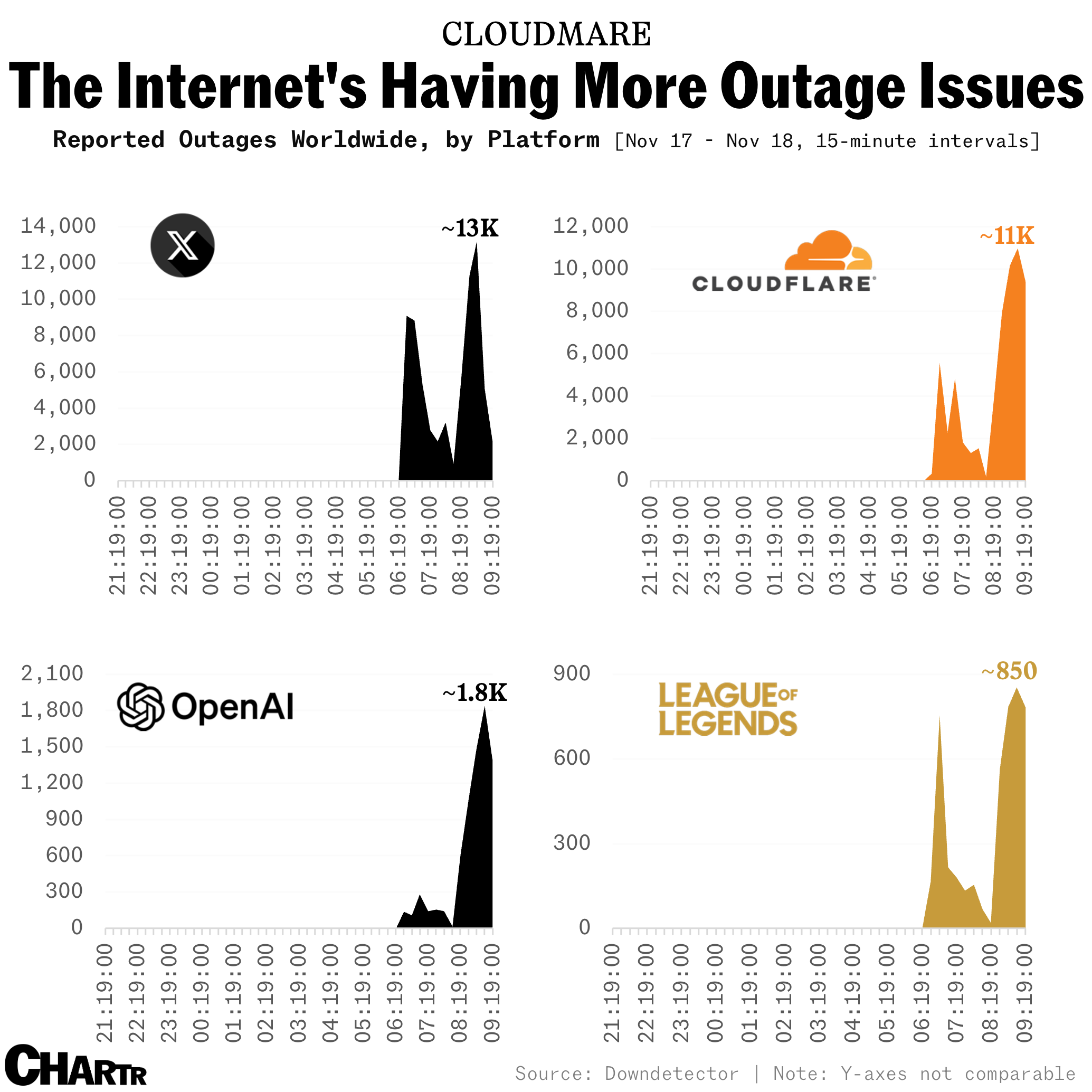
Site outages chart
Sherwood News

Cloudflare, an American IT behemoth that supplies tools to protect websites from cyberattacks and helps users connect and load content online, is down around 3% in early trading on Tuesday, as investors (at least those who can connect to their brokerages) react to the issues. Though the stock began to sink in premarket trading when the problems first came to light, the wider market mood is also likely weighing on Cloudflare, with the S&P 500 Index down more than 1% as of 10:08 a.m. ET.

More Tech

See all Tech
tech

Amazon’s Prime Day is coming early this year

Amazon is moving its four-day Prime Day event up from July, where it’s been for the last five years, to June 23 through 26.

The retail giant cites scheduling clashes with the FIFA World Cup and the 250th anniversary of the signing of the Declaration of Independence as reasons for the move. Prime Day is one of Amazon’s biggest sales events of the year, helping drive $24.1 billion in US online spending last year, according to Adobe Analytics.

More concretely, the move means Amazon will pull a massive chunk of sales from one of its biggest events into Q2, which ends June 30, rather than Q3.

Beyond the top-line revenue shift, Amazon is also using the event to flex its newer strategic muscles, aggressively cross-promoting its same-day grocery delivery networks and its Amazon Haul discount storefront.

tech

Tesla’s China-made EV sales grew 39% in May, marking 7 straight months of growth

Sales of Tesla vehicles made at its Shanghai plant — produced for China, Europe, and other international markets — grew 39% in May to 85,982 vehicles, a record for the year.

The data marks the company’s seventh straight month of year-over-year wholesale growth for made-in-China vehicles and the company’s continued stabilization overseas. Across the entire Chinese auto industry, overall wholesale volume of so-called new energy vehicles — EVs and hybrids — produced domestically grew 12% from May 2025.

The China Passenger Car Association will report China-only sales later this month, offering a clearer picture of performance in Tesla’s second-largest market. On Monday, several European markets posted year-over-year sales growth for Tesla.

The China Passenger Car Association will report China-only sales later this month, offering a clearer picture of performance in Tesla’s second-largest market. On Monday, several European markets posted year-over-year sales growth for Tesla.

tech

Alphabet announces $80 billion equity raise to fund AI infrastructure, including a $10 billion bet from Berkshire Hathaway

To fund its rapidly expanding AI infrastructure push, Alphabet just announced a whopping $80 billion equity capital raise.

While concerns over share dilution sent the stock down slightly after-hours, the deal secured a major anchor partner: Berkshire Hathaway, which is backing the offering with a $10 billion investment. (Berkshire was run by Warren Buffett until he stepped down as CEO at the beginning of this year, handing the reins to Greg Abel.)

Alphabet plans to spend up to $190 billion on capex this year.

<10%

Despite a massive surge in corporate AI spending, the technology is broadly failing to deliver the massive cost reductions executives had anticipated, according to a new global survey from Bain & Co. shared with Bloomberg. The largest share of major companies measuring their AI returns — 40% — realized cost savings of 10% or less, with poor access to internal data cited as the primary roadblock. Most had expected higher returns. More concerningly, Bain warned that many companies are using their original, overly optimistic projections — rather than their actual savings — to justify funding their next wave of expensive AI investments, creating a “circular bet with a structural leak.”

Latest Stories

Sherwood Media, LLC and Chartr Limited produce fresh and unique perspectives on topical financial news and are fully owned subsidiaries of Robinhood Markets, Inc., and any views expressed here do not necessarily reflect the views of any other Robinhood affiliate, including Robinhood Markets, Inc., Robinhood Financial LLC, Robinhood Securities, LLC, Robinhood Crypto, LLC, Robinhood Money, LLC, Robinhood U.K. Ltd, Robinhood Derivatives, LLC, Robinhood Gold, LLC, Robinhood Asset Management, LLC, Robinhood Credit, Inc., Robinhood Ventures DE, LLC and, where applicable, its managed investment vehicles.