

Tech
Bitcoin Conference Draws Cryptocurrency Fans To Miami
Jack Dorsey onstage at the Bitcoin 2021 Convention in Miami, Florida (Joe Raedle/Getty Images)
OUT OF THE BLUE

Jack Dorsey has made a Bluetooth-based messaging app that doesn’t require internet

At the weekend, the Twitter cofounder unveiled the beta version of “Bitchat” — an encrypted, decentralized messaging service built on... Bluetooth.

Millie Giles

However you spent your Fourth of July weekend, it probably wasn’t as productive as Jack Dorsey’s (or, for that matter, Joey Chestnut’s).

On Sunday, the Twitter cofounder and ex-CEO announced that he’d successfully completed his “weekend project” of learning about Bluetooth mesh networks — and created a beta version of “Bitchat,” a new encrypted messaging app able to function entirely via Bluetooth, without the need for internet connection, cell service, phone numbers, or emails.

Dorsey’s “personal experiment” works by connecting users’ phones via local Bluetooth clusters, allowing messages to be sent between devices. Then, “bridge” devices that connect overlapping clusters are used to stretch the mesh network over a greater distance.

Privacy, please

Dorsey has long been a fan of decentralized communications, playing a major role in the development of social networking apps Damus and Bluesky, and his new app’s peer-to-peer encrypted messaging will also rival Meta-owned WhatsApp — without the requirements of identifiable accounts or data collection.

What really separates Bitchat, though, is its use of Bluetooth to keep it functioning offline, similar to mesh messaging apps used during the 2019 Hong Kong protests, per CNBC. While Bluetooth technology isn’t anything new, it’s still impressively prescient in the modern tech world.
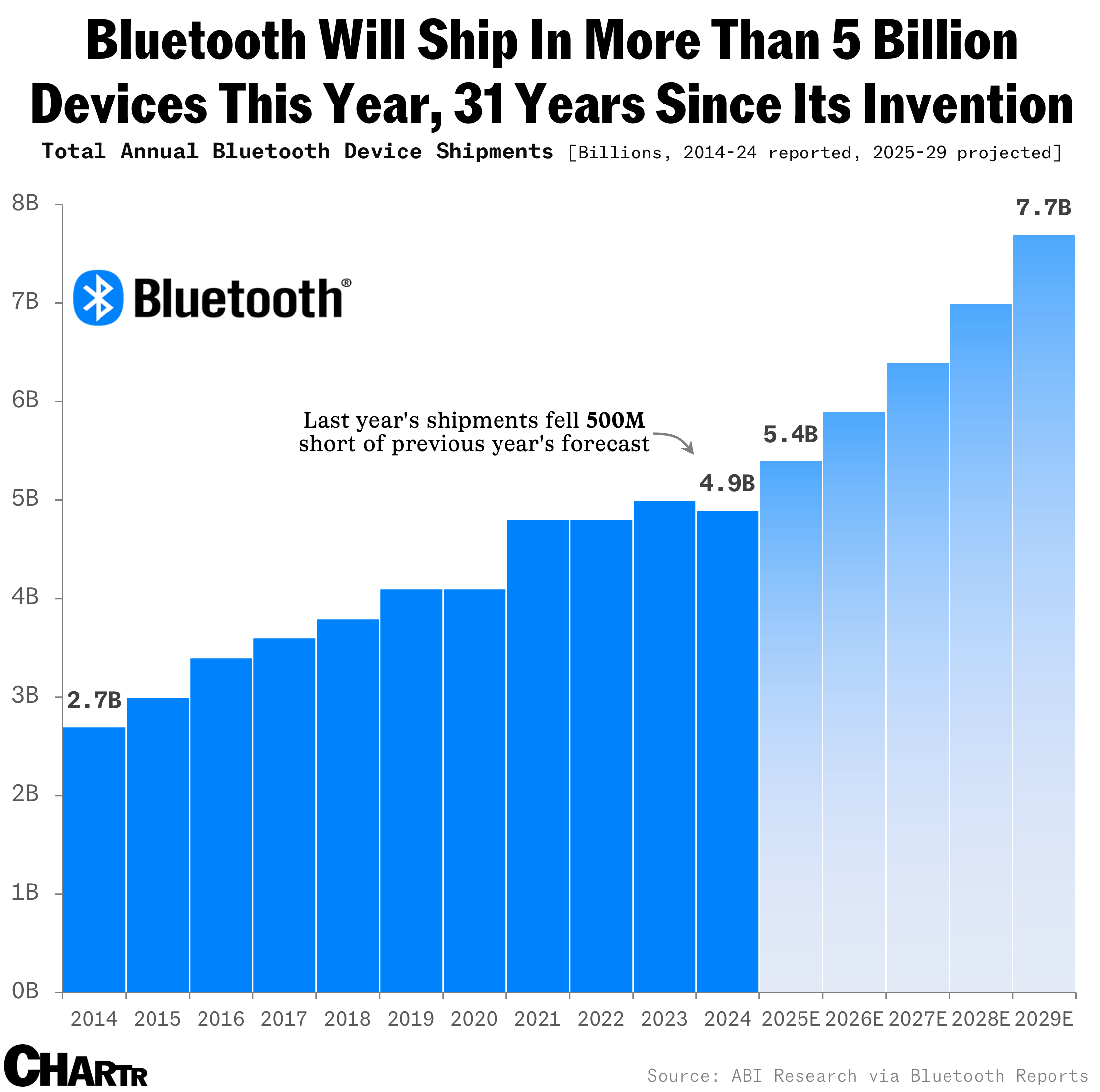
Bluetooth Device Shipments
Sherwood News

Long in the tooth

Based on developments made at Nokia-owned Ericsson in 1994, the first Bluetooth device hit the market in 1999 the same year that the first camera phone was released. 

With a name that started as a reference to King Harald, who united Denmark and Norway, and a logo resembling Nordic runes for his initials, Bluetooth connected computers, phones, and gadgets with wireless transfer capabilities at breakneck speed in the decades to come. In 2000, an estimated 800,000 Bluetooth-enabled devices were shipped; by 2020, this number had multiplied 5,125x over to 4.1 billion, per company reports.

There are very few technologies that are still growing after 30-plus years... but, despite contracting slightly in 2024, Bluetooth looks to have managed it, with the company projecting that shipments will near 8 billion by 2029.


More Tech

See all Tech
tech

Anthropic launches “Claude Design,” sending shares of Figma and Adobe down

Anthropic has been slowly and steadily gaining a leading share in the enterprise AI market by focusing on coding, spreadsheets, and other common productivity and workplace apps.

Now it’s going after design apps.

Today Anthropic launched Claude Design, a dedicated app powered by its latest model, Claude Opus 4.7, that lets users use text prompts to build website designs, user interface prototypes, presentations, and marketing materials.

Shares of Figma and Adobe sank on the news.

While Claude has previously had the ability to create designs and user interfaces, breaking it out into a dedicated app signals a major new piece of its enterprise strategy alongside its popular Claude Code product.

Today Anthropic launched Claude Design, a dedicated app powered by its latest model, Claude Opus 4.7, that lets users use text prompts to build website designs, user interface prototypes, presentations, and marketing materials.

Shares of Figma and Adobe sank on the news.

While Claude has previously had the ability to create designs and user interfaces, breaking it out into a dedicated app signals a major new piece of its enterprise strategy alongside its popular Claude Code product.

tech

Apple’s China iPhone shipments surged 20% in Q1 even as overall smartphone shipments fell

Apple’s iPhone shipments in China jumped 20% last quarter, even as the country’s overall smartphone market fell 4%, according to new data from Counterpoint Research. Rising memory costs have pushed prices higher across the industry, weighing on demand.

Apple appears poised to ride out the broader smartphone slump. Its strength at the less price-sensitive high end of the market and its unusual leverage over suppliers, which helps keep costs in check, give it an edge over rivals.

Greater China remains a critical region for Apple, making up about 18% of its total revenue in the fourth quarter. The company accounted for 19% of China’s smartphone market in the first quarter, up from 15% a year earlier, per Counterpoint.

tech
Rani Molla

Anthropic has surged past OpenAI in capturing business spending on generative-AI software

Last quarter, Anthropic attracted the lion’s share of trackable business spending on generative-AI software, according to new data from Ramp, a fintech company that provides corporate cards and expense management software for small firms and Fortune 500 companies alike.

The data showed that in the first quarter, Anthropic saw 37% of spending, its biggest share yet, versus 33% for OpenAI. Notably, the dataset doesn’t capture spending by Google or Microsoft.

OpenAI, which makes ChatGPT, still leads in overall adoption at 81% of AI buyers, but Anthropic is catching up, at nearly 63% in March. Overall, more than half of Ramp’s customers currently pay for AI, up from just 18% two years ago.

Anthropic’s enterprise tools, including Claude Code and Cowork, have been making waves among the business class, sending its revenue soaring.

Anthropic’s revenue share is even higher among companies spending on AI for the first time.

“Anthropic has definitely been on a tear,” Ara Kharazian, Ramp’s economist, told Sherwood News. “Its increase in adoption rates has been driven by its ability to sell to less technical users and smaller contracts than it typically has.”

It’s notable that midway through the first quarter, Anthropic had a falling-out with one of its biggest customers, the US government, which near the end of February decided to shun Anthropic’s products and lean into working with OpenAI.

tech
Jon Keegan

Report: Google ditches its objection to defense work, pitches Gemini to Pentagon

In 2018, Google employees protested against the company’s tech being used for the US military’s Project Maven — a drone targeting program — reminding the company of its “don’t be evil” motto.

After the controversy, the company declined to renew the contract with the Pentagon, drawing a bright line between Big Tech and the national security establishment.

What a difference a few years makes.

Google is now actively working to get its Gemini AI model to be used in classified national security settings, according to a new report from The Information. Seeking a similar deal to the one OpenAI hashed out with the Pentagon, Google reportedly wants a contract that allows use of Gemini in classified work, but with a prohibition on mass domestic surveillance and autonomous lethal weapons.

But Google is playing catch-up in a major way. Amazon and Microsoft both have been widely used for classified defense work, and contractors are already experienced in working with their cloud systems, while Google’s services have never been used in classified work.

What a difference a few years makes.

Google is now actively working to get its Gemini AI model to be used in classified national security settings, according to a new report from The Information. Seeking a similar deal to the one OpenAI hashed out with the Pentagon, Google reportedly wants a contract that allows use of Gemini in classified work, but with a prohibition on mass domestic surveillance and autonomous lethal weapons.

But Google is playing catch-up in a major way. Amazon and Microsoft both have been widely used for classified defense work, and contractors are already experienced in working with their cloud systems, while Google’s services have never been used in classified work.

Latest Stories

Sherwood Media, LLC produces fresh and unique perspectives on topical financial news and is a fully owned subsidiary of Robinhood Markets, Inc., and any views expressed here do not necessarily reflect the views of any other Robinhood affiliate, including Robinhood Markets, Inc., Robinhood Financial LLC, Robinhood Securities, LLC, Robinhood Crypto, LLC, Robinhood Derivatives, LLC, or Robinhood Money, LLC. Futures and event contracts are offered through Robinhood Derivatives, LLC.
