Tech
Jevons paradox
Sherwood News

Jevons Paradox is the latest jargon you need to know to signal you’re smart on AI

A paradox named after an English economist born in 1835 blew up this week.

The world of technology moves fast. For commentators and analysts who want to signal they know what’s going on, that means adapting just as quickly.

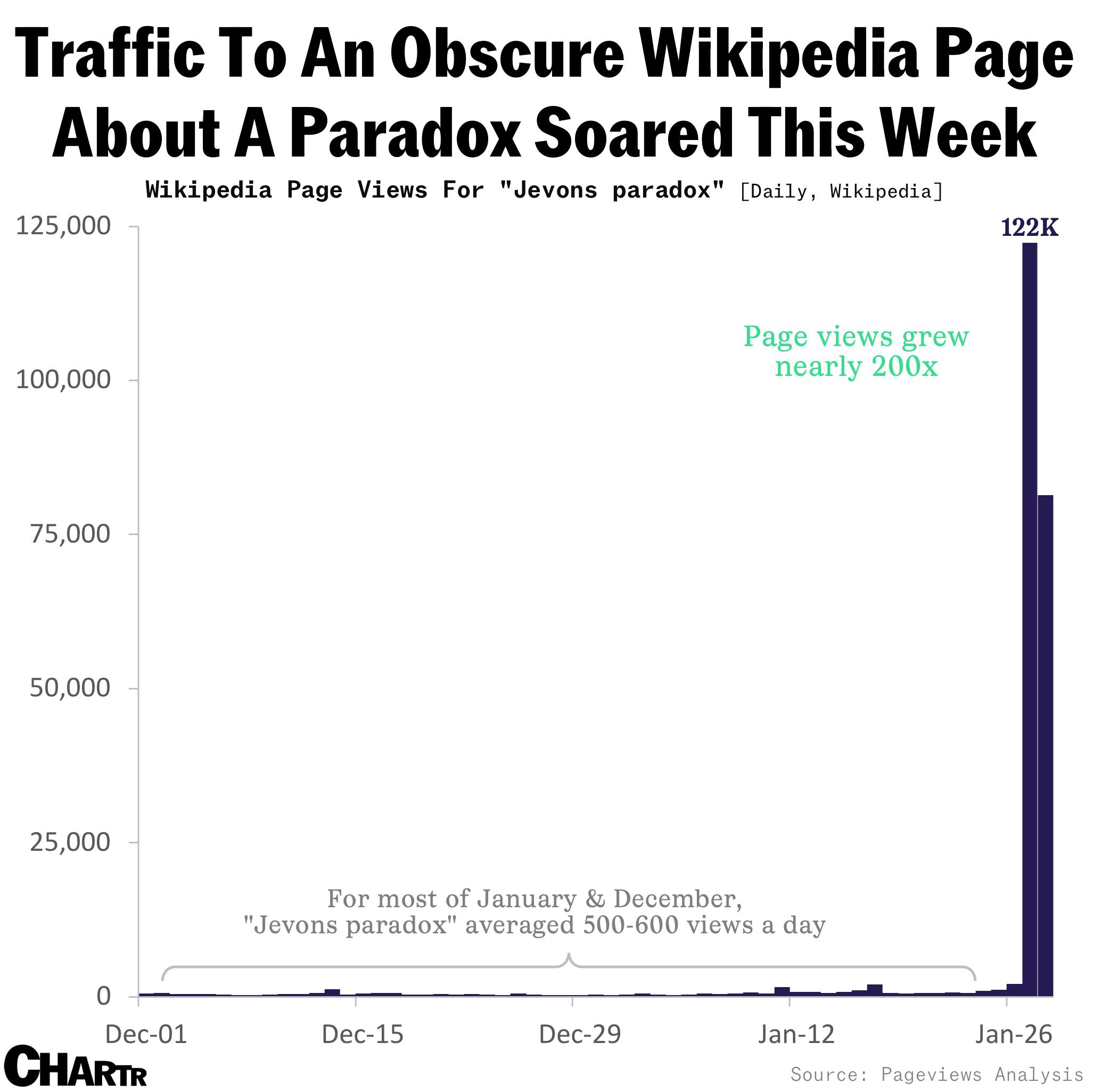
After mastering epidemiology and evangelizing for crypto during the pandemic, many Twitter (now X) “experts” turned their hand to military strategy and geopolitics in the wake of Russia’s invasion of Ukraine. But for the last 18 months, AI has been the topic du jour. In the wake of DeepSeek turning the entire industry on its head — and wiping nearly $600 billion off of the market cap of Nvidia in a single day — one new phrase has become table stakes for anyone wading into the DeepSeek discourse: Jevons Paradox, with traffic to its associated Wikipedia page soaring this week.

Per that very Wikipedia page:

“...the Jevons paradox occurs when technological advancements make a resource more efficient to use (thereby reducing the amount needed for a single application), however, as the cost of using the resource drops, overall demand increases causing total resource consumption to rise.

The original example posited by Mr. William Stanley Jevons, summarized nicely by Axios, was coal. Progress in steam engines, which enabled them to use less coal, didn’t lead to a drop in coal demand — it led to a huge rise.

Though a bit of an oversimplification, that is essentially the crux of the current debate in AI: DeepSeek reportedly achieved something for a lot less money and resources than US competitors like OpenAI and Meta used. That could be interpreted in two ways:

  • We will therefore need fewer high-tech chips like the ones Nvidia makes, and fewer energy plants to power them (which is why power and data center stocks got hammered this week);

  • Or, and this is where the Jevons Paradox comes in, we will want even more.

The market seemed to follow the first school of thought on Monday, but came around to the second by Tuesday, with chip analysts and tech heavyweights, most notably Microsoft’s CEO Satya Nadella, citing the paradox as proof that AI use will “skyrocket.”


More Tech

See all Tech
toy soldier standing with dollar

Welcome to the OpenAI, Anthropic, and Google price wars

It’s the clearest signal yet that AI models are becoming commoditized.

tech

Report: OpenAI and Nvidia in talks to team up for 10-gigawatt data center in Ohio

Fresh off scaling back ambitious plans for its Stargate data centers, OpenAI may be moving forward with a new plan: a 10-gigawatt data center in Ohio powered and backed by Nvidia.

According to a report by The Information, the new data center, built on federal land, would dwarf the largest data centers being built today in terms of computing power.

The facility would cost about $500 billion to build, and OpenAI would would own the equipment and be on the hook for 20 years of lease payments, which Nvidia would provide a backstop for, per the report.

If this sounds familiar, Nvidia and OpenAI did announce a similar deal back in September. Nvidia said it would invest as much as $100 billion in what CEO Jensen Huang called “the biggest AI infrastructure project in history,” which never came to fruition (though Nvidia did invest $30 billion in OpenAI). Per the report, this potential deal is a new plan.

OpenAI’s Stargate partner SoftBank is part of the plan as well. SoftBank’s SB Energy is providing financing for the project, and broke ground on the facility in March. The land on which the data center would be built is owned by the Department of Energy.

The facility would cost about $500 billion to build, and OpenAI would would own the equipment and be on the hook for 20 years of lease payments, which Nvidia would provide a backstop for, per the report.

If this sounds familiar, Nvidia and OpenAI did announce a similar deal back in September. Nvidia said it would invest as much as $100 billion in what CEO Jensen Huang called “the biggest AI infrastructure project in history,” which never came to fruition (though Nvidia did invest $30 billion in OpenAI). Per the report, this potential deal is a new plan.

OpenAI’s Stargate partner SoftBank is part of the plan as well. SoftBank’s SB Energy is providing financing for the project, and broke ground on the facility in March. The land on which the data center would be built is owned by the Department of Energy.

A robotics system is demonstrated during LogiMAT 2026, highlighting advances in warehouse automation. (Photo by Leonardo Gerzon/NurPhoto via Getty Images)

The robots are coming... to help small businesses, actually

Labor shortages, not bots, are the bane of so-called blue-collar businesses.

Patrick Sisson23h
tech

Amazon just secured a massive $17.5 billion line of credit

Amazon has landed a $17.5 billion line of credit arranged by Citibank, according to a new SEC filing.

While the filing says the money is for general corporate purposes, the company is clearly on a global borrowing spree to fund its massive AI infrastructure investments, with $200 billion in planned capex this year. For perspective, that budget is larger than the entire GDP of most countries. This giant credit line comes shortly after Amazon shattered the record for issuance in Canada’s “maple bond” market.

The spending is so aggressive that credit rating agency S&P recently warned Amazon’s leverage will increase substantially and it will likely report negative free operating cash flow over the next two years to support the data center build-out. Yet, Amazon is rushing to borrow anyway, hoping to service a massive $364 billion cloud backlog.

Latest Stories

Sherwood Media, LLC and Chartr Limited produce fresh and unique perspectives on topical financial news and are fully owned subsidiaries of Robinhood Markets, Inc., and any views expressed here do not necessarily reflect the views of any other Robinhood affiliate, including Robinhood Markets, Inc., Robinhood Financial LLC, Robinhood Securities, LLC, Robinhood Crypto, LLC, Robinhood Money, LLC, Robinhood U.K. Ltd, Robinhood Derivatives, LLC, Robinhood Gold, LLC, Robinhood Asset Management, LLC, Robinhood Credit, Inc., Robinhood Ventures DE, LLC and, where applicable, its managed investment vehicles.