

Meta’s new AI paves the way for social networks where nothing is what it seems
Five ways of thinking about Llama 3, its latest large language model
I. On Thursday, the AI hype train rolled through Meta's family of apps. The company's Meta AI assistant, a ChatGPT-like bot that can answer a wide range of questions, is beginning to roll out broadly across Facebook, Messenger, Instagram and WhatsApp.
Powering the bot is Llama 3, the latest and most capable version of Meta's large language model. As with its predecessors — and in contrast to models from OpenAI, Google, and Anthropic — Llama 3 is open source. Today Meta made it available in two sizes: one with 8 billion parameters, and one with 70 billion parameters. (Parameters are the variables inside a large language model; in general, the more parameters a model contains, the smarter and more sophisticated its output.)
A third model, which will be trained on more than 400 billion parameters, is still being trained, CEO Mark Zuckerberg said. OpenAI has never revealed the number of parameters in GPT-4, but analyses have suggested that it may be around 1.8 trillion.
Like all of Meta's open-source efforts, Llama 3 is a lot of different things at once. It's a developer relations program and a way to recruit top engineers. It's a response to competitive pressure and a potential new source of revenue. It's a major new tool for collecting data. It's a shot in the dark.
Meta has a lot to say about Llama 3's performance on various AI benchmarking tests — but nothing, as The Verge noted, to say about GPT-4. The company primarily wants to benchmark itself against smaller models rather than acknowledge comparisons with top performers — even as Zuckerberg says that "Our goal is to build the world's leading AI."
Where Meta is arguably leading at the moment is in the quality of AI it is now offering for the cost — free —at a time when its top rivals are charging $20 a month for premium models.
And with the introduction of its AI assistant into Facebook, Instagram, and WhatsApp, Meta may also now be leading in distribution. The company's apps have 3.19 billion daily users, and Meta will work to ensure that those users find reasons to consult its AI bots regularly.
II.
An AI chatbot inside Instagram or WhatsApp may not immediately seem useful. Those apps are for chatting with friends and family. What's the point of putting a bot there? There are other, more obvious places for drafting emails, doing light research, or cheating on your homework using AI.
But — not for the first time! — Snap showed Meta the way.
Last year, the company introduced an OpenAI-powered bot named MyAI into Snapchat. As Meta would later do, Snap let users bring AI into conversations with their friends, asking questions, drawing pictures, and so on.
Initially, MyAi was available only to subscribers to Snapchat's premium product. But the company rolled it out to the entire 750-million person user base a few months later, and it was a hit. Within two months, 150 million users had sent the bot 10 billion messages, the company said. It helps them plan events, recommends restaurants, offers recipes, and more.
MyAi had its share of detractors, too. But Snap proved out the use case. And a year later, Meta helped itself to the same idea.
III.
It's a feat of engineering to create high-quality LLMs with relatively few parameters, and to make them available to billions of people. And yet, I've seen Llama 3 do almost nothing that ChatGPT wasn't already doing in 2022.
Earlier this year I wrote about the disastrous launch of Humane's Ai Pin and the broader hangover the tech industry is facing after the past 18 months of nonstop AI hype. The leap in quality from GPT-2 to GPT-3 had been exponential. From GPT-3 to GPT-4, less so.
Everything since has felt incremental. The releases come more often, and the numbers on those benchmarking tests creep up a few percentage points each time. But new capabilities for consumers have been few and far between.
AT&T once got in a modest amount of trouble for calling its cellular network "5G" when it was actually still 4G. AI model releases, I think, are starting to feel similar to the fake 5G era of mobile phones. The version numbers go up, but the use cases stay almost entirely the same.
IV.
One aspect of Llama 3 actually give me the old sensation of AI vertigo — the feeling that something new and unsettling is happening.
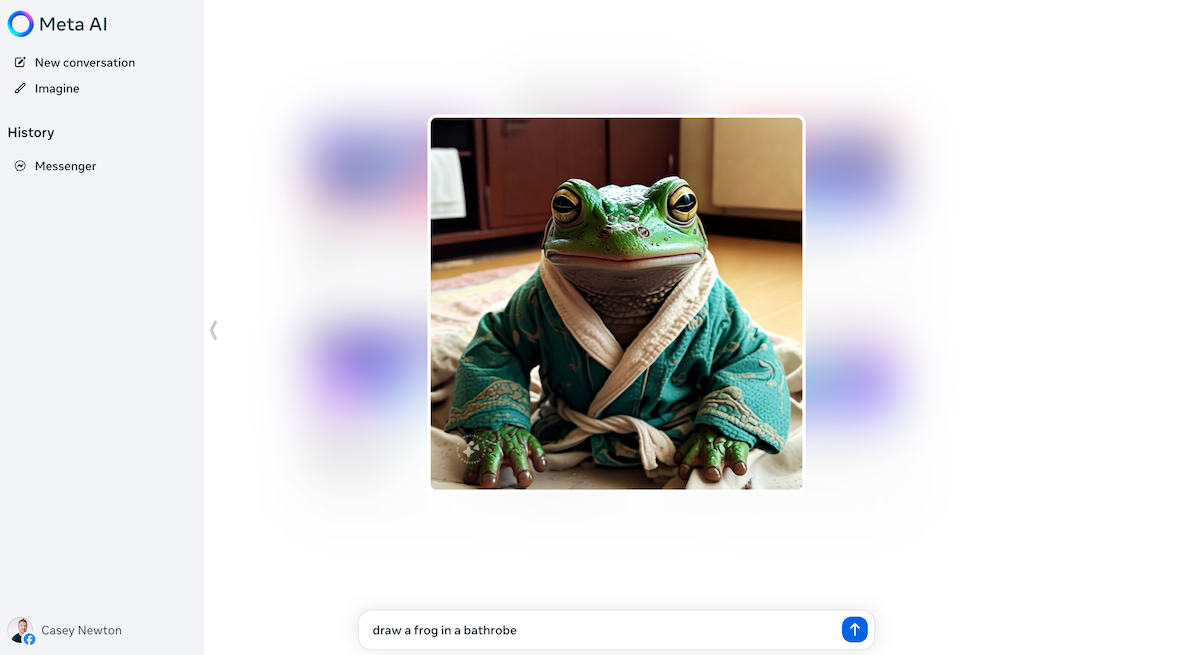
Go to meta.ai and tell the bot to draw something. I chose "frog wearing a bathrobe."
The image generates quickly. But that's not the impressive part.
Go back into the prompt and change a word. Maybe the frog is now wearing a military uniform, or a cowboy hat. Within milliseconds of editing the prompt, a new image appears to match it.
If you're used to the long stretches it can take ChatGPT to generate an image, Llama 3's performance is worth a look.
V.
Where is all of this going?
No one knows for sure. But the steps Meta took today continue building the groundwork for something I wrote about here last year: the synthetic social network.
In September, Meta had just unveiled 28 chatbots based on the likenesses of Kendall Jenner, MrBeast, Snoop Dogg, and other celebrities. It is a confusing product — Snoop Dogg's character is a dungeon master for a role playing game, for some reason? And most of the bots got little traction. (The fake Snoop Dogg barely has 14,000 followers; the real one has 86.7 million.)
This week, though, the New York Times reported that Meta is taking the next step down this path: offering to let creators interact with their fans on its platforms via a chatbot trained on the way they speak. "Most of the messages would be sent automatically and would at least initially disclose that they were A.I.-generated," report Sapna Maheshwari and Mike Isaac.
No one wants to talk to the Dungeons & Dragons chatbot that looks like Snoop Dogg. But they very well might want to talk to the Snoop Dogg chatbot in Snoop's actual Instagram DMs. And soon, they may have that chance.
Instinctively, we might assume that people will hate this sort of thing. And yet the success of companies like Character.Ai and Replika — to say nothing of the rise of Shrimp Jesus on Facebook itself — suggest synthetic chats and media are about to become hugely popular.
The first era of Facebook was for talking with friends and family. The second, TikTok-influenced era of the company is more focused on content from creators and other people you don't know.
This week, we got a glimpse of the era yet to come: one where we interact regularly with both people and bots — perhaps not even always knowing, or caring, which one we are talking to.
In recent months, conversations about the future of the internet rightly focused on how AI-generated text threatens to overwhelm the web. But for all that is impressive about Llama 3, its release offers a reminder that synthetic media is about to ooze into every corner of social products, too.
And what happens after that is anyone's guess.
Casey Newton writes Platformer, a daily guide to understanding social networks and their relationships with the world. This piece was originally published on Platformer.

.gif)

