Tech
tech

Meta, like Twitter, is also paying people to generate AI slop

Surprise! The social media companies tasked with stopping the AI slop on their platforms are responsible for it.

Remember shrimp Jesus?

404 Media found that Facebook, through its Creator Bonus Program, has been paying creators in countries like India and the Philippines to generate just that kind of weird viral AI crap.

404 reports on numerous videos showing people how to make money off virality using AI image prompts meant to tug on people’s heartstrings and inspire bewilderment, with fake images of starving children and houses that look like hummingbirds.

Those of you old enough to remember last month might recognize that plot line from Sherwood’s story on Twitter, whose revenue share program has people in Vietnam programming armies of generative AI bots to garner likes and paychecks.

“We encourage creators to use AI tools to produce high-quality content that meets all our Community Standards, and we take action against those who attempt to drive traffic using inauthentic engagement whether they use AI or not,” Meta told 404 in a statement. In other words: “We’re all trying to find the guy who did this.”

404 reports on numerous videos showing people how to make money off virality using AI image prompts meant to tug on people’s heartstrings and inspire bewilderment, with fake images of starving children and houses that look like hummingbirds.

Those of you old enough to remember last month might recognize that plot line from Sherwood’s story on Twitter, whose revenue share program has people in Vietnam programming armies of generative AI bots to garner likes and paychecks.

“We encourage creators to use AI tools to produce high-quality content that meets all our Community Standards, and we take action against those who attempt to drive traffic using inauthentic engagement whether they use AI or not,” Meta told 404 in a statement. In other words: “We’re all trying to find the guy who did this.”

More Tech

See all Tech
tech

Apple updates Mac chips and amps up AI claims

Apple’s new M5 Pro and M5 Max chips are the latest step in its steady silicon march: faster CPUs, stronger graphics, more memory bandwidth. The 30% CPU performance increase is meaningful but incremental — not the kind of leap that accompanied the original M1 transition from Intel.

What’s more notable is how aggressively Apple is framing this around AI. The company is touting up to 4x higher peak GPU compute for AI workloads and the ability to run larger models locally, leaning hard into the on-device AI narrative as it positions the MacBook Pro as a more capable personal AI development machine.

It may be paying off in unexpected ways, as the explosion of interest in roll-your-own AI agents like Moltbot have made low-cost Macs like the MacMini a hot item.

It may be paying off in unexpected ways, as the explosion of interest in roll-your-own AI agents like Moltbot have made low-cost Macs like the MacMini a hot item.

tech

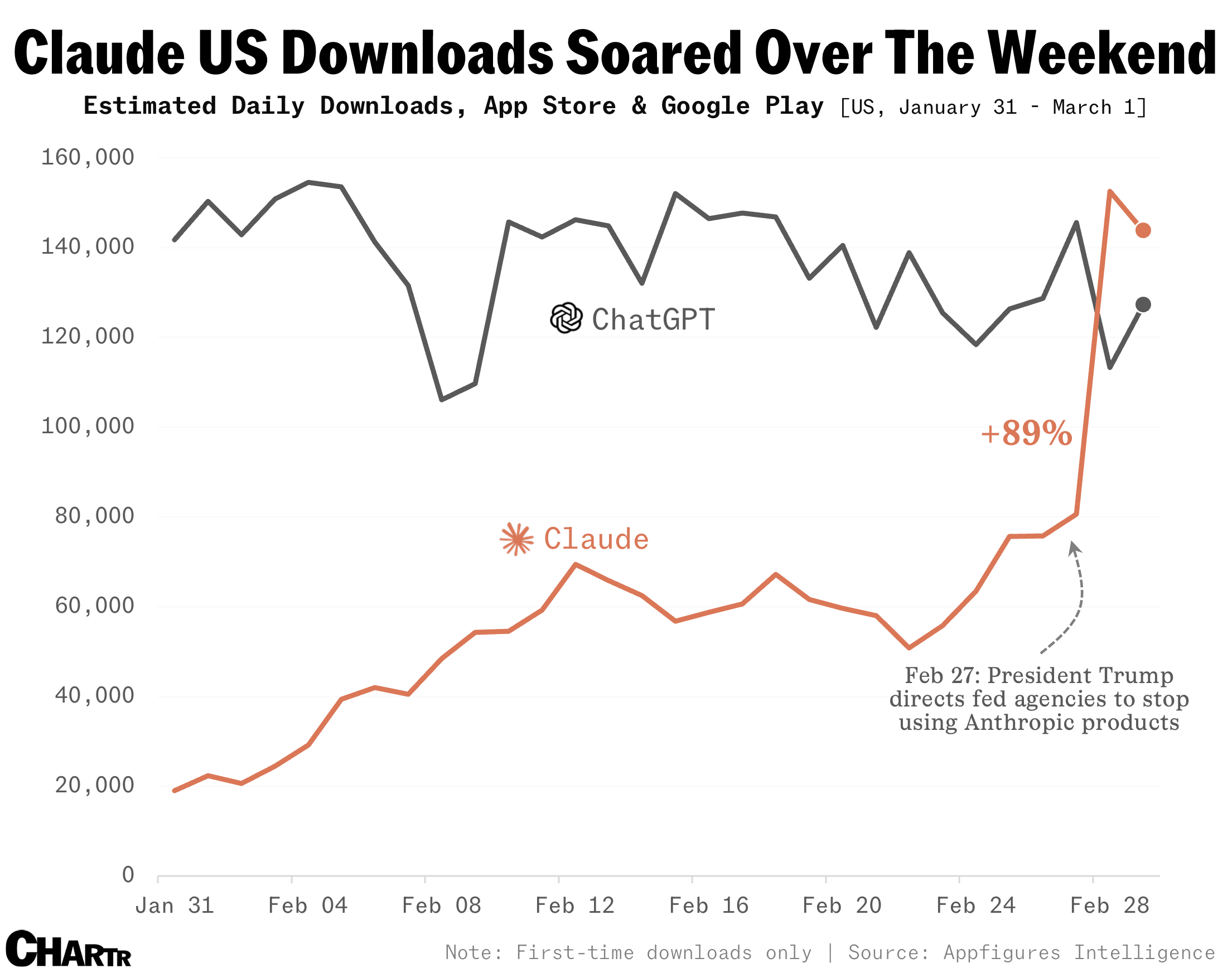
Claude is still top of the US free App Store, as users defect from ChatGPT following Pentagon deal

Last Friday, President Trump directed federal agencies to cease using all Anthropic products owing to its very messy, very public dispute with the Department of War (née Defense), which had centered around the potential US military use of its AI. Just a day later, OpenAI announced that it had made an agreement to supply artificial intelligence to the Pentagon.

It didn’t take long for consumers to respond to news of the deal, which OpenAI CEO Sam Altman has now conceded looked “opportunistic and sloppy” in a post on X. Uninstalls of the ChatGPT mobile app jumped 295% on Saturday from the day before, according to figures from Sensor Tower reported by TechCrunch, as fears around the since-amended agreement’s privacy implications grew.

Claude ChatGPT downloads Feb chart
Sherwood News
tech

After tussle with Pentagon, Anthropic’s $60 billion worth of recent investments might be at risk

The fallout from Anthropic’s dramatic split from the Pentagon is still being measured. For a domestic company to be labeled a “supply-chain risk to national security” by the US defense secretary is unprecedented, as Anthropic noted in a post responding to Defense Secretary Pete Hegseth’s tweet.

Making it even more shocking is the fact that Anthropic appeared to be on track to have one of the largest and most anticipated tech IPOs in American history.

Axios’ Dan Primack writes that the $60 billion in venture capital Anthropic just raised last month could very well be at risk. Primack argues that investors may get cold feet now that the company has run afoul of the Trump administration, and it faces significant uncertainty as the industry waits to see what official acts follow Hegseth’s words.

Making it even more shocking is the fact that Anthropic appeared to be on track to have one of the largest and most anticipated tech IPOs in American history.

Axios’ Dan Primack writes that the $60 billion in venture capital Anthropic just raised last month could very well be at risk. Primack argues that investors may get cold feet now that the company has run afoul of the Trump administration, and it faces significant uncertainty as the industry waits to see what official acts follow Hegseth’s words.

Latest Stories

Sherwood Media, LLC produces fresh and unique perspectives on topical financial news and is a fully owned subsidiary of Robinhood Markets, Inc., and any views expressed here do not necessarily reflect the views of any other Robinhood affiliate, including Robinhood Markets, Inc., Robinhood Financial LLC, Robinhood Securities, LLC, Robinhood Crypto, LLC, or Robinhood Money, LLC.