
Tech
mannequins looking at the mobile phone
Getty Images
PHANTOM THREADS

Meta says that Threads now has more than 350 million monthly active users

But the question remains: who actually uses it?

Millie Giles

Social media giant Meta reported its first-quarter earnings on Wednesday, and there was a lot to like: ad revenues increased 16% year over year; its AI data center plans are ramping up; and total revenue crushed expectations, hitting $42.3 billion.

But amid all of the big numbers, there was one comparatively needle-sized figure in the earnings call. CEO Mark Zuckerberg revealed that Threads, Meta’s answer to Twitter/X, has now grown to over 350 million monthly active users, up some 30 million from the previous quarter — or, the equivalent of adding roughly the entire user base (~35 million) of rival Bluesky in just three months.

It seems that the text-first app is still growing almost two years after its debut, with Zuckerberg indicating on the call that Threads “continues to be on track to become our next major social app.” For some reason, though, it just doesn’t really feel that way.

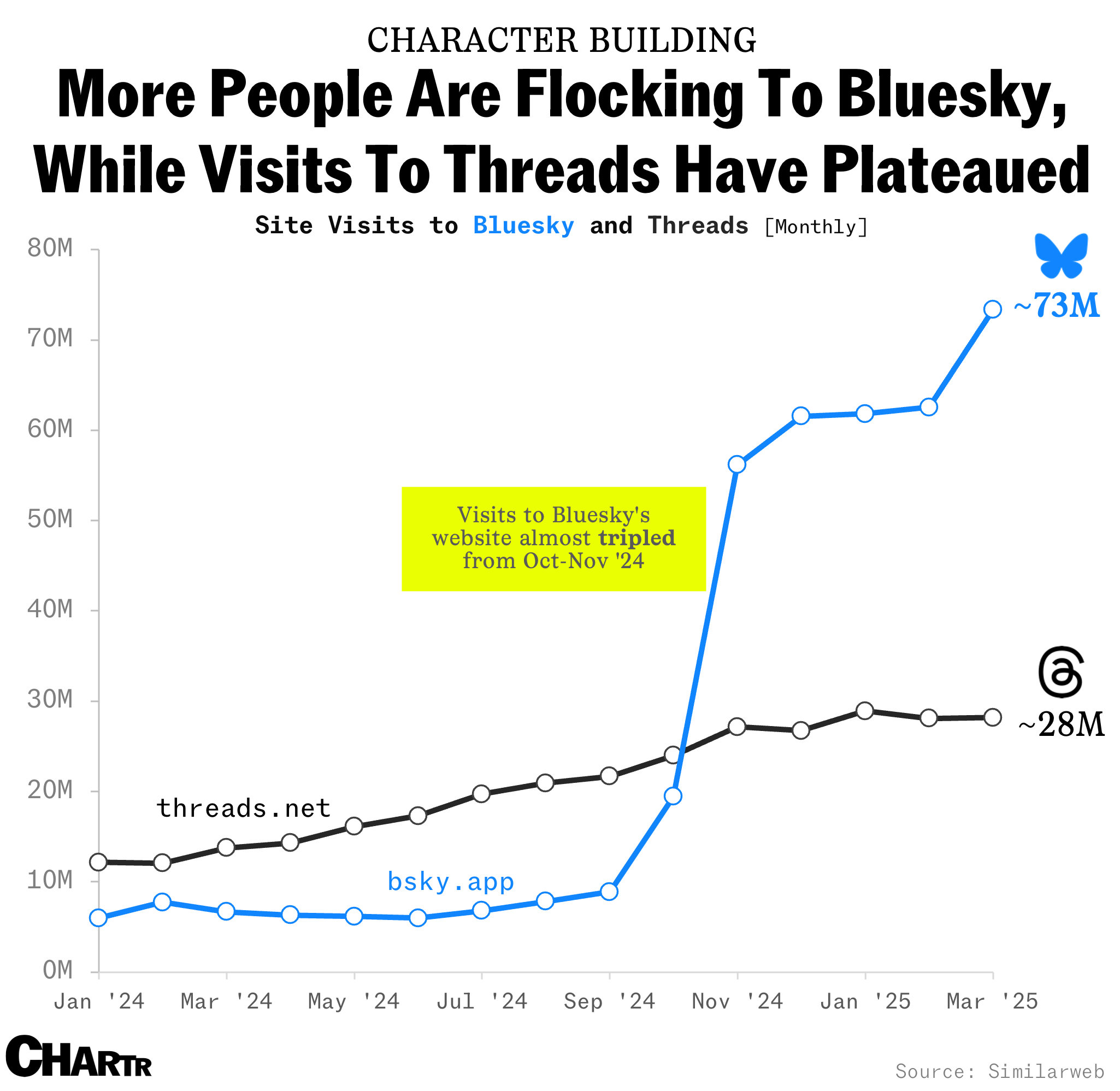
Though we don’t have access to in-app traffic, looking at site visit data from Similarweb suggests that people seem to be driving clicks to Bluesky, the new microblogging platform on the block, much more than to the Instagram-linked service.
Bluesky vs. Threads
Sherwood News

Bluesky rocketed in popularity during the US presidential election — owing to a mass exodus of users from X — with visits to the platform almost tripling in the month of November last year. Even since then, visits to Bluesky have gone up, climbing to ~73 million in March. Meanwhile, visits to threads.net have plateaued, having seen a much more modest uplift from November’s X-odus.

Now, if you’re wondering why a Meta-backed social media service has a “.net” domain, Threads has only just managed to secure “threads.com.” It officially changed the URL on April 24, after the messaging startup app that originally had the address was finally acquired by Shopify last June.

Common threads

So how does a platform that has 350 million active users per month only drive 28 million visits to its site?

One obvious answer is that, because it’s still so inextricably linked with Instagram, Threads users are even more app-based and therefore less likely to navigate to threads.net on a web browser. Another explanation is that the 350 million figure potentially includes a lot of people who might use Threads very lightly — clicking on one or two links via Instagram per month, with little intent on sharing Threads content more widely.

When Threads first launched in July 2023, it reported an instant surge of interest, hitting 10 million user signups in just seven hours, then 100 million in under five days — a milestone that took Facebook 4.5 years to reach.

But much of this momentum has come from Threads’ connection to Instagram, which reportedly has ~2 billion monthly active users. In order to sign up for Threads, you need an existing Instagram account; the direct message function on Threads redirects to Instagram DMs; and the microblogging app is plugged on Instagram feeds by showing users Threads posts from their followers and people of interest.

Accounts made through Instagram, then barely touched, are perhaps what’s giving Threads that “empty feeling,” and prompts the question of who actually uses it despite its strong user base. The challenge for Meta now is keeping those 350 million MAUs posting on the app — which it’s found some success in by creating spaces for particular topics of interest and communities, à la Reddit — and, beyond that, monetizing it. Last week, Meta announced in a blog post that all “eligible advertisers globally” will now be able to run ads on Threads.

X-ed out

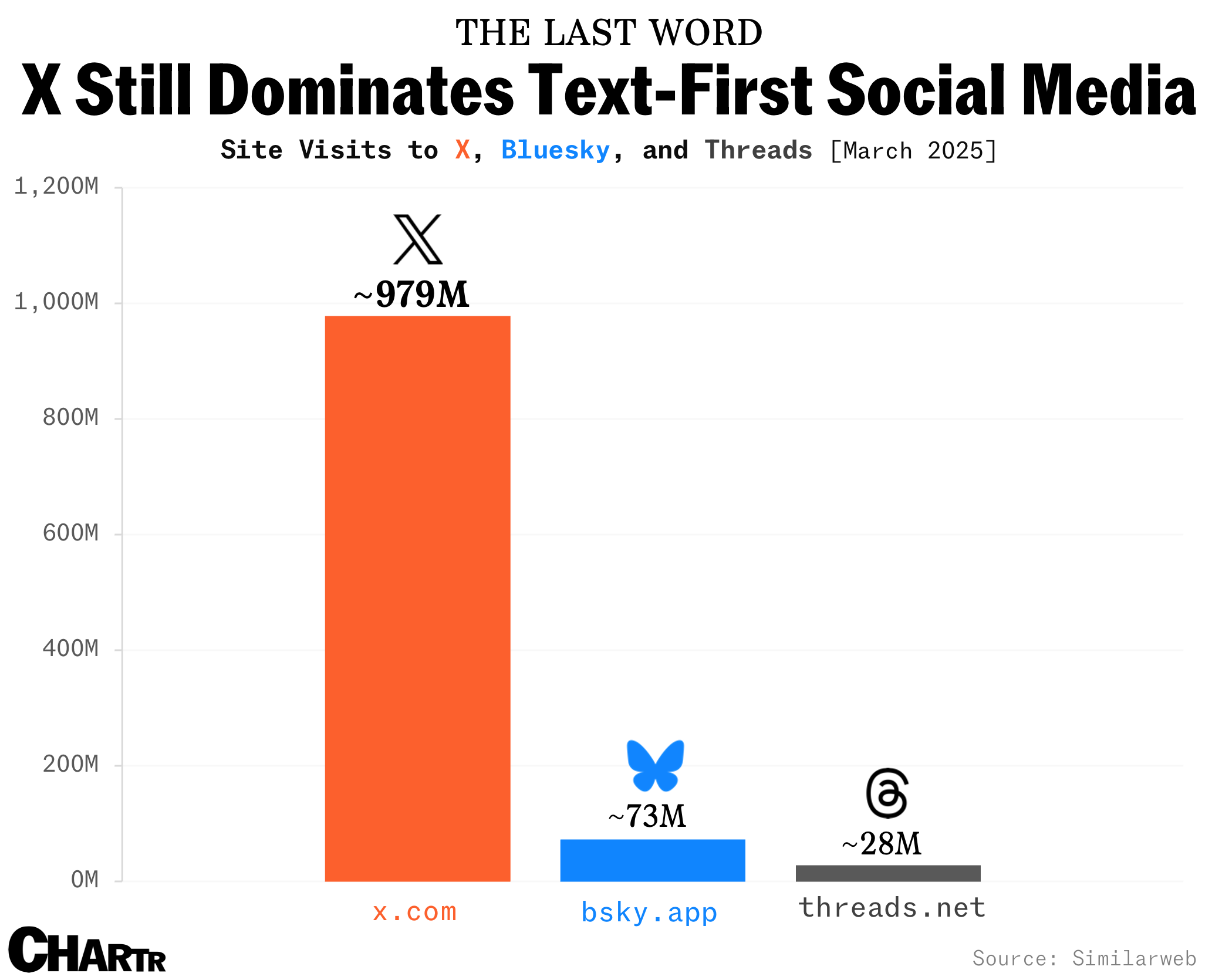
Still, both Threads and Bluesky might struggle to outpace the original microblogging platform, X. Site visit data from Similarweb shows that X.com had 979 million site visits in March alone, almost 35x the amount of visits that threads.net saw that month.
X traffic Similarweb
Sherwood News

Indeed, on the same day that Meta reported its Q1 earnings, X CEO Linda Yaccarino reported that the platform now has 600 million monthly active users globally, slightly up from the 570 million the company said it reached last September.

However, Meta’s approach with Threads thus far has been to address its Goliath competition head-on. On Monday, an internal Meta planning deck was revealed in courts as part of the FTC’s ongoing antitrust trial against the company, which showed that employees initially pitched Threads as a better version of Twitter at a time when the social platform was experiencing “instability.” Now, Meta is stepping up efforts to directly wrangle users from X, testing a new feature that allows users to easily find the Threads accounts of the same creators they follow on X.


More Tech

See all Tech
tech

Uber jumps after unveiling Lucid robotaxi at CES

Uber shares jumped more than 5% after the company unveiled a production-intent robotaxi developed in partnership with Lucid and Nuro at the Consumer Electronics Show on Monday. The autonomous vehicle runs on Nvidia’s Drive AGX Thor computer. Nvidia itself announced a slate of autonomous hardware and software announcements at CES.

The companies said this fall that the San Francisco Bay Area will be the first market for the joint effort. The robotaxi is already being tested on public roads, with a commercial launch planned for later this year.

Uber + Lucid + Nvidia is just another example of the tangled web of partnerships in the autonomous driving space, where Nvidia is now becoming more and more prominent.

The companies said this fall that the San Francisco Bay Area will be the first market for the joint effort. The robotaxi is already being tested on public roads, with a commercial launch planned for later this year.

Uber + Lucid + Nvidia is just another example of the tangled web of partnerships in the autonomous driving space, where Nvidia is now becoming more and more prominent.

tech

Meta delays international Ray-Ban Display expansion thanks to “unprecedented demand” and “extremely limited inventory”

Meta said today that it’s delaying the early 2026 international expansion of its Ray-Ban Display glasses because of “extremely limited inventory” and “unprecedented demand.” The company didn’t specify whether the issue was more supply or demand, but has previously insisted its smart glasses are a hit.

Waitlists for the smart glasses, which are controlled with a band you wear on your wrist, extend “well into 2026.”

“We’ll continue to focus on fulfilling orders in the US while we re-evaluate our approach to international availability,” the company wrote. Expansion had been planned for the UK, France, Italy, and Canada.

In order to buy the smart glasses, consumers must do an in-person product demo to ensure the tech is “properly fitted to you,” according to Meta. Demos in New York City are unavailable for the next few weeks, the company’s scheduling website shows. It also notes that “that due to high demand, the product may be sold out and unavailable for purchase after your demo.”

US-AI-TECH-COMPUTERS-TELECOM

Nvidia’s autonomous tech gives other automakers a chance to take on Tesla

Nvidia made a number of autonomous vehicle announcements at CES yesterday that should have Tesla worried.

tech

Report: Returns on Nvidia’s Omniverse business are underwhelming

Today in Las Vegas, Nvidia’s Jensen Huang will be taking the stage at the CES conference to show off his company’s latest innovations. If youve watched any of Huang’s impressive jargon-filled keynote speeches, you’ll notice that he gets extra animated when talking about “digital twins.”

Nvidia’s “Omniverse” platform allows companies to use Nvidia software and hardware to run large-scale simulations of factories and assembly lines.

The idea is that you can train your robots in Nvidia’s simulated environment, saving huge amounts of time and money. Huang is making a huge bet on this nascent product, and according to a new report, it isn’t exactly taking off.

The Information reports that much to Huang’s anger and frustration, the Omniverse offerings have yet to generate significant revenue.

According to the report, despite a long list of customers who Nvidia says are using Omniverse, some say the software is hard to use and fails to allow for simulating robot interactions with complex objects. The report also says Nvidia shuttered its Omniverse Cloud service in August of last year due to a lack of demand.

Nvidia has certainly successfully blazed trails into new categories before, but considering Huang’s enthusiasm for the Omniverse offerings, it is a rare stumble for the chip juggernaut.

The idea is that you can train your robots in Nvidia’s simulated environment, saving huge amounts of time and money. Huang is making a huge bet on this nascent product, and according to a new report, it isn’t exactly taking off.

The Information reports that much to Huang’s anger and frustration, the Omniverse offerings have yet to generate significant revenue.

According to the report, despite a long list of customers who Nvidia says are using Omniverse, some say the software is hard to use and fails to allow for simulating robot interactions with complex objects. The report also says Nvidia shuttered its Omniverse Cloud service in August of last year due to a lack of demand.

Nvidia has certainly successfully blazed trails into new categories before, but considering Huang’s enthusiasm for the Omniverse offerings, it is a rare stumble for the chip juggernaut.

tech

Amazon brings its ChatGPT-style assistant online

Today, Amazon expanded access to its ChatGPT-style AI assistant, Alexa+, making it available on the web via Alexa.com.

Previously, Alexa+, which launched early last year, had mostly been accessible through Amazon devices like Echo smart speakers, but the site allows a broader audience to use the assistant, much like rivals such as OpenAI’s ChatGPT and Google’s Gemini.

In a press release, Amazon said that to “truly serve as a personal assistant, Alexa+ needs to be available wherever they are — at home, on their phone, and now on the web.”

The stock is up more than 2% in early trading.

In a press release, Amazon said that to “truly serve as a personal assistant, Alexa+ needs to be available wherever they are — at home, on their phone, and now on the web.”

The stock is up more than 2% in early trading.

Latest Stories

Sherwood Media, LLC produces fresh and unique perspectives on topical financial news and is a fully owned subsidiary of Robinhood Markets, Inc., and any views expressed here do not necessarily reflect the views of any other Robinhood affiliate, including Robinhood Markets, Inc., Robinhood Financial LLC, Robinhood Securities, LLC, Robinhood Crypto, LLC, or Robinhood Money, LLC.