

Tech
mannequins looking at the mobile phone
Getty Images
PHANTOM THREADS

Meta says that Threads now has more than 350 million monthly active users

But the question remains: who actually uses it?

Millie Giles

Social media giant Meta reported its first-quarter earnings on Wednesday, and there was a lot to like: ad revenues increased 16% year over year; its AI data center plans are ramping up; and total revenue crushed expectations, hitting $42.3 billion.

But amid all of the big numbers, there was one comparatively needle-sized figure in the earnings call. CEO Mark Zuckerberg revealed that Threads, Meta’s answer to Twitter/X, has now grown to over 350 million monthly active users, up some 30 million from the previous quarter — or, the equivalent of adding roughly the entire user base (~35 million) of rival Bluesky in just three months.

It seems that the text-first app is still growing almost two years after its debut, with Zuckerberg indicating on the call that Threads “continues to be on track to become our next major social app.” For some reason, though, it just doesn’t really feel that way.

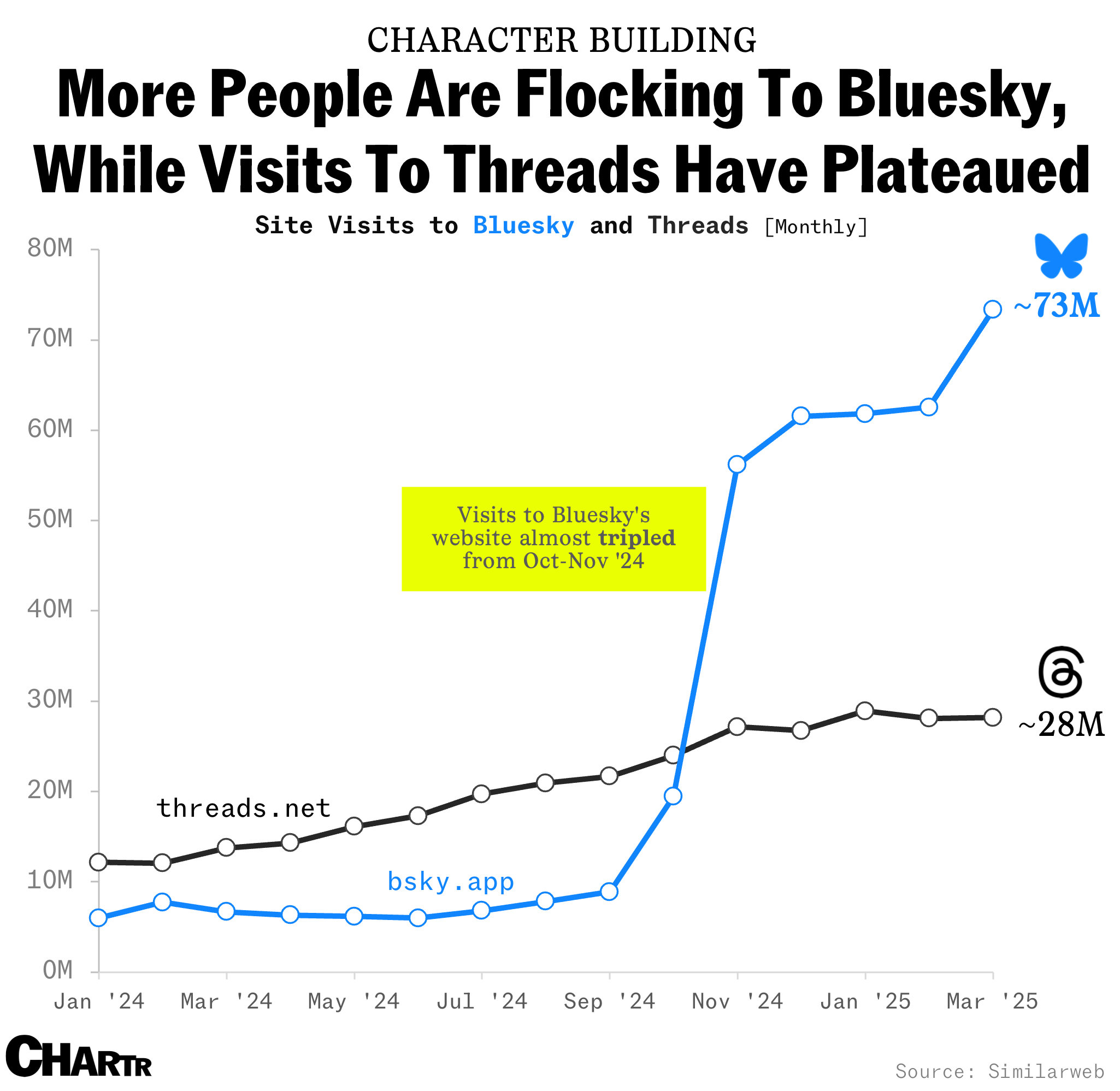
Though we don’t have access to in-app traffic, looking at site visit data from Similarweb suggests that people seem to be driving clicks to Bluesky, the new microblogging platform on the block, much more than to the Instagram-linked service.
Bluesky vs. Threads
Sherwood News

Bluesky rocketed in popularity during the US presidential election — owing to a mass exodus of users from X — with visits to the platform almost tripling in the month of November last year. Even since then, visits to Bluesky have gone up, climbing to ~73 million in March. Meanwhile, visits to threads.net have plateaued, having seen a much more modest uplift from November’s X-odus.

Now, if you’re wondering why a Meta-backed social media service has a “.net” domain, Threads has only just managed to secure “threads.com.” It officially changed the URL on April 24, after the messaging startup app that originally had the address was finally acquired by Shopify last June.

Common threads

So how does a platform that has 350 million active users per month only drive 28 million visits to its site?

One obvious answer is that, because it’s still so inextricably linked with Instagram, Threads users are even more app-based and therefore less likely to navigate to threads.net on a web browser. Another explanation is that the 350 million figure potentially includes a lot of people who might use Threads very lightly — clicking on one or two links via Instagram per month, with little intent on sharing Threads content more widely.

When Threads first launched in July 2023, it reported an instant surge of interest, hitting 10 million user signups in just seven hours, then 100 million in under five days — a milestone that took Facebook 4.5 years to reach.

But much of this momentum has come from Threads’ connection to Instagram, which reportedly has ~2 billion monthly active users. In order to sign up for Threads, you need an existing Instagram account; the direct message function on Threads redirects to Instagram DMs; and the microblogging app is plugged on Instagram feeds by showing users Threads posts from their followers and people of interest.

Accounts made through Instagram, then barely touched, are perhaps what’s giving Threads that “empty feeling,” and prompts the question of who actually uses it despite its strong user base. The challenge for Meta now is keeping those 350 million MAUs posting on the app — which it’s found some success in by creating spaces for particular topics of interest and communities, à la Reddit — and, beyond that, monetizing it. Last week, Meta announced in a blog post that all “eligible advertisers globally” will now be able to run ads on Threads.

X-ed out

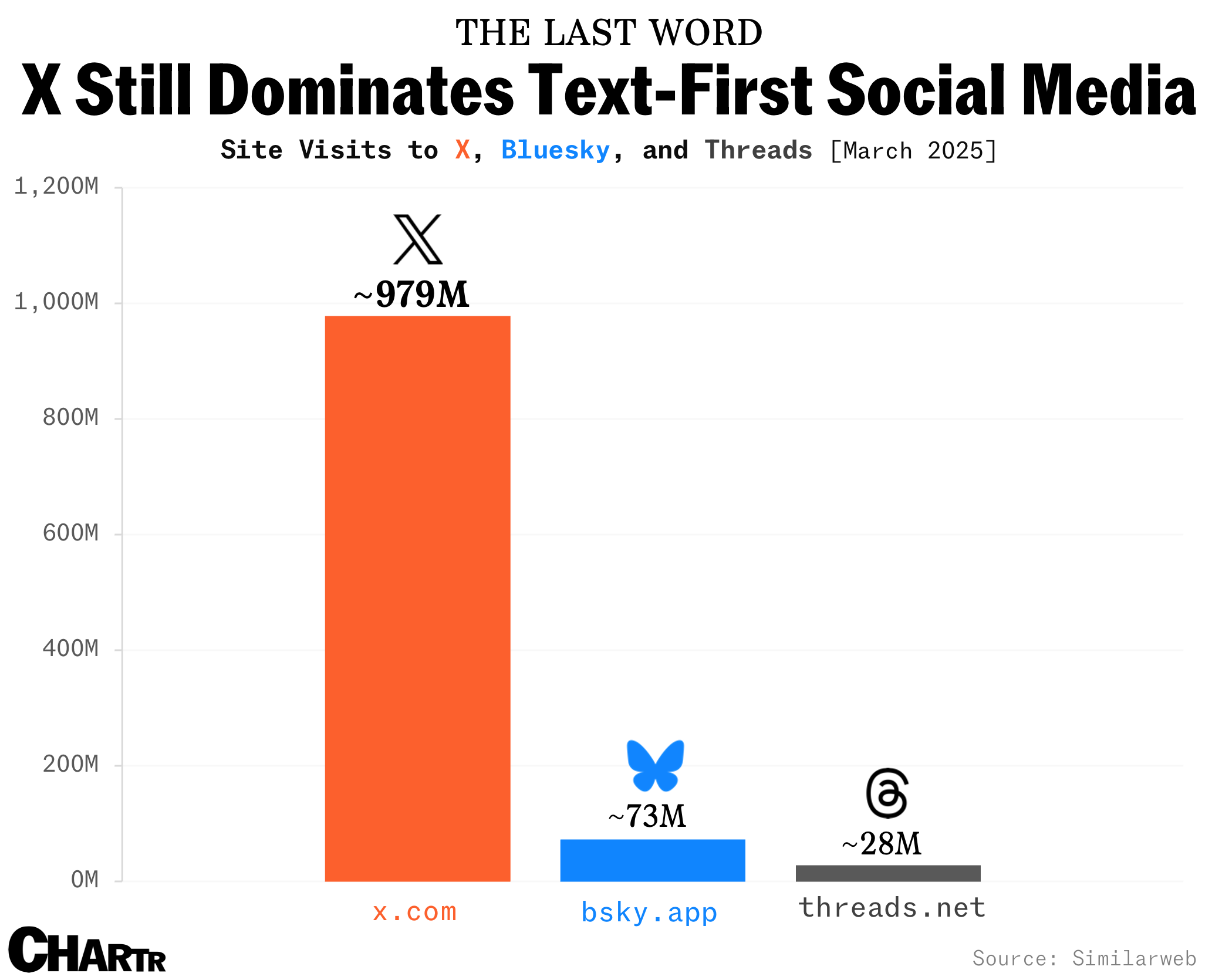
Still, both Threads and Bluesky might struggle to outpace the original microblogging platform, X. Site visit data from Similarweb shows that X.com had 979 million site visits in March alone, almost 35x the amount of visits that threads.net saw that month.
X traffic Similarweb
Sherwood News

Indeed, on the same day that Meta reported its Q1 earnings, X CEO Linda Yaccarino reported that the platform now has 600 million monthly active users globally, slightly up from the 570 million the company said it reached last September.

However, Meta’s approach with Threads thus far has been to address its goliath competition head-on. On Monday, an internal Meta planning deck was revealed in courts as part of the FTC’s ongoing antitrust trial against the company, which showed that employees initially pitched Threads as a better version of Twitter at a time when the social platform was experiencing “instability.” Now, Meta is stepping up efforts to directly wrangle users from X, testing a new feature that allows users to easily find the Threads accounts of the same creators they follow on X.


More Tech

See all Tech
tech
Tom Jones

Prediction markets have, predictably, been given a boost by the summer of sports

Major platforms like Kalshi and Polymarket have seen huge upticks in users of late, thanks in no small part to what’s felt like a recent sporting smorgasbord, with major competitions across hockey, basketball, and soccer soaking up fans’ time (and spending, clearly) at the outset of summer.

While gaming industry groups may not like it, there’s been a huge change in the methods people are using to put money on the big games, with everyone from fortunate NYC bar owners, to a far less fortunate Spanish supporter, turning to prediction markets to try and turn their sports know-how into cold, hard cash.

According to a new report from Adam Blacker for apptopia, that shift might have been even more seismic than imagined in the wake of the NBA and NHL finals and around the 2026 World Cup kicking off.

While gaming industry groups may not like it, there’s been a huge change in the methods people are using to put money on the big games, with everyone from fortunate NYC bar owners, to a far less fortunate Spanish supporter, turning to prediction markets to try and turn their sports know-how into cold, hard cash.

According to a new report from Adam Blacker for apptopia, that shift might have been even more seismic than imagined in the wake of the NBA and NHL finals and around the 2026 World Cup kicking off.

South by Southwest Conference and Festivals

Gold Tesla Cybercabs are piling up, but they’re not picking up passengers yet

Low-volume production started in April. Now people are noticing them more and more in the wild.

Rani Molla6/15/26
tech
Jon Keegan

Anthropic pulls Fable and Mythos access worldwide after Trump administration bars their use by foreign nationals

Only days after releasing two versions of its next-gen AI model, Anthropic has disabled them for users worldwide.

Anthropic says it received a Friday night order from the Trump administration to suspend access to the models for any foreign national (anywhere in the world) — a group that included some Anthropic employees. In response, the company turned off access to everyone.

Last week, the company released to the public its much-anticipated Claude Fable 5 model (and its restricted version Claude Mythos 5, which is still being tested with trusted partners). Anthropic said in a blog post announcing the action that officials cited national security concerns with the new models, while offering few specific details.

The post said that the government gave the company “verbal evidence of a potential narrow, non-universal jailbreak” of the public Fable 5 model. A jailbreak is a means by which users can evade restrictions built into the code to unlock prohibited functionality. Anthropic downplayed the significance of the attack, and said other major models, such as OpenAI’s GPT-5.5, could also be affected by the technique described.

Fears of these first Mythos-class models being misused are running high, after Anthropic warned the cybersecurity world in May that the advanced cyber capabilities of Mythos have rapidly discovered thousands of vulnerabilities in ubiquitous software, leading to the decision to restrict the full version of the model to a close group of trusted partners for testing.

This morning, Axios reported that Anthropic technical staff have flown to Washington to meet with White House officials to resolve the issue.

The Wall Street Journal is reporting that the Trump administration’s decision to take action against Anthropic was prompted by discussions that Amazon CEO Andy Jassy had with officials, including Treasury Secretary Scott Bessent. According to the report, Amazon researchers said they had been able to evade some of Fable 5’s security restrictions using specific prompts. Amazon is a major investor in Anthropic.

Anthropic is currently suing the US government to fight the Pentagon’s blacklisting of the company on national security grounds.

Last week, the company released to the public its much-anticipated Claude Fable 5 model (and its restricted version Claude Mythos 5, which is still being tested with trusted partners). Anthropic said in a blog post announcing the action that officials cited national security concerns with the new models, while offering few specific details.

The post said that the government gave the company “verbal evidence of a potential narrow, non-universal jailbreak” of the public Fable 5 model. A jailbreak is a means by which users can evade restrictions built into the code to unlock prohibited functionality. Anthropic downplayed the significance of the attack, and said other major models, such as OpenAI’s GPT-5.5, could also be affected by the technique described.

Fears of these first Mythos-class models being misused are running high, after Anthropic warned the cybersecurity world in May that the advanced cyber capabilities of Mythos have rapidly discovered thousands of vulnerabilities in ubiquitous software, leading to the decision to restrict the full version of the model to a close group of trusted partners for testing.

This morning, Axios reported that Anthropic technical staff have flown to Washington to meet with White House officials to resolve the issue.

The Wall Street Journal is reporting that the Trump administration’s decision to take action against Anthropic was prompted by discussions that Amazon CEO Andy Jassy had with officials, including Treasury Secretary Scott Bessent. According to the report, Amazon researchers said they had been able to evade some of Fable 5’s security restrictions using specific prompts. Amazon is a major investor in Anthropic.

Anthropic is currently suing the US government to fight the Pentagon’s blacklisting of the company on national security grounds.

Latest Stories

Sherwood Media, LLC and Chartr Limited produce fresh and unique perspectives on topical financial news and are fully owned subsidiaries of Robinhood Markets, Inc., and any views expressed here do not necessarily reflect the views of any other Robinhood affiliate, including Robinhood Markets, Inc., Robinhood Financial LLC, Robinhood Securities, LLC, Robinhood Crypto, LLC, Robinhood Money, LLC, Robinhood U.K. Ltd, Robinhood Derivatives, LLC, Robinhood Gold, LLC, Robinhood Asset Management, LLC, Robinhood Credit, Inc., Robinhood Ventures DE, LLC and, where applicable, its managed investment vehicles.
