

Tech
tech
Rani Molla

Meta’s not telling where it got its AI training data

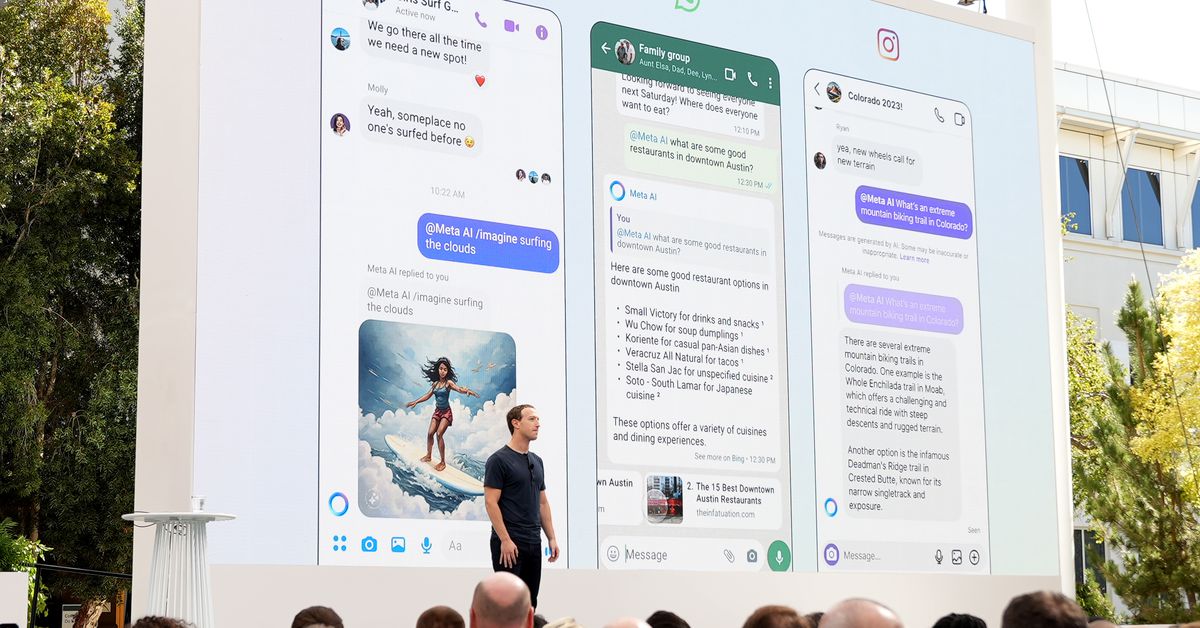
Today Meta unleashed its ChatGPT competitor, Meta AI, across its apps and as a standalone. The company boasts that it is running on its latest, greatest AI model, Llama 3, which was trained on “data of the highest quality”! A dataset seven times larger than Llama2! And includes 4 times more code!

What is that training data? There the company is less loquacious.

Meta said the 15 trillion tokens on which its trained came from “publicly available sources.” Which sources? Meta told The Verge’s Alex Heath that it didn’t include Meta user data, but didn’t give much more in the way of specifics.

It did mention that it includes AI-generated data, or synthetic data: “we used Llama 2 to generate the training data for the text-quality classifiers that are powering Llama 3.” There are plenty of known issues with synthetic or AI-created data, foremost of which is that it can exacerbate existing issues with AI, because it’s liable to spit out a more concentrated version of any garbage it is ingesting.

AI companies are turning to such data because there’s not enough good, public data on the entire internet to train their increasingly greedy AI models. (Meta had reportedly floated buying a publisher like Simon & Schuster to satisfy its insatiable data needs.)

Meta, of course, isn’t the only company that’s tight-lipped about where its AI data is coming from. In a now infamous interview with WSJ’s Johanna Stern, OpenAI’s chief technology officer Mira Murati was unable to answer questions about what Sora, OpenAI’s video generating app, was trained on. YouTube? Facebook? Instagram — she said she wasn’t sure.

What is that training data? There the company is less loquacious.

Meta said the 15 trillion tokens on which its trained came from “publicly available sources.” Which sources? Meta told The Verge’s Alex Heath that it didn’t include Meta user data, but didn’t give much more in the way of specifics.

It did mention that it includes AI-generated data, or synthetic data: “we used Llama 2 to generate the training data for the text-quality classifiers that are powering Llama 3.” There are plenty of known issues with synthetic or AI-created data, foremost of which is that it can exacerbate existing issues with AI, because it’s liable to spit out a more concentrated version of any garbage it is ingesting.

AI companies are turning to such data because there’s not enough good, public data on the entire internet to train their increasingly greedy AI models. (Meta had reportedly floated buying a publisher like Simon & Schuster to satisfy its insatiable data needs.)

Meta, of course, isn’t the only company that’s tight-lipped about where its AI data is coming from. In a now infamous interview with WSJ’s Johanna Stern, OpenAI’s chief technology officer Mira Murati was unable to answer questions about what Sora, OpenAI’s video generating app, was trained on. YouTube? Facebook? Instagram — she said she wasn’t sure.

More Tech

See all Tech
tech

Microsoft is reportedly building a super app to tame product sprawl — and finally crack mobile

Super apps are very 2010s, but they might be the future for Microsoft. The enterprise giant is working on combining its sprawling and often confusing product suite into a single super app expected by late summer, Fortune reports.

By unifying the tools, Microsoft is hoping that the massive popularity of some of its offerings — particularly GitHub Copilot — will rub off on its other, slower-growing products.

The tool will merge its coding assistant GitHub Copilot, its chat function Copilot, its Copilot Cowork tool, and a new agentic workflow called Autopilot. The move, known internally as “Delivering one Copilot,” will have the dual purpose of simplifying Microsoft’s fragmented desktop AI offerings and finally helping the office software giant gain a foothold on mobile, where competing tools have dominated.

Microsoft is taking a page from frenemy OpenAI’s playbook. In March, OpenAI announced plans for its own desktop super app to combine ChatGPT, Codex, and its Atlas browser into one central workstation.

The tool will merge its coding assistant GitHub Copilot, its chat function Copilot, its Copilot Cowork tool, and a new agentic workflow called Autopilot. The move, known internally as “Delivering one Copilot,” will have the dual purpose of simplifying Microsoft’s fragmented desktop AI offerings and finally helping the office software giant gain a foothold on mobile, where competing tools have dominated.

Microsoft is taking a page from frenemy OpenAI’s playbook. In March, OpenAI announced plans for its own desktop super app to combine ChatGPT, Codex, and its Atlas browser into one central workstation.

42

Forty-two is the answer to life, the universe, and everything in Douglas Adams’ classic “The Hitchhiker’s Guide to the Galaxy.” It’s also the number of unsupervised Robotaxis Tesla has on the road in Texas, the only state where it’s operating autonomous service, according to records from a newly required government database in the state.

That’s much lower than CEO Elon Musk had hoped, as the company struggles to ready its camera-only autonomous vehicles for commercial scale. In 2025, Musk said that the service would be available to “half the population of the US by the end of the year.”

Even smaller competition has more: Avride has 317 and Nuro has 47. Meanwhile, Tesla’s chief rival, Alphabet subsidiary Waymo, has 577 in operation in the state. Nationwide, Waymo’s fleet currently numbers more than 3,000.

Unfortunately for Tesla, figuring out how to actually scale its robotaxi fleet remains the ultimate question.

INDIA-TECHNOLOGY-AI-DIPLOMACY

Anthropic raises $65 billion at a $965 billion valuation, releases a more “honest” Claude Opus 4.8

Anthropic’s monster $965 billion valuation puts it firmly ahead of OpenAI’s $850 billion valuation as the rivals head toward expected IPOs later this year.

Jon Keegan5/28/26
tech
Jon Keegan

Report: Microsoft tries to get back in the AI coding game with new model

Microsoft wants to fight its way back into the AI coding field by releasing a new model next week at its annual Microsoft Build developer conference, The Information reports.

The company is expected to announce a new family of models as Microsoft AI CEO Mustafa Suleyman seeks to shore up the company’s own AI offerings and gradually wean it off OpenAI’s technology over the remainder of their $13 billion partnership.

Microsoft was initially well positioned to meet software developers with AI-enhanced tools. It owns GitHub, the most popular platform for hosting and sharing code, and GitHub’s Copilot AI-powered coding tool was released months before OpenAI’s ChatGPT debuted in 2022.

But it fumbled one of the biggest first-mover advantages in history as Anthropic’s Claude Code, OpenAI’s Codex, and Cursor rolled out coding tools that developers loved.

Microsoft was initially well positioned to meet software developers with AI-enhanced tools. It owns GitHub, the most popular platform for hosting and sharing code, and GitHub’s Copilot AI-powered coding tool was released months before OpenAI’s ChatGPT debuted in 2022.

But it fumbled one of the biggest first-mover advantages in history as Anthropic’s Claude Code, OpenAI’s Codex, and Cursor rolled out coding tools that developers loved.

Ojai outside

Waymo to launch free robotaxi rides in its new Ojai vans

The new vehicles are less expensive — which is important for the service to really scale.

Rani Molla5/28/26

Latest Stories

Sherwood Media, LLC and Chartr Limited produce fresh and unique perspectives on topical financial news and are fully owned subsidiaries of Robinhood Markets, Inc., and any views expressed here do not necessarily reflect the views of any other Robinhood affiliate, including Robinhood Markets, Inc., Robinhood Financial LLC, Robinhood Securities, LLC, Robinhood Crypto, LLC, Robinhood Money, LLC, Robinhood U.K. Ltd, Robinhood Derivatives, LLC, Robinhood Gold, LLC, Robinhood Asset Management, LLC, Robinhood Credit, Inc., Robinhood Ventures DE, LLC and, where applicable, its managed investment vehicles.
