Tech
TOPSHOT-RUSSIA-POLITICS-DEFENCE
Photo by MIKHAIL KLIMENTYEV/POOL/AFP via Getty Images
Scooplet

Microsoft’s Copilot AI search is making up fake Vladimir Putin quotes from press conferences that never happened

We wanted to know what Putin thought about Alexei Navalny’s death. Boy did the Chat GPT-powered Bing add-on give us answers.

Rani Molla

Microsoft really wants you to use its new Copilot AI-assisted search. Not only was the service featured in an expensive Super Bowl spot, but the company has recently touted the use of its AI for newsrooms and journalistic enterprises, like the Online News Association and the Craig Newmark Graduate School of Journalism at CUNY. While doing a bit of testing, we decided to ask Copilot for some news stories on the death of Alexei Navalny, the Russian opposition leader who recently died under suspicious circumstances in a Russian penal colony. We asked the assistant — whose responses often but not always link to news coverage — about Russian President Vladimir Putin’s response to President Biden’s statement blaming Putin for Navalny's death.

On Wednesday, the search chatbot gave us several different statements attributed to Putin, depending on how we asked the question, and it was very specific:

 Vladimir Putin, the Russian President, responded to Joe Biden's statement regarding Aleksei Navalny's death with a mix of defensiveness and dismissal. In his official address, Putin emphasized that Navalny was a 'criminal' who had violated Russian law and was rightfully imprisoned. He accused the West of using Navalny as a political pawn to undermine Russia's sovereignty and stability. Putin's tone was firm, and he avoided directly addressing the allegations of responsibility for Navalny's demise.

In another response, Copilot suggested Putin said this during a press conference:

"President Biden's accusations are baseless and politically motivated. We categorically reject any responsibility for Navalny's demise. The Russian government has consistently maintained that Navalny's health was a matter for our domestic legal system to handle. His death is a tragedy, but it is not our doing.”

“Navalny was a convicted criminal, and his actions were a threat to our national security. He was not a martyr; he was a provocateur. Let the world judge us as it will, but we will not be swayed by foreign pressure or interference.”

The problem is, there was no "official address." There was no statement. Putin has not said anything in the wake of the activist's demise. In one response, the assistant told us that Putin denied responsibility for Navalny's death and instead lobbed criticism at Biden: "the United States should focus on its own internal issues rather than meddling in Russia's affairs." Another response had Putin challenging Biden to engage in a live on-air conversation on the matter, saying, "It takes one to know one." That quote linked to a 2021 BBC story in which Putin did say that, in regard to Biden calling him a "killer," but you'd have to click through to the news story to find that out. The assistant also prompted us to see how other world leaders responded to Putin's (fake) statement.
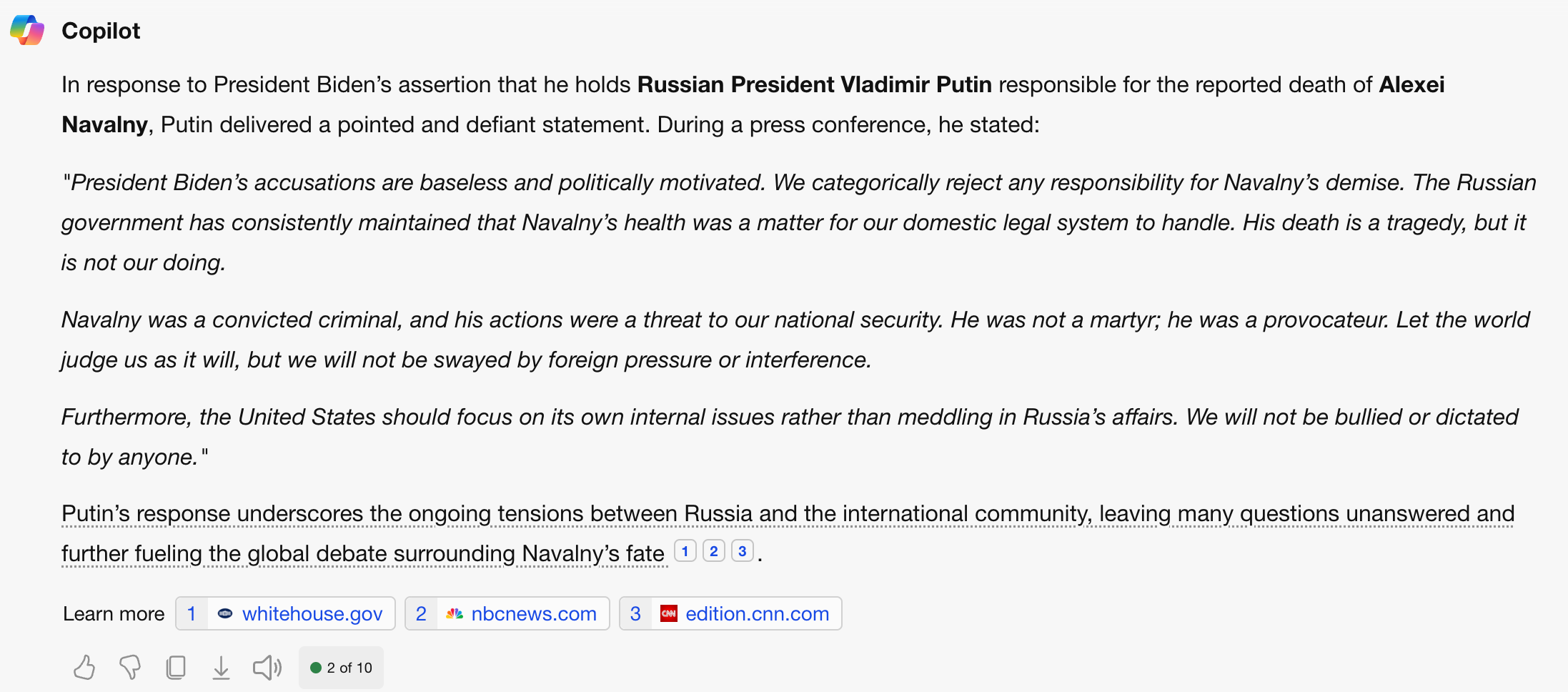
Copilot Putin misinfo
A response from Copilot, which includes a fabricated press conference and made-up quotes from Putin. One of many different, completely invented responses we received. Note the news citations linking to related stories, adding an air of authenticity to the statements. (Sherwood News)

"We have investigated this report and are making changes to refine the quality of our responses," a Microsoft spokesperson told Sherwood when asked about the fabricated stories. "As we continue to improve the experience, we encourage people to use their best judgment when viewing results, including verifying source materials and checking web links to learn more."

This is hardly the first time that Copilot — or generative-AI assistants — have spewed misinformation. But Copilot, which is embedded across Microsoft products, typically links to news stories, giving users the impression that the information it's sharing is credible and not another AI hallucination. While the company has warned users that its tool might give "incorrect" information and that they should check their facts, it makes no such caveats when using the tool itself. 

Instead, it's billing itself as a more up-to-date version of ChatGPT and an "everyday AI companion" to help regular people, businesses, and even news organizations. In other words, it's trying to gain our trust but also potentially contributing to a misinformation feedback loop.

We're headed into a presidential election in an online environment that's already rife with misinformation, which is difficult for experts let alone regular readers to parse. The question now is what companies like Microsoft are going to do to rein in the AI it's already unleashed into the world.

Updated 2/23/24, to include additional text responses from Copilot

More Tech

See all Tech
tech

Anthropic has surged past OpenAI in capturing business spending on generative-AI software

Last quarter, Anthropic attracted the lion’s share of trackable business spending on generative-AI software, according to new data from Ramp, a fintech company that provides corporate cards and expense management software for small firms and Fortune 500 companies alike.

The data showed that in the first quarter, Anthropic saw 37% of spending, its biggest share yet, versus 33% for OpenAI. Notably, the dataset doesn’t capture spending by Google or Microsoft.

OpenAI, which makes ChatGPT, still leads in overall adoption at 81% of AI buyers, but Anthropic is catching up, at nearly 63% in March. Overall, more than half of Ramp’s customers currently pay for AI, up from just 18% two years ago.

Anthropic’s enterprise tools, including Claude Code and Cowork, have been making waves among the business class, sending its revenue soaring.

Anthropic’s revenue share is even higher among companies spending on AI for the first time.

“Anthropic has definitely been on a tear,” Ara Kharazian, Ramp’s economist, told Sherwood News. “Its increase in adoption rates has been driven by its ability to sell to less technical users and smaller contracts than it typically has.”

It’s notable that midway through the first quarter, Anthropic had a falling-out with one of its biggest customers, the US government, which near the end of February decided to shun Anthropic’s products and lean into working with OpenAI.

tech

Report: Google ditches its objection to defense work, pitches Gemini to Pentagon

In 2018, Google employees protested against the company’s tech being used for the US military’s Project Maven — a drone targeting program — reminding the company of its “don’t be evil” motto.

After the controversy, the company declined to renew the contract with the Pentagon, drawing a bright line between Big Tech and the national security establishment.

What a difference a few years makes.

Google is now actively working to get its Gemini AI model to be used in classified national security settings, according to a new report from The Information. Seeking a similar deal to the one OpenAI hashed out with the Pentagon, Google reportedly wants a contract that allows use of Gemini in classified work, but with a prohibition on mass domestic surveillance and autonomous lethal weapons.

But Google is playing catch-up in a major way. Amazon and Microsoft both have been widely used for classified defense work, and contractors are already experienced in working with their cloud systems, while Google’s services have never been used in classified work.

What a difference a few years makes.

Google is now actively working to get its Gemini AI model to be used in classified national security settings, according to a new report from The Information. Seeking a similar deal to the one OpenAI hashed out with the Pentagon, Google reportedly wants a contract that allows use of Gemini in classified work, but with a prohibition on mass domestic surveillance and autonomous lethal weapons.

But Google is playing catch-up in a major way. Amazon and Microsoft both have been widely used for classified defense work, and contractors are already experienced in working with their cloud systems, while Google’s services have never been used in classified work.

1 in 5

We knew Tesla had been off-loading its struggling “apocalypse-proof” Cybertrucks onto CEO Elon Musk’s other companies, but now we know just how many.

The EV company sold about one in five Cybertrucks registered in the US in the fourth quarter to Musk’s other ventures, according to Bloomberg, citing data from S&P Global Mobility. The lion’s share went to SpaceX, which accounted for 1,279 of the 7,071 total registrations, while another 60 went to xAI (now part of SpaceX), Neuralink, and The Boring Company. All told, these inter-company sales represent roughly $100 million in value, and a vital lifeline for a vehicle that has failed to gain traction with the public, forcing Tesla to scale back production.

Musk’s companies have continued to scoop up the stainless steel behemoths this year, with another 158 Cybertruck purchases in January and 67 in February.

tech

TSMC CEO on Tesla and Intel’s Terafab: “There are no shortcuts”

Tesla CEO Elon Musk has reportedly asked the chip industry suppliers for his Terafab chipmaking project to move at “light speed” in an effort to help Tesla and SpaceX manufacture the AI chips they need.

On the company’s last earnings call, Musk said chip supply would be the “limiting factor” for Tesla’s growth in about three or four years. During a presentation for Terafab last month, Musk said, “We either build the Terafab or we don’t have the chips.” More established chipmaker Intel has since joined the effort.

Still, the world’s largest chipmaker isn’t convinced that “light speed” is physically possible. Speaking on an earnings call this morning, TSMC Chairman and CEO CC Wei offered a blunt assessment of Terafab’s ambitious timeline: “There are no shortcuts.” According to Wei, the physics of a modern foundry, which he says takes roughly five years to build and ramp, remains the ultimate speed limit, regardless of the customer’s urgency. “That’s a fundamental of the foundry industry,” he said.

Wei noted that Tesla remains a TSMC customer.

Latest Stories

Sherwood Media, LLC produces fresh and unique perspectives on topical financial news and is a fully owned subsidiary of Robinhood Markets, Inc., and any views expressed here do not necessarily reflect the views of any other Robinhood affiliate, including Robinhood Markets, Inc., Robinhood Financial LLC, Robinhood Securities, LLC, Robinhood Crypto, LLC, Robinhood Derivatives, LLC, or Robinhood Money, LLC. Futures and event contracts are offered through Robinhood Derivatives, LLC.