

Tech
tech
Jon Keegan

OpenAI and SoftBank’s $500 billion AI data center “Stargate” stumbles

On the second day of his second term, President Trump stood alongside SoftBank CEO Masayoshi Son, Oracle founder Larry Ellison, and OpenAI cofounder and CEO Sam Altman to announce the $500 billion “Project Stargate,” which Trump said included “the construction of colossal data centers, very, very massive structures.”

While it sounded like SoftBank’s Son was ready to “immediately start deploying $100 billion with a goal of making $500 billion within the next four years,” the company started looking for a $16.5 billion loan to cover the investment. And Trump’s chaotic tariff announcements have reportedly delayed SoftBank’s initial $100 billion investment, amid chatter of a possible oversupply of AI data centers.

Now The Wall Street Journal reports that there are deeper problems with Stargate, and the plans may be significantly scaled back. Apparently the organization is not fully formed yet, according to an Oracle executive on an investor call last month, and the Journal reports that Stargate has “yet to complete a single deal for a data center.”

OpenAI is moving forward on its own, including a massive data center under construction in Abilene, Texas, that the company is applying the “Stargate” name to, though it technically is not part of the SoftBank-OpenAI partnership.

Bloomberg is reporting that OpenAI’s relationship with Oracle is bearing more fruit. Oracle is reportedly supplying OpenAI with 2 million of Nvidia’s top-of-the-line GB200 GPUs as they develop 4.5 gigawatts of additional AI data center capacity in Texas, Michigan, Wisconsin, and Wyoming.
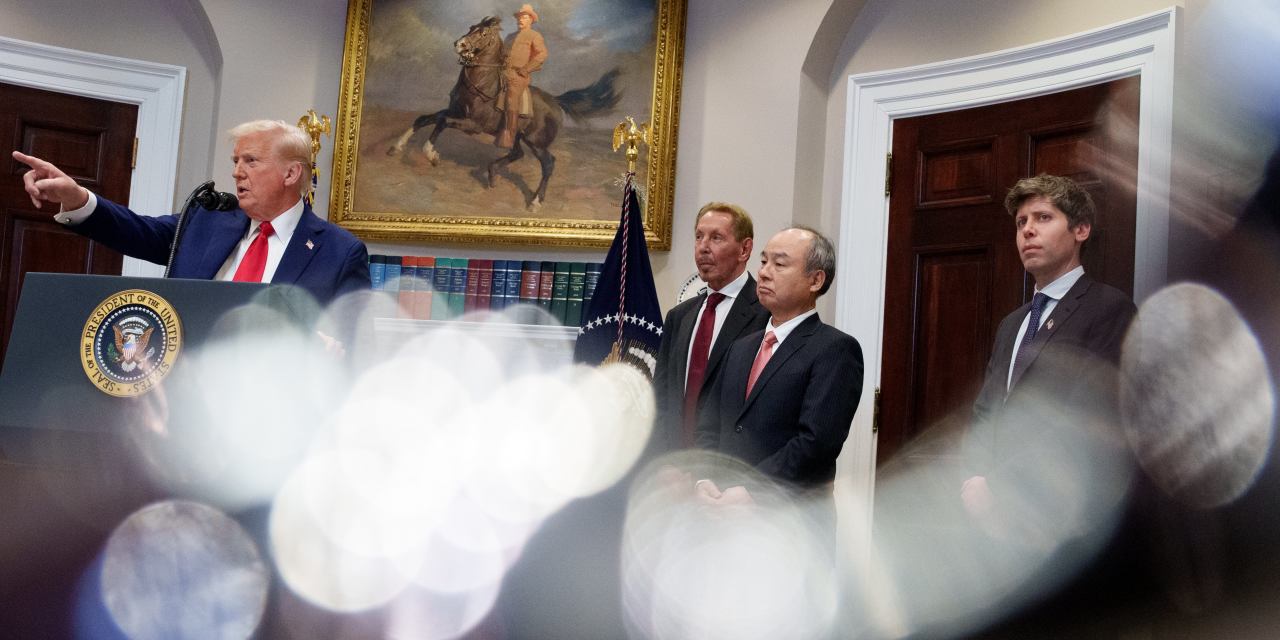
While it sounded like SoftBank’s Son was ready to “immediately start deploying $100 billion with a goal of making $500 billion within the next four years,” the company started looking for a $16.5 billion loan to cover the investment. And Trump’s chaotic tariff announcements have reportedly delayed SoftBank’s initial $100 billion investment, amid chatter of a possible oversupply of AI data centers.

Now The Wall Street Journal reports that there are deeper problems with Stargate, and the plans may be significantly scaled back. Apparently the organization is not fully formed yet, according to an Oracle executive on an investor call last month, and the Journal reports that Stargate has “yet to complete a single deal for a data center.”

OpenAI is moving forward on its own, including a massive data center under construction in Abilene, Texas, that the company is applying the “Stargate” name to, though it technically is not part of the SoftBank-OpenAI partnership.

Bloomberg is reporting that OpenAI’s relationship with Oracle is bearing more fruit. Oracle is reportedly supplying OpenAI with 2 million of Nvidia’s top-of-the-line GB200 GPUs as they develop 4.5 gigawatts of additional AI data center capacity in Texas, Michigan, Wisconsin, and Wyoming.

More Tech

See all Tech
tech

Google’s YouTube to launch cheaper streaming packages that could potentially compete with Netflix

Google’s YouTube announced today that it will launch 10 genre-specific packages early next year that will cost less than its existing $82.99-per-month YouTube TV.

While the company didn’t specify how much these new packages will cost, they’re expected to come in well under the price of the full YouTube TV bundle. That could put its price point in line with other major streaming services like those offered by Apple, Disney, and Netflix. YouTube already commands the largest share of TV viewership in the US, and lower-priced subscription options could widen its lead even further.

That’s unwelcome news for other streamers, particularly Netflix, which has faced investor pressure since reports emerged about its acquisition of Warner Bros. Discovery.

Paramount has since launched a hostile counterbid, but Netflix’s stock continues to struggle. Shares are down nearly 2% today.

While the company didn’t specify how much these new packages will cost, they’re expected to come in well under the price of the full YouTube TV bundle. That could put its price point in line with other major streaming services like those offered by Apple, Disney, and Netflix. YouTube already commands the largest share of TV viewership in the US, and lower-priced subscription options could widen its lead even further.

That’s unwelcome news for other streamers, particularly Netflix, which has faced investor pressure since reports emerged about its acquisition of Warner Bros. Discovery.

Paramount has since launched a hostile counterbid, but Netflix’s stock continues to struggle. Shares are down nearly 2% today.

tech

Elon Musk tells Google executive that “Waymo never really had a chance against Tesla”

Not one for modesty, Tesla CEO Elon Musk responded to a post on X by Jeff Dean, chief scientist at Google DeepMind, by saying, “Waymo never really had a chance against Tesla.” He added, “This will be obvious in hindsight.”

Dean had noted that Waymo vehicles have driven riders 96 million miles autonomously without a driver, alluding to the fact that Tesla’s Robotaxi service still requires safety operators in the front seat in both its locations.

Tesla currently operates about 30 Robotaxi vehicles in Austin and 120 in the Bay Area, while Waymo had more than 2,500 across the country (at least 200 in Austin and 1,000 in the Bay Area) as of late November. Musk has said Tesla would remove safety monitors in Austin and that it would scale to 500 vehicles there and 1,000 in the Bay Area by year-end, but the clock is ticking on reaching those goals.

Tesla, of course, is more focused on the 6.7 billion miles its vehicles have driven with Full Self-Driving tech, driver assistance software that requires a driver be present and paying attention. The idea is that, with a software update, millions of Teslas could be turned into potential robotaxis.

Read more on Tesla and Waymo’s battle for driverless supremacy here.

tech

Amazon announces major AI investment in India a day after Microsoft

Amazon said today that it plans to invest more than $35 billion in India by 2030, adding to the nearly $40 billion it has invested in the country so far. The latest investment is focused on AI-driven digitization, boosting exports, and expanding employment, the company said.

The news comes just after Microsoft revealed it would spend $17.5 billion on the subcontinent from 2026 to 2029 to accelerate the nation’s AI infrastructure.

India has become a strategic battleground for global tech firms thanks to its rapidly growing digital economy, vast developer base, and government support for AI infrastructure. Together, the back-to-back announcements underscore how aggressively both cloud giants are ramping up their global AI spending as they race to build — and profit from — the next generation of computing.

India has become a strategic battleground for global tech firms thanks to its rapidly growing digital economy, vast developer base, and government support for AI infrastructure. Together, the back-to-back announcements underscore how aggressively both cloud giants are ramping up their global AI spending as they race to build — and profit from — the next generation of computing.

Latest Stories

Sherwood Media, LLC produces fresh and unique perspectives on topical financial news and is a fully owned subsidiary of Robinhood Markets, Inc., and any views expressed here do not necessarily reflect the views of any other Robinhood affiliate, including Robinhood Markets, Inc., Robinhood Financial LLC, Robinhood Securities, LLC, Robinhood Crypto, LLC, or Robinhood Money, LLC.