
Tech
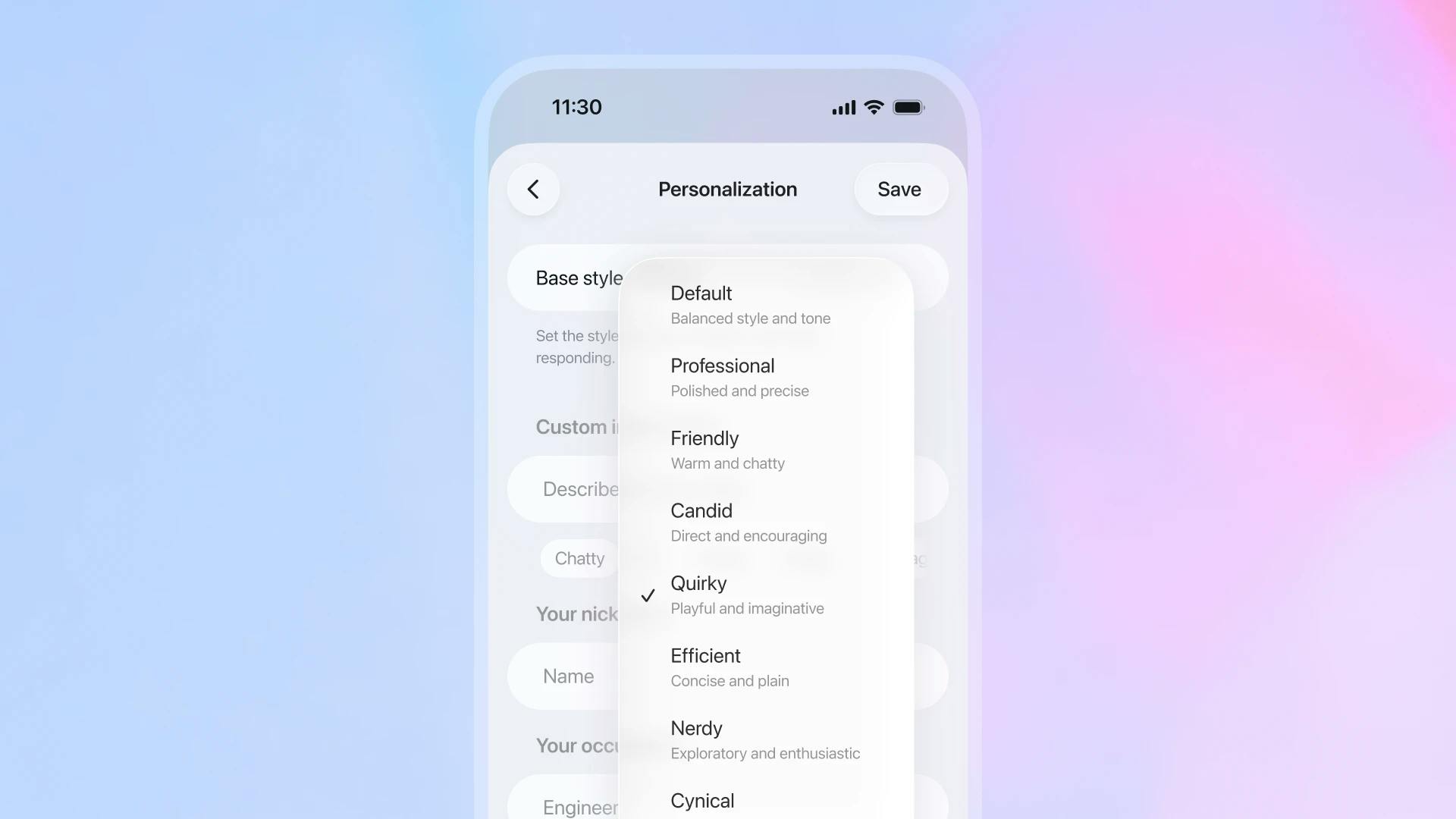
GPT-5.1 screenshot
(OpenAI)

OpenAI releases GPT 5.1, which can be “Professional,” “Candid,” or “Quirky”

The new “more conversational” model follows instructions better, but backslides on some safety tests.

Jon Keegan

Today OpenAI released GPT 5.1, an update that aims to make ChatGPT “more conversational.” The model comes in two versions: GPT-5.1 Instant (“now warmer, more intelligent, and better at following your instructions”) and GPT-5.1 Thinking (“now easier to understand and faster on simple tasks, more persistent on complex ones”).

Despite an earlier update this year that was rolled back due to being overly sycophantic, the new model responds in more chummy conversation that the company says “surprises people with its playfulness” in testing.

Users now have finer control over ChatGPT’s “personality,” with new settings for “Professional,” “Candid,” and “Quirky.”

In the model’s system card, OpenAI details how well the new 5.1 models compare to the earlier 5.0 models on internal benchmarks for disallowed content.

The company has said it is prioritizing the addition of new checks to help users who may be suffering a mental health crisis, after a series of alarming incidents where ChatGPT encouraged self-harm and reinforced delusional behavior.

Two new tests were included with this release for the first time: “mental health” and “emotional reliance.” GPT 5.1 Thinking actually scored slightly lower on 9 of 13 testing categories than its predecessor, GPT-5 Thinking, and GPT-5.1 Instant scored lower than GPT-5 Instant on 5 of 13 tests.

More thinking, more tokens

OpenAI says that GPT-5.1 Thinking now spends less time on simple tasks and more time on difficult problems. This is measured by the number of model-generated tokens (tiny bits of text). Based on a chart in the announcement, the very toughest queries handled by GPT-5.1 Thinking will use 71% more tokens to complete the query. That’s a lot more tokens, and a lot more computing!

All those tokens can add up. Every time OpenAI’s customer-facing models gobble up more computing cycles, it spends more on “inference,” or running the models (as opposed to the more resource-intensive training process that happens while building the models). When enterprise customers use OpenAI’s API to use the models, the customer pays by the token count, but free users using the chat interface do not.

As a private company, OpenAI’s finances aren’t public, but a new report from the Financial Times raises the question of how much all these “thinking” models are costing the company. While The Information recently reported that OpenAI spent $2.5 billion in the first half of 2025, AI skeptic, podcaster, and writer Ed Zitron told the FT he has seen internal OpenAI figures showing that OpenAI’s cash burn for the first half of the year was much higher — close to $5 billion.

To satisfy the $1 trillion in recent deals it has signed on to, OpenAI will need to find a way to generate more revenue.


More Tech

See all Tech
tech

Apple’s China iPhone shipments surged 20% in Q1 even as overall smartphone shipments fell

Apple’s iPhone shipments in China jumped 20% last quarter, even as the country’s overall smartphone market fell 4%, according to new data from Counterpoint Research. Rising memory costs have pushed prices higher across the industry, weighing on demand.

Apple appears poised to ride out the broader smartphone slump. Its strength at the less price-sensitive high end of the market and its unusual leverage over suppliers, which helps keep costs in check, give it an edge over rivals.

Greater China remains a critical region for Apple, making up about 18% of its total revenue in the fourth quarter. The company accounted for 19% of China’s smartphone market in the first quarter, up from 15% a year earlier, per Counterpoint.

tech

Anthropic has surged past OpenAI in capturing business spending on generative-AI software

Last quarter, Anthropic attracted the lion’s share of trackable business spending on generative-AI software, according to new data from Ramp, a fintech company that provides corporate cards and expense management software for small firms and Fortune 500 companies alike.

The data showed that in the first quarter, Anthropic saw 37% of spending, its biggest share yet, versus 33% for OpenAI. Notably, the dataset doesn’t capture spending by Google or Microsoft.

OpenAI, which makes ChatGPT, still leads in overall adoption at 81% of AI buyers, but Anthropic is catching up, at nearly 63% in March. Overall, more than half of Ramp’s customers currently pay for AI, up from just 18% two years ago.

Anthropic’s enterprise tools, including Claude Code and Cowork, have been making waves among the business class, sending its revenue soaring.

Anthropic’s revenue share is even higher among companies spending on AI for the first time.

“Anthropic has definitely been on a tear,” Ara Kharazian, Ramp’s economist, told Sherwood News. “Its increase in adoption rates has been driven by its ability to sell to less technical users and smaller contracts than it typically has.”

It’s notable that midway through the first quarter, Anthropic had a falling-out with one of its biggest customers, the US government, which near the end of February decided to shun Anthropic’s products and lean into working with OpenAI.

tech
Jon Keegan

Report: Google ditches its objection to defense work, pitches Gemini to Pentagon

In 2018, Google employees protested against the company’s tech being used for the US military’s Project Maven — a drone targeting program — reminding the company of its “don’t be evil” motto.

After the controversy, the company declined to renew the contract with the Pentagon, drawing a bright line between Big Tech and the national security establishment.

What a difference a few years makes.

Google is now actively working to get its Gemini AI model to be used in classified national security settings, according to a new report from The Information. Seeking a similar deal to the one OpenAI hashed out with the Pentagon, Google reportedly wants a contract that allows use of Gemini in classified work, but with a prohibition on mass domestic surveillance and autonomous lethal weapons.

But Google is playing catch-up in a major way. Amazon and Microsoft both have been widely used for classified defense work, and contractors are already experienced in working with their cloud systems, while Google’s services have never been used in classified work.

What a difference a few years makes.

Google is now actively working to get its Gemini AI model to be used in classified national security settings, according to a new report from The Information. Seeking a similar deal to the one OpenAI hashed out with the Pentagon, Google reportedly wants a contract that allows use of Gemini in classified work, but with a prohibition on mass domestic surveillance and autonomous lethal weapons.

But Google is playing catch-up in a major way. Amazon and Microsoft both have been widely used for classified defense work, and contractors are already experienced in working with their cloud systems, while Google’s services have never been used in classified work.

1 in 5
Rani Molla

We knew Tesla had been off-loading its struggling “apocalypse-proof” Cybertrucks onto CEO Elon Musk’s other companies, but now we know just how many.

The EV company sold about one in five Cybertrucks registered in the US in the fourth quarter to Musk’s other ventures, according to Bloomberg, citing data from S&P Global Mobility. The lion’s share went to SpaceX, which accounted for 1,279 of the 7,071 total registrations, while another 60 went to xAI (now part of SpaceX), Neuralink, and The Boring Company. All told, these inter-company sales represent roughly $100 million in value, and a vital lifeline for a vehicle that has failed to gain traction with the public, forcing Tesla to scale back production.

Musk’s companies have continued to scoop up the stainless steel behemoths this year, with another 158 Cybertruck purchases in January and 67 in February.

Latest Stories

Sherwood Media, LLC produces fresh and unique perspectives on topical financial news and is a fully owned subsidiary of Robinhood Markets, Inc., and any views expressed here do not necessarily reflect the views of any other Robinhood affiliate, including Robinhood Markets, Inc., Robinhood Financial LLC, Robinhood Securities, LLC, Robinhood Crypto, LLC, Robinhood Derivatives, LLC, or Robinhood Money, LLC. Futures and event contracts are offered through Robinhood Derivatives, LLC.
