OpenAI’s “Operator” is here to slowly take over your computer and mess up your life
Operator made a consequential mistake 13% of the time in early testing, such as emailing the wrong person or messing up a reminder for a person to take medication.
OpenAI released a “research preview” of its AI agent that can control your web browser. Called “Operator,” it has the ability to control your mouse and keyboard and analyze things it “sees” on your computer — very, very slowly. Currently it’s only available to ChatGPT Pro users in the US.
Operator makes use of the multistep “reasoning” you can find in ChatGPT o1, and the multimodal “vision” capabilities of ChatGPT 4o. This reasoning process achieves better (but slower) performance by breaking tasks into steps. Lots and lots of steps.
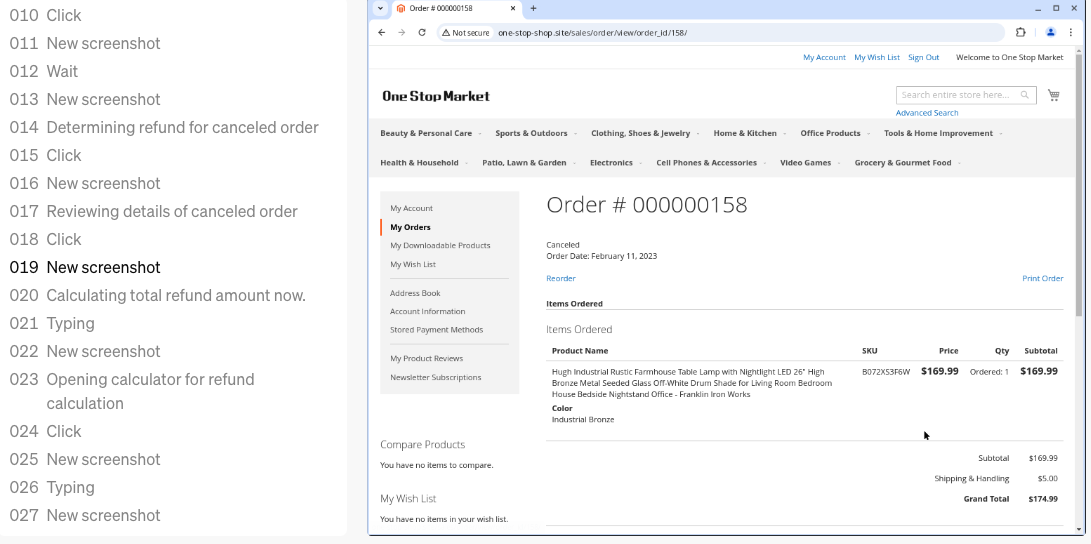
In the video demonstrations shared on the product page, you can watch Operator break the task down into dozens of distinct actions like “clicking,” “typing,” and “scrolling.” One example showed 152 steps to take a grammar quiz, and 146 steps to determine the amount of a refund from a canceled online order.
The potential for this kind of freewheeling AI web browsing on demand is positioned as an agent that can save you the drudgery of having to order groceries, research holidays, make restaurant reservations, or buy tickets to concerts.
Operator makes high-stakes mistakes
It’s one thing when ChatGPT spits out an incorrect answer, but if your chatbot is actually spending your money and triggering things in the real world, the stakes are much, much higher.
In its testing, OpenAI found that in one test of 100 sample tasks, 13% of the time Operator made a consequential mistake like emailing the wrong person, incorrectly bulk-removing email labels, setting the wrong date for a reminder to take the user’s medication, and ordering the wrong food item. Some of the other mistakes were easily reversible “nuisances.” OpenAI noted after mitigations, they reduced this error rate by approximately 90%.
OpenAI stresses that you have the ability to grab the wheel from the AI at any time, and you can approve any action before it is executed, but in this early evaluation version, you’ll probably have to spend more time babysitting the agent than just going ahead and doing the task on your own.
For now it limits the tasks you can use it for, prohibiting banking or job applications.
OpenAI shared a list of example tasks that some hypothetical user might want an AI to do for them. Ten out of ten times Operator was able to research bear habitats, create a grocery list, and make a ’90s playlist on Spotify.
Medium persuasion
The system card for the model behind Operator — Computer-Using Agent (CUA) — describes the process OpenAI used to assess the risks of letting a prerelease, novel AI agent go hog wild with your computer.
Like other model releases, OpenAI tested the model by using red teams with expertise in social engineering, CBRN (chemical, biological, radiological, and nuclear) threats, and cybersecurity. OpenAI gave itself a “low” risk for everything except “persuasion,” which got a “medium” risk score and is considered safe enough for public release.
High consequence
But there are some important restrictions on how you can use Operator. Because there is a slightly elevated risk of using Operator for influencing people, the usage policy prohibits impersonating people or organizations, concealing the role of AI in tasks, or using it to spread disinformation or false interactions, like fake reviews or fake profiles.
OpenAI prohibits people from using Operator to commit any crimes, but you are also prohibited from using it to bully, harass, defame, or discriminate against others based on protected attributes.
Under a heading titled “high consequence domains,” it notes that you can’t use Operator to make “high-stakes decisions” that might affect your safety or well-being, automate stock trading, or use it for political campaigning or lobbying.
OpenAI’s announcement follows competitor Anthropic’s October release of a similar feature that can control your computer. There is widespread hype that “agentic AI” like Operator will be a breakthrough for how people use these tools.
OpenAI CEO Sam Altman said in an announcement video that Operator is expected to roll out to international ChatGPT Pro and ChatGPT Plus users “soon,” but noted that the European rollout “will unfortunately take a while.”