The robots are coming... to help small businesses, actually
Labor shortages, not bots, are the bane of so-called blue-collar businesses.
When Andy Lonsberry unsuccessfully tried to start a company with his brother and father to make custom ATVs and motorcycles in 2002, it wasn’t high costs or high wages that sank their diligent attempt to launch a domestic manufacturing firm. It was labor — specifically, a lack of welders to help meet what became a growing backlog of unfinished work.
For Lonsberry, that experience shaped how he thinks about customers for his current company, Path Robotics, which creates welding robots that can do everything from finish a motorcycle chassis to weld together the hulls of massive ships. For him, their newest AI-enabled model — which straps a smart welding torch to the top of a Boston Dynamics robot — offers a satisfying coda to his family’s startup story.
Path’s automation solutions have become extremely valuable to other small- and medium-sized manufacturing companies in the Midwest, such as EK Machine in Fall River, Wisconsin, or Mid-Land Enterprises in Joplin, Missouri, maker of brass valves and fittings. The company’s robots, which customers rent for a fixed monthly subscription fee, provide value by increasing throughput, not eliminating jobs, said Lonsberry. If welding costs for a product run require $100 worth of human labor, Path can help a company do the same run for $70, giving companies a way to work through that backlog quickly for a lower cost.
“The democratization of technology should be able to help small businesses and small manufacturers,” said Lonsberry. “Manufacturing in the United States is notoriously done in very disparate settings.”
Hiring humans remains something small businesses, especially in manufacturing, struggle with across the country. Manufacturing sites in the US lose 20% of their capacity every year due to labor shortages, and many remain fairly small: 93% have fewer than 100 workers and 75% have fewer than 20, data from the Manufacturing Extension Partnership shows. Deloitte found that the net need for new employees in manufacturing could be around 3.8 million between 2024 and 2033. The welding industry, for example, will be short 320,000 people by 2026, according to the American Welding Society.
Now, getting some extra nonhuman help on the factory floor is becoming a viable option for small-business budgets. Berkeley-based Ambi Robotics offers a stacking system, available on a monthly robots-as-a-service (RaaS) subscription, that can package goods on a standard wooden pallet for shipping. The company’s own research has shown it can cut so-called “dock door” costs by 67%, allowing workers to be repositioned to higher-value jobs.
Formic, a small firm in the Chicago suburbs that manufactures robots that help pack and palletize products, found that its RaaS model can handle the most onerous tasks for small firms packaging, say, produce. With packaging machines starting at $3,500 a month, the extra help remains cheaper than hiring another worker, said Chief Operating Officer Danijel Lolic. Per Bureau of Labor Statistics data, at the average wage of $26 an hour, an additional warehouse worker would cost about $4,160 a month. Lolic also said the recurring fee is much more manageable than up-front investment; small firms working on one shift a day take substantial time to pay for a six-figure robot. For Lolic, that access to robotics, which can constantly be updated throughout a rental agreement, lets small firms stay competitive.
“Bigger companies who have engineering teams, automation expertise, and the big capital budgets, they’re going to keep pushing their advantage,” he said.
As Path’s Lonsberry has found, many of the smaller factories that utilize robotics tend to be in little towns and draw from relatively small labor pools, so even minor labor disruptions lead to hiring challenges, slowed-down production lines, and lost revenue. He argues that the labor gap and capacity challenge has been a big drain on US manufacturing; with more capacity to build and make, costs start coming down, leading to US-made goods that are much more competitive on a global scale.
The vast expansion of robots in the economy can seem like a matter of when, not if — just the buzzed-about and not-quite-proven humanoid category has seen a flood of venture capital funding, hitting $1.7 billion in 2024, $4.8 billion in 2025, and $5.1 billion through the end of April 2026.
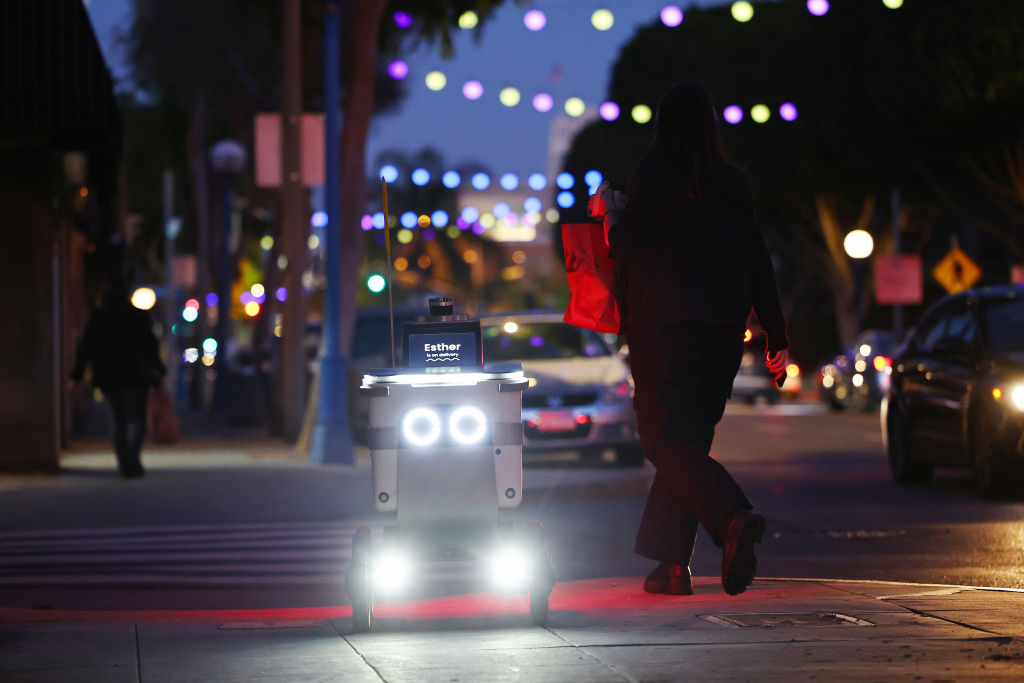
That excitement and investment has helped bend the cost for robotics curve toward accessibility. Manufacturing costs fell 40% between 2023 and 2024, and the price of parts has plummeted. The price tag for a lidar sensor that may have cost $80,000 a decade ago has dropped 98%, said Ali Kashani, cofounder and CEO of Nvidia-backed Serve Robotics, whose delivery robots help Uber Eats and DoorDash serve customers across the US.
Remember the e-scooter boom of the last decade? Producing those electric motors and batteries in mass quantities may not have saved startups like Bird, but it did lower the cost of those components. Better, cheaper parts, along with better connectivity and data capacity so new robots can stay connected and rapidly respond to their environment, make them much better workers.
More importantly, new models of paying for robotic services that avoid costly, up-front capital expenditure have started to democratize access to these machines. RaaS deals give small companies the ability to bring on, say, a welding robot to fill in a gap in the workforce, or get some extra help packing and shipping during busy seasons. Factor in free maintenance services and advances in artificial intelligence, which make it easier than ever to reprogram robots, and a small machine shop can add a bot without needing to hire coders or engineers.
Industries across the economy have seen specialized robot services spring up. Barn Owl Precision Agriculture created a line of weeding and spray robots for small family farms. Serve Robotics has a few different lines that help with food prep and medical clinics; Vebu, which was acquired by Serve Robotics, makes the Autocado food prep system, and Diligent Robotics (which was also acquired by Serve) offers automated systems that fetch medical supplies.
“Everybody has been in a hospital. Everybody knows one of the defining features of being in that space is waiting for a nurse,” Kashani said. “The reality is we have a shortage of nurses in the country, and it so happens nurses spend a quarter of their time walking around and grabbing stuff.”
Susanne Bieller, general secretary of the International Federation of Robotics, predicts sustained growth in robotics in the coming years. Decades ago, industry robotics tended to be massive, fixed machines on auto assembly lines, and over time, more and more industries have gradually started to incorporate automation.
And this isn’t just a US issue. Bieller said the labor gap in manufacturing is a global challenge — demographic shifts, less interest from younger generations in a welding career, and early retirement across manufacturing during the pandemic have created a worker shortage that she thinks robotics will be poised to fill.
But won’t robots eventually take over blue-collar gigs? One of the most well-known automation stories, the introduction of robots to auto factory floors, didn’t cause a massive loss of jobs, argues Jim Hirsch, VP of sales at QNX, which makes operating systems for automation. (QNX, which is owned by BlackBerry, was also a primary driver for one of the hottest rallies in the company’s shares recently.)
For the last half-century, auto industry employment has remained relatively steady at a little over a million jobs, though it looks different than it once did: output has greatly increased, and those roles have been relocated and spread across the country.
“It’s usually better if technology is empowering people to be more productive,” said Kashani. “When you do that, you generally make those businesses strong and help them grow, and they can hire more people. When you increase productivity, people have more things to do, and that’s going to be true in small businesses.”
Patrick Sisson is a reporter covering cities, technology, and business.