
Tech
Side quests: Shopify is giving up on logistics

Side quests: Shopify is giving up on logistics

Side quests

Shopify revealed yesterday that it is selling its logistics business to Flexport and laying off 20% of its workforce, as the online shopping giant essentially gives up on doing the actual delivering itself for its e-commerce customers.

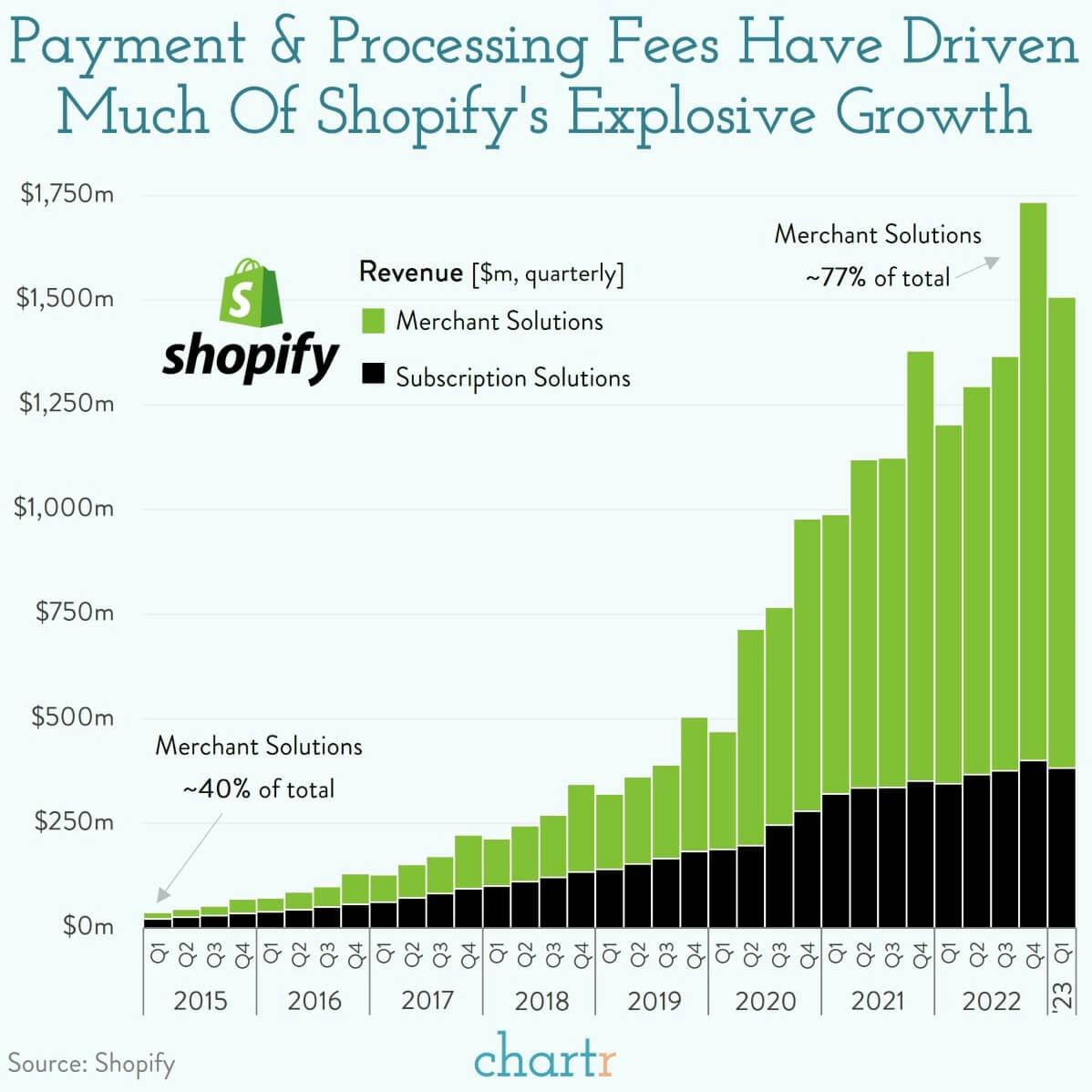
The announcement came alongside the company's quarterly results, which saw a 25% increase in sales to $1.5bn compared to the previous year, far exceeding expectations of $1.43bn.

Offloading its logistics business marks a significant reversal for Shopify, which only purchased last-mile delivery startup Deliverr a year ago for $2.1bn, its largest acquisition to date. The company's CEO, Tobias Lütke, emphasized that SHOP is refocusing on its main objective of "building incredible software for e-commerce," distinguishing between the company's "main quests" and "side quests”.

Had the Canadian e-commerce company just stuck with its original “main quest” — of providing a place for pretty much anyone to create their own online store front — then it would still be heavily reliant upon its monthly subscription payments. However, that division now typically accounts for less than a quarter of its business, with processing payment fees, marketing, up-front capital and, until recently, logistics making up the bulk of its sales.

Shopify's news is a good reminder that the business of moving stuff from one place to another is still really hard — particularly when your competition is Amazon.


More Tech

See all Tech
tech

OpenAI files confidentially for IPO

Today OpenAI announced it has filed confidentially with the SEC to go public. The company said in a blog post that it filed the draft S-1 form.

OpenAI’s filing comes a week after arch-rival Anthropic — now valued at $965 billion — also filed a confidential S-1 for its own public offering. Both IPOs are expected to be among the largest in US history.

In a press release, OpenAI wrote:

“We expect it to leak so we’re just announcing it. We have not decided on timing yet; it may be a while because there are things we want to do that are likely easier as a private company. But it’s a complicated set of tradeoffs and this gives us the option to go public sooner if that ends up being best.”

In a press release, OpenAI wrote:

“We expect it to leak so we’re just announcing it. We have not decided on timing yet; it may be a while because there are things we want to do that are likely easier as a private company. But it’s a complicated set of tradeoffs and this gives us the option to go public sooner if that ends up being best.”

South by Southwest Conference and Festivals

The number of Tesla Robotaxis on the road has been going down

That’s the wrong direction for a business trying to scale its autonomous vehicles.

tech

Intel shares soar on report of Google chip deal, possible future Nvidia business

Shares of Intel soared in early trading on a report that Google and Nvidia are considering turning to the chipmaker as a backup supplier to TSMC, as surging demand continues to outpace supply.

The Information reports that Google has placed an order with Intel to manufacture more than 3 million of its increasingly popular tensor processing unit chips in 2028.

According to the report, Nvidia is currently testing to see if Intel could manufacture its next-gen Feynman chips.

Taiwan-based TSMC has enjoyed a huge lead in the market of manufacturing advanced chips for Apple, Nvidia, and others.

Intel has been struggling to fight its way back into the AI chip business, but has made headway with the help of the Trump administration, which sought to shore American chipmaking with a $8.9 billion investment of taxpayer money, and several high-profile deals.

The Information reports that Google has placed an order with Intel to manufacture more than 3 million of its increasingly popular tensor processing unit chips in 2028.

According to the report, Nvidia is currently testing to see if Intel could manufacture its next-gen Feynman chips.

Taiwan-based TSMC has enjoyed a huge lead in the market of manufacturing advanced chips for Apple, Nvidia, and others.

Intel has been struggling to fight its way back into the AI chip business, but has made headway with the help of the Trump administration, which sought to shore American chipmaking with a $8.9 billion investment of taxpayer money, and several high-profile deals.

Latest Stories

Sherwood Media, LLC and Chartr Limited produce fresh and unique perspectives on topical financial news and are fully owned subsidiaries of Robinhood Markets, Inc., and any views expressed here do not necessarily reflect the views of any other Robinhood affiliate, including Robinhood Markets, Inc., Robinhood Financial LLC, Robinhood Securities, LLC, Robinhood Crypto, LLC, Robinhood Money, LLC, Robinhood U.K. Ltd, Robinhood Derivatives, LLC, Robinhood Gold, LLC, Robinhood Asset Management, LLC, Robinhood Credit, Inc., Robinhood Ventures DE, LLC and, where applicable, its managed investment vehicles.
