Tech
Snap Partner Summit 2023
Evan Spiegel, CEO of Snap, Inc. (Photo by Joe Scarnici)

Snapchat’s answer to its sinking stock price is more ads

Snap is set to experiment with advertising next to your messages with friends

Snap back to reality…

Yesterday, Snap CEO Evan Spiegel marked the company’s 13th anniversary with a letter to employees that cut straight to the chase: Snap is struggling. The Snapchat founder addressed the company’s ongoing challenges and its share price, which has shed 45% of its value this year.

After bursting onto the public markets in 2017, Snap, Inc. promised investors exposure to what could be the next Facebook (now Meta), a company that’s currently valued at $1.3 trillion… some ~88x what Snap is worth.

Snap, like Meta, relies on advertising for the overwhelming majority of its business, some 96% of its $4.6 billion in revenue was from ads last year, a figure that barely grew relative to 2022 — not ideal for a company that is still running at a heavy loss.
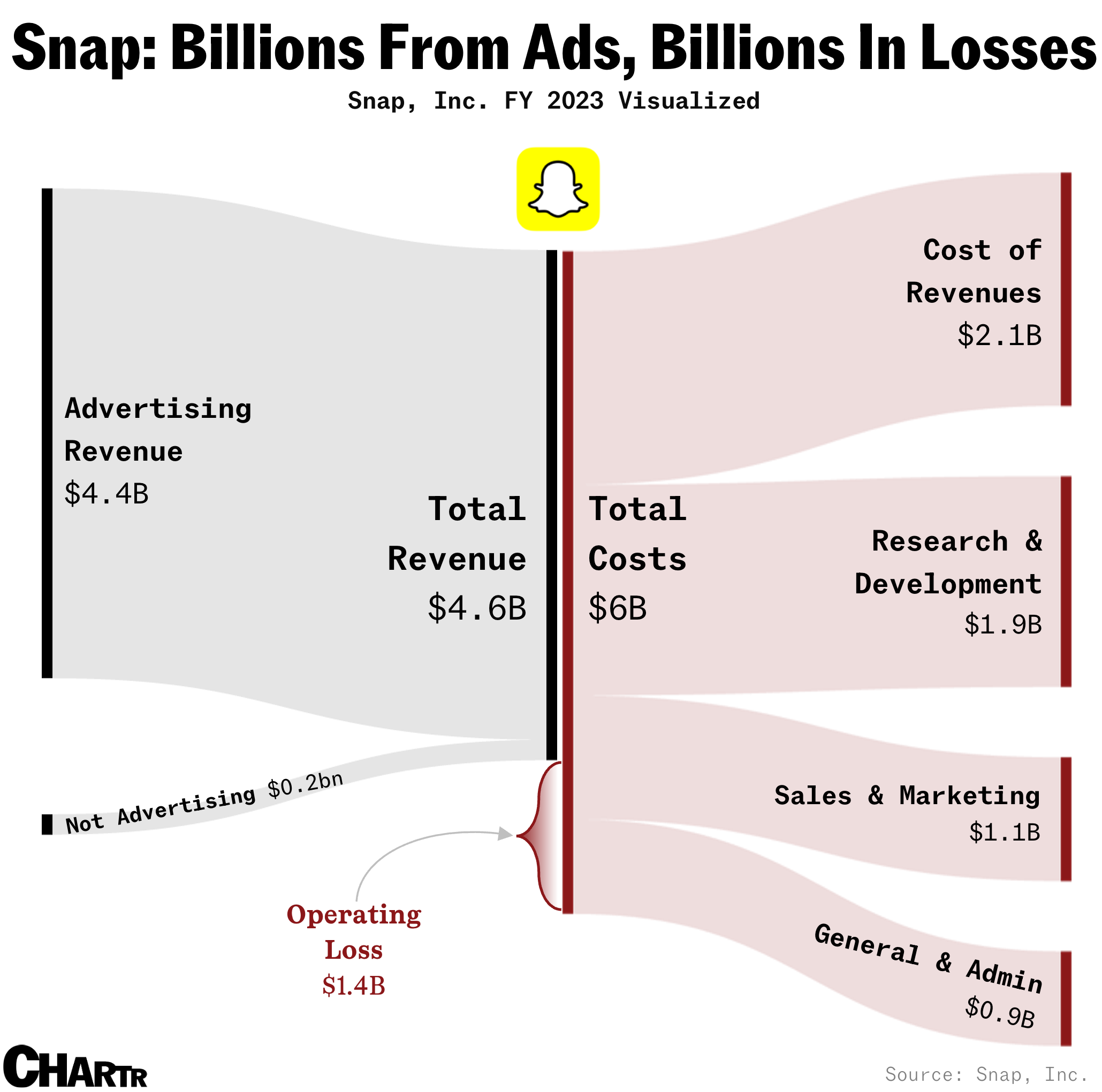
The economics of Snapchat
Sherwood News

Ads with friends

In a bid to grow its sales, Spiegel outlined two new experiments to get more ads in more places across the app. One change is the introduction of "Sponsored Snaps", which will now appear in the previously ad-free chat inbox. While opening these sponsored messages is optional, the move signals that no part of the Snapchat experience is off-limits when it comes to monetization. Additionally, Snap is rolling out "Promoted Places", allowing businesses to pay for greater prominence on the Snap Map — a feature people use to see what their friends are up to and keep track of their favorite spots.

When those ad dollars do roll in, they quickly get spent, as Snap continues to invest heavily in other projects such as the company's mini camera drones, Pixy, and AR glasses called Spectacles — a product the company has been developing for roughly a decade.

The good news for Snap is that its user numbers have continued to climb… although only really outside of North America recently. The app now boasts 432 million daily active users — more than double what it was five years ago.
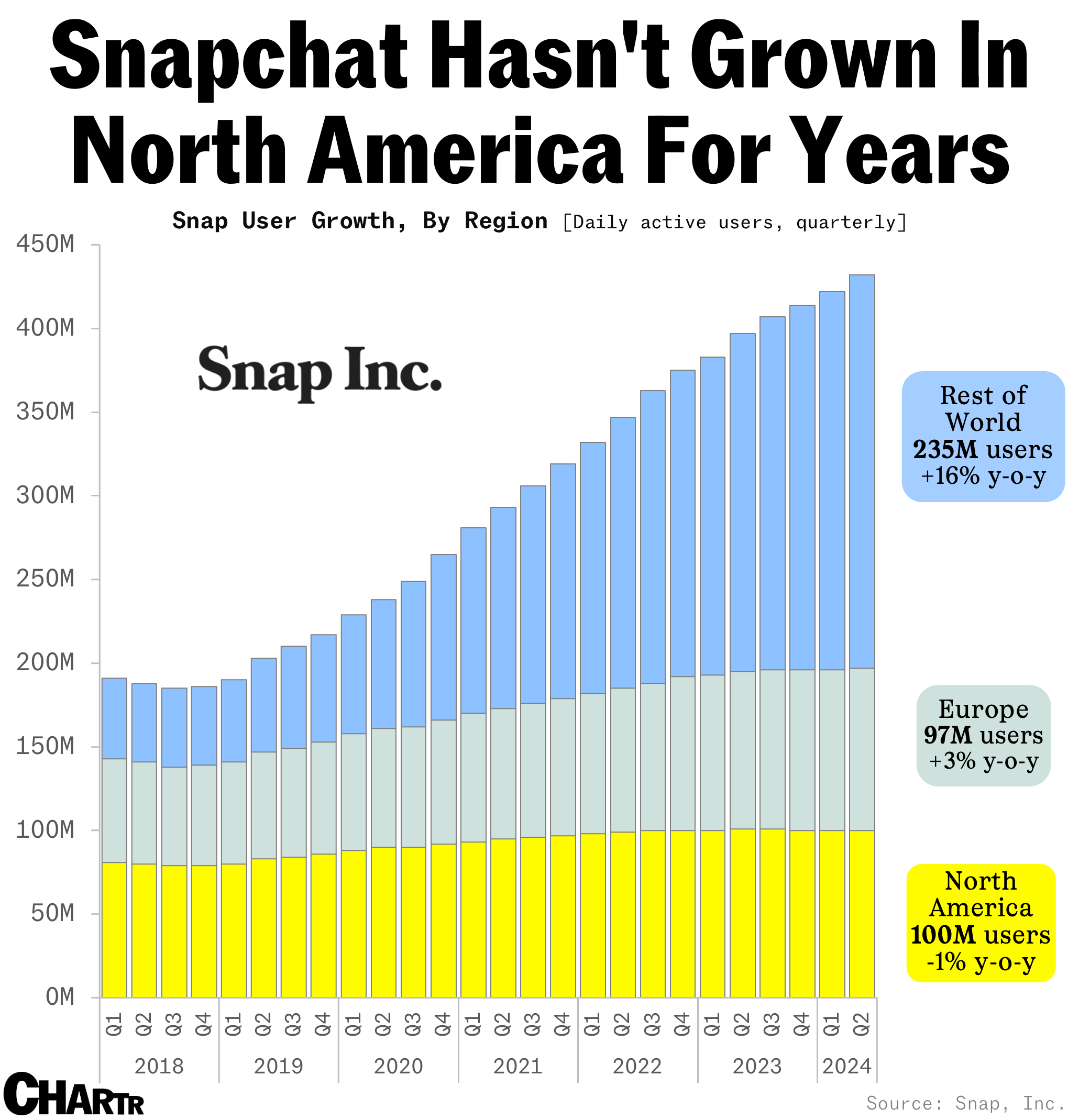
Snap’s users have grown internationally
Sherwood News

Although impressive, much of this growth has come from outside of its most lucrative markets — the average revenue per user in the US was $7.67 in the latest quarter, more than seven times the $1.02 generated by users in its “Rest of World” region. This disparity highlights one of Snap's ongoing challenges: how to turn its growing international audience into a more profitable one. More ads might help.

Founder mode

In his letter Spiegel goes on to compare Snapchat's product strategy to the menu of fast-food chain In-N-Out Burger — with Snapping, chatting, and watching Stories apparently akin to the fast-food joint's hamburger, cheeseburger, and Double-Double. We’re not quite sure what to make of that analogy.

More Tech

See all Tech
tech

EU calls for bids to build “AI gigafactories” in 2026

The European Union wants to shore up its domestic AI infrastructure, and reduce its dependence on American tech companies.

To further this goal, the bloc is planning on accepting bids to build EU-based “AI gigafactories,” according to a report from The Wall Street Journal.

EU Executive Vice-President for Tech Sovereignty, Security and Democracy Henna Virkkunen announced that bids would begin in January or February, according to the report.

As the AI arms race heats up, countries are racing to secure their own sovereign AI infrastructure, including building their own AI models that reflect countries’ culture and language, and control over cloud computing resources.

Europe is lagging behind the US and Asia in AI infrastructure. But it may be hard for the EU to fully break free of American tech — unlike the US and China, there is no European alternative for the powerful GPUs needed to train and run AI models. It’s very likely that any AI gigafactories in the EU will be filled with GPUs from Nvidia.

EU Executive Vice-President for Tech Sovereignty, Security and Democracy Henna Virkkunen announced that bids would begin in January or February, according to the report.

As the AI arms race heats up, countries are racing to secure their own sovereign AI infrastructure, including building their own AI models that reflect countries’ culture and language, and control over cloud computing resources.

Europe is lagging behind the US and Asia in AI infrastructure. But it may be hard for the EU to fully break free of American tech — unlike the US and China, there is no European alternative for the powerful GPUs needed to train and run AI models. It’s very likely that any AI gigafactories in the EU will be filled with GPUs from Nvidia.

tech

Google’s AI chip business could be a $900 billion boon for the company

Google may be sitting on a massive new business that it has yet to fully exploit.

Google’s custom tensor processing unit (TPU) AI chips have been getting a lot of attention recently, making the tech world wonder if there are other ways to power its AI dreams rather than just by using Nvidia’s GPUs.

Bloomberg spoke with analysts who estimate that, if it does decide to sell its chips to others, Google could capture 20% of the AI market, making it a $900 billion business. For comparison, Google Cloud pulled in $43.2 billion of revenue last year.

Even if Google just sticks with renting access to its TPUs, it will continue to drive down costs and increase margins as it ekes out performance improvements, such as the 30x improvement in power efficiency that the latest generation of TPUs has delivered for the company.

Bloomberg spoke with analysts who estimate that, if it does decide to sell its chips to others, Google could capture 20% of the AI market, making it a $900 billion business. For comparison, Google Cloud pulled in $43.2 billion of revenue last year.

Even if Google just sticks with renting access to its TPUs, it will continue to drive down costs and increase margins as it ekes out performance improvements, such as the 30x improvement in power efficiency that the latest generation of TPUs has delivered for the company.

tech

OpenAI’s Sam Altman has explored bringing his feud with Tesla’s Elon Musk to space

Billionaires, they’re just like us: they want to bring their terrestrial beefs to outer space.

OpenAI CEO Sam Altman has explored buying or partnering with a rocket company to compete with Tesla CEO Elon Musk’s SpaceX, The Wall Street Journal reports. The two billionaires have had numerous public feuds over the years that have played out in the courts and on social media. They also both lead AI companies that have insatiable needs for data centers and have publicly discussed building data centers in space.

Altman seems like he thinks this could be more than science fiction. He reportedly reached out to rocket maker Stoke Space to potentially make equity investments in the company to get a controlling stake, though the talks are no longer active, WSJ reports.

Or perhaps he just wanted a Sherwood bobblehead of himself.

tech

Report: Meta to slash metaverse, VR spending by up to 30%

Four years after changing its name to reflect its focus on the loosely defined “metaverse,” Meta is planning deep cuts to the company’s money-losing virtual reality efforts, according to a report from Bloomberg.

Meta’s Reality Labs division, home to the teams working on metaverse products — which include Quest VR headsets, Horizon Worlds, and its Ray-Ban Meta glasses — has lost about $70 billion since the company started breaking out the unit in 2020.

The company has struggled to get consumers to buy into CEO Mark Zuckerberg’s vision of working and playing in virtual reality worlds, like the company’s Horizon Worlds platform.

Investors seem to love the news of the pivot, as shares shot up as much as 5% in early trading.

Meta’s recent hiring spree of AI superstars from competitors for its Meta Superintelligence Labs shows that the company’s attention is now all in on AI.

Meta’s Reality Labs division, home to the teams working on metaverse products — which include Quest VR headsets, Horizon Worlds, and its Ray-Ban Meta glasses — has lost about $70 billion since the company started breaking out the unit in 2020.

The company has struggled to get consumers to buy into CEO Mark Zuckerberg’s vision of working and playing in virtual reality worlds, like the company’s Horizon Worlds platform.

Investors seem to love the news of the pivot, as shares shot up as much as 5% in early trading.

Meta’s recent hiring spree of AI superstars from competitors for its Meta Superintelligence Labs shows that the company’s attention is now all in on AI.

Salesforce CEO Marc Benioff Kicks Off Dreamforce With Keynote Presentation

The best quotes from Salesforce’s earnings call

CEO Marc Benioff doesn’t disappoint.

Latest Stories

Sherwood Media, LLC produces fresh and unique perspectives on topical financial news and is a fully owned subsidiary of Robinhood Markets, Inc., and any views expressed here do not necessarily reflect the views of any other Robinhood affiliate, including Robinhood Markets, Inc., Robinhood Financial LLC, Robinhood Securities, LLC, Robinhood Crypto, LLC, or Robinhood Money, LLC.